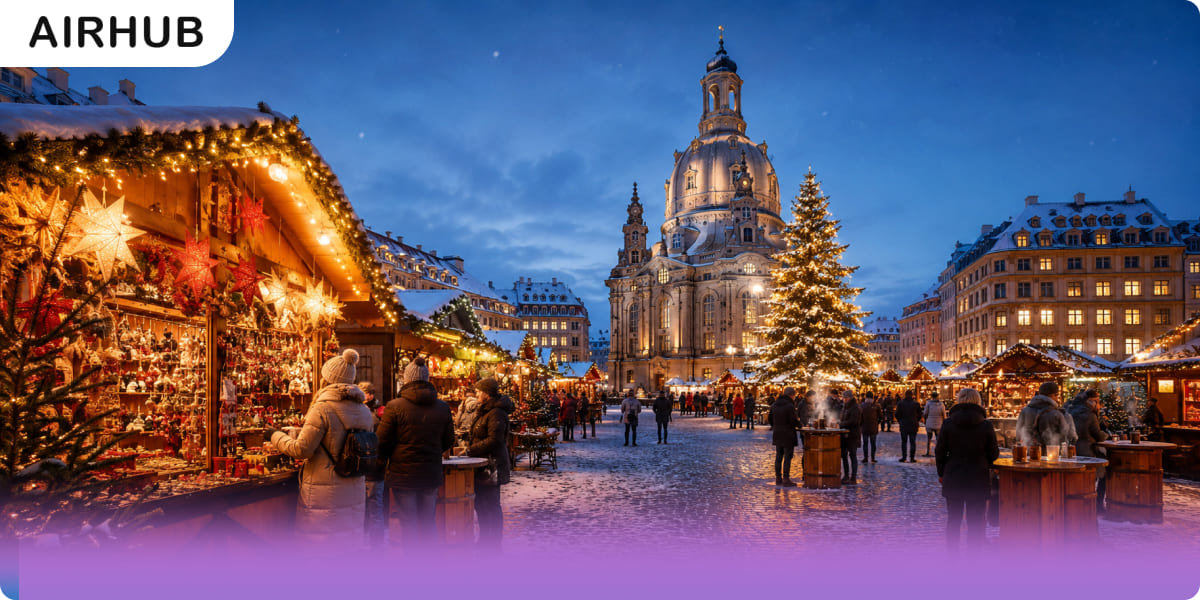
Most Christmas market guides will tell you Nuremberg is magical and Dresden is the oldest. Almost none of them will tell you which Sunday in November the markets are shut, or that Berlin’s prettiest one charges you to walk in.
Here’s the frame that actually matters. Germany’s season is dictated by Advent, and in 2026 the first Sunday of Advent falls on 29 November. That single date sets everything else in motion: most markets open the Friday before, on 27 November, while the bigger cities jump ahead to Monday 23 November. A handful open in mid-November, and a stubborn few are still pouring Glühwein on New Year’s Eve.
Get that timing wrong and you land in a city where the squares are still empty scaffolding. So below are 13 of the best Christmas markets in Germany, grouped by the kind of trip you’re planning, with 2026 dates and entry fees attached to each plus the two lists nobody publishes and everybody needs: which markets open early, and which are still running after Christmas Day.
2026 Dates at a Glance
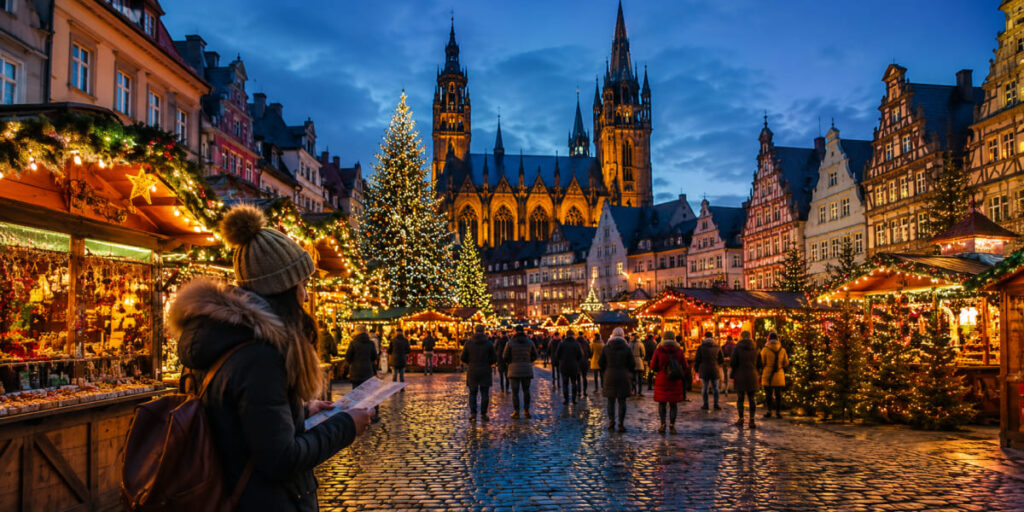
| Market | City | 2026 Dates | Entry |
| Christkindlesmarkt | Nuremberg | 27 Nov – 24 Dec 2026 | Free |
| WeihnachtsZauber Gendarmenmarkt | Berlin | 23 Nov – 31 Dec 2026 | €2 (free Mon–Fri, 12–2 pm) |
| Striezelmarkt | Dresden | 25 Nov – 24 Dec 2026 | Free |
| Marienplatz Christkindlmarkt | Munich | 20 Nov – 24 Dec 2026 (closed 22 Nov) | Free |
| Reiterlesmarkt | Rothenburg ob der Tauber | 20 Nov – 23 Dec 2026 | Free |
| Cathedral Market | Cologne | 16 Nov – 23 Dec 2026 (closed 22 Nov) | Free |
| Weißer Zauber | Hamburg | Not yet officially announced (2025 was 18 Nov–23 Dec) | Free |
| Santa Pauli | Hamburg | 9 Nov – 23 Dec 2026 | Free (18+ areas: Strip-Zelt) |
| Stuttgart Christmas Market | Stuttgart | 25 Nov – 23 Dec 2026 | Free |
| Tollwood Winter Festival | Munich | 24 Nov – 23 Dec 2026 | Free (market + most events; Grand Chapiteau shows ticketed) |
| Römerberg Christmas Market | Frankfurt | 23 Nov – 22 Dec 2026 | Free |
| Leipzig Christmas Market | Leipzig | 24 Nov – 23 Dec 2026 | Free |
| Dortmund Christmas Market | Dortmund | 19 Nov – 30 Dec 2026 (closed 22 Nov & 25 Dec) | Free |
When German Christmas Markets Open and Close in 2026
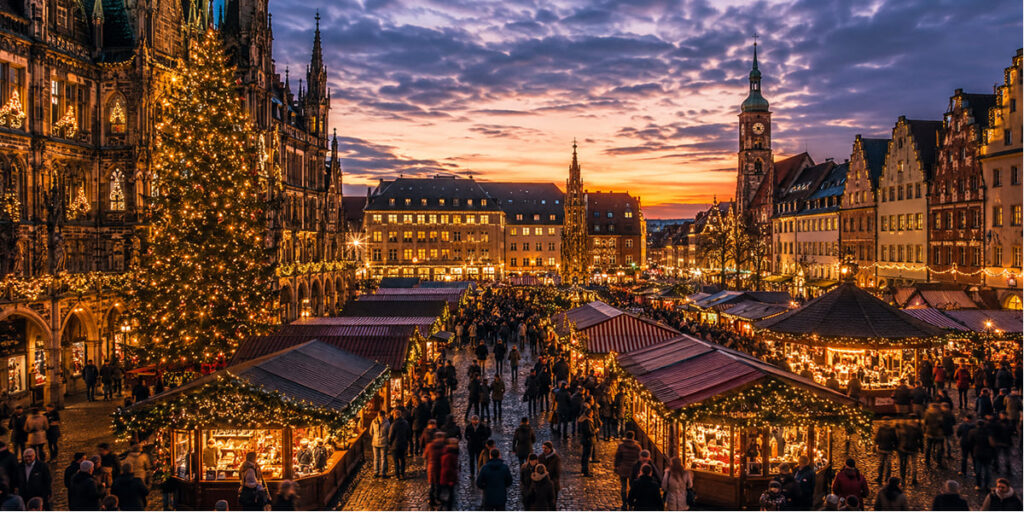
The Advent calendar governs the entire season. With the first Sunday of Advent landing on 29 November 2026, the bulk of markets will open on Friday 27 November, and the larger cities will move a few days earlier Monday 23 November is standard for Berlin, Hamburg and several others.
Closing is messier. Most wrap up on 23 or 24 December, occasionally shutting at lunchtime on Christmas Eve just as the mood peaks. A minority run to New Year’s Eve, and a few in Berlin, Cologne and Dortmund push into January.
Then there’s the date nobody warns you about: Sunday 22 November 2026. That’s Totensonntag, Germany’s Sunday of the Dead, a day of remembrance for those who have died. Many Christmas markets close completely for it, and some simply delay opening until it has passed. If your flight lands in that early window, check individual markets rather than assuming arriving at a shuttered square on day one sets a tone that’s hard to shake.
Markets That Celebrate Timeless Traditions
Wooden huts, Lebkuchen, brass bands, no gimmicks. Start here.
Nuremberg’s Christkindlesmarkt
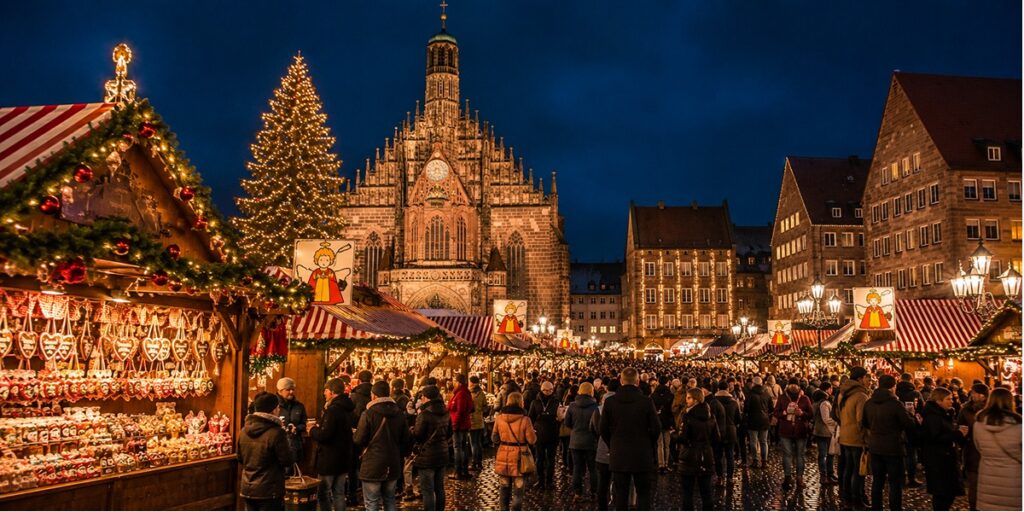
2026: 27 November 24 December. Free entry.
It gets called the queen of Christmas markets, and the credentials hold up established in the 17th century, and still the reference point every other German market gets measured against. Wooden huts line the Hauptmarkt selling gingerbread, nuts and ornaments. Each year a local Christkind the gift-bringing angel the market takes its name from, opens proceedings, and traders hand out Nuremberg plum men and spiced Spekulatius biscuits.
The honest caveat: it is also the most crowded and most touristed market in the country, and the two facts are related. If crush bothers you, go on a weekday morning rather than a Saturday evening, or accept that you’ll be shuffling.
Rothenburg ob der Tauber’s Reiterlesmarkt
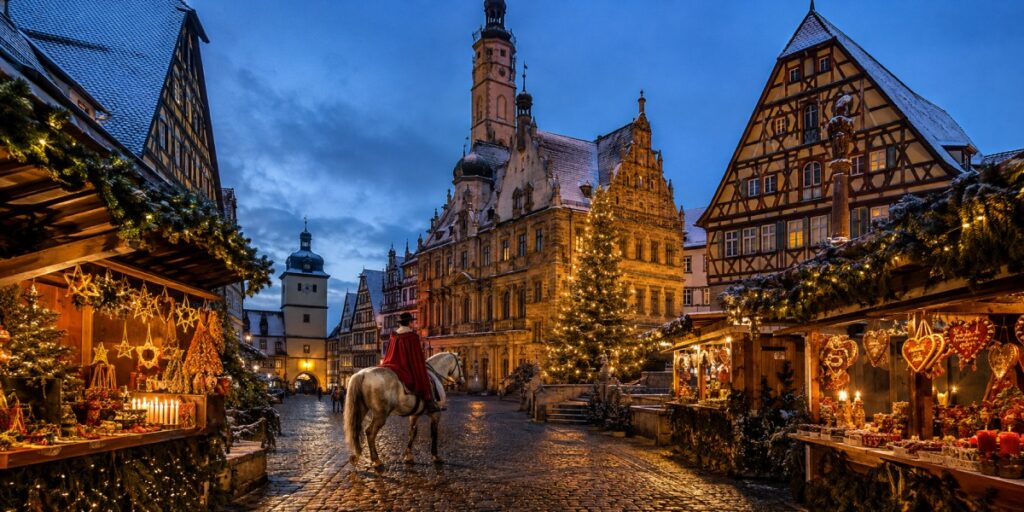
Up in the Franconian hills, Rothenburg looks painted rather than built. Around 60 stalls fill the streets near the town hall with handmade candles, ornaments and gingerbread, and the opening ritual is genuinely charming a costumed rider arrives on horseback to greet visitors, then the mayor lights the tree.
Be clear about what you’re coming for, though. The market is small; the walled medieval town around it is the real attraction.
Dresden’s Striezelmarkt
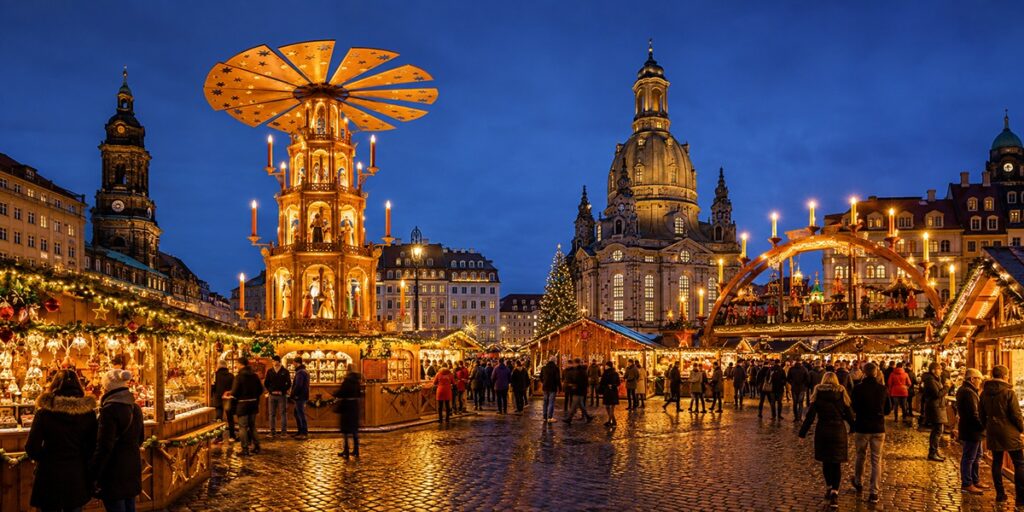
2026: late November – 24 December
Running since 1434 and claiming the title of oldest Christmas market in the world, held on the Altmarkt at the centre of Dresden’s baroque old city. Over 200 vendors sell Erzgebirge folk art, nutcrackers and Dresdner Stollen, the city’s famous fruit bread. The centrepiece is a 14.62-metre Erzgebirge pyramid Guinness recognised as the world’s tallest plus the largest walk-through candle arch anywhere.
What makes Dresden worth a full weekend rather than an afternoon is everything around the Striezelmarkt: several smaller markets sit within walking distance, including an excellent medieval one. Few German cities reward market-hopping this well on foot.
Cologne’s Cathedral Market
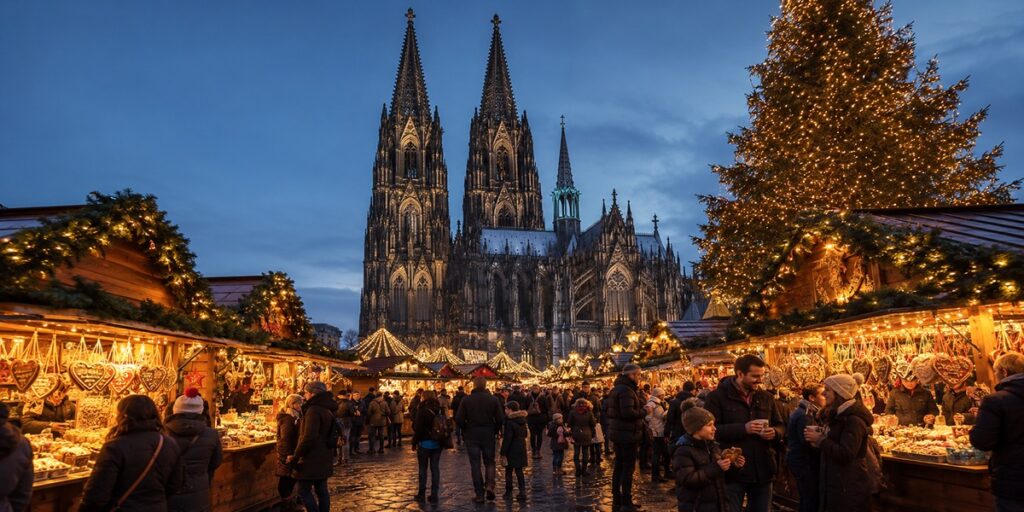
Roughly 150 huts spread across Roncalliplatz directly under the twin spires of Cologne Cathedral about as dramatic a backdrop as Germany has to offer. The market has a strong environmental reputation. Families drinking punch and eating gingerbread in the shadow of the country’s largest church. Classic, warm, slightly reverent.
Markets for City Sparkle
For travellers who want the market as one part of a proper city break.
Berlin’s WeihnachtsZauber at Gendarmenmarkt
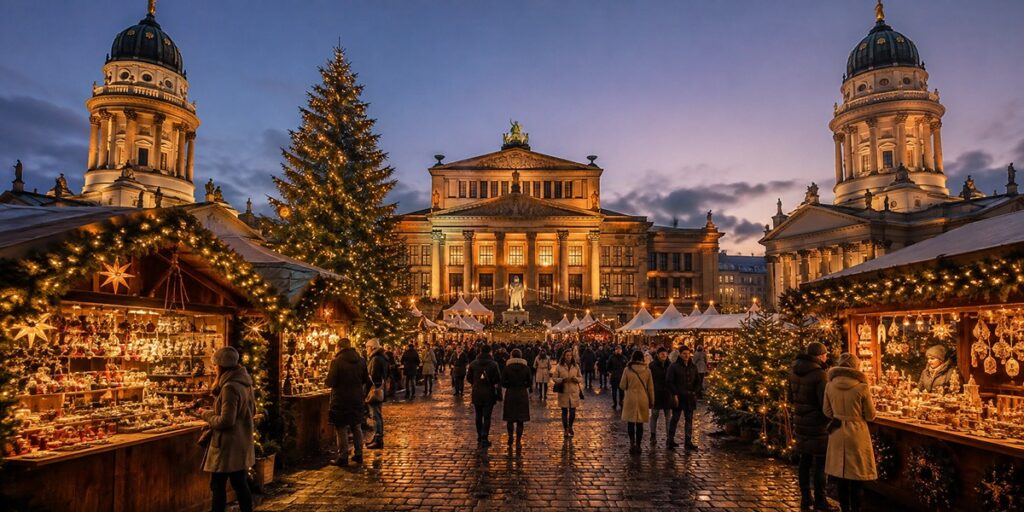
2026: 23 November – 31 December. Entry €2 free Monday to Friday between 12pm and 2pm, children under 12 free.
Berlin’s most upmarket market, staged between the German and French Cathedrals and the Konzerthaus. This is craftsmanship rather than fairground: there’s a large tent where woodcarvers, glassblowers and candle-makers work in front of you, and the food leans toward gourmet tents rather than sausage stands.
Two things catch people out here, both worth knowing in advance. This market spent several years exiled to Bebelplatz while Gendarmenmarkt itself was being renovated it’s back on the original square for 2026, but plenty of older articles will still send you to the wrong place. And the admission gate takes cash only, as do a fair number of stalls inside. Tickets can be bought online ahead of time for a fee.
It’s also one of very few German markets still open on New Year’s Eve.
Hamburg’s Weißer Zauber (Winterwald)
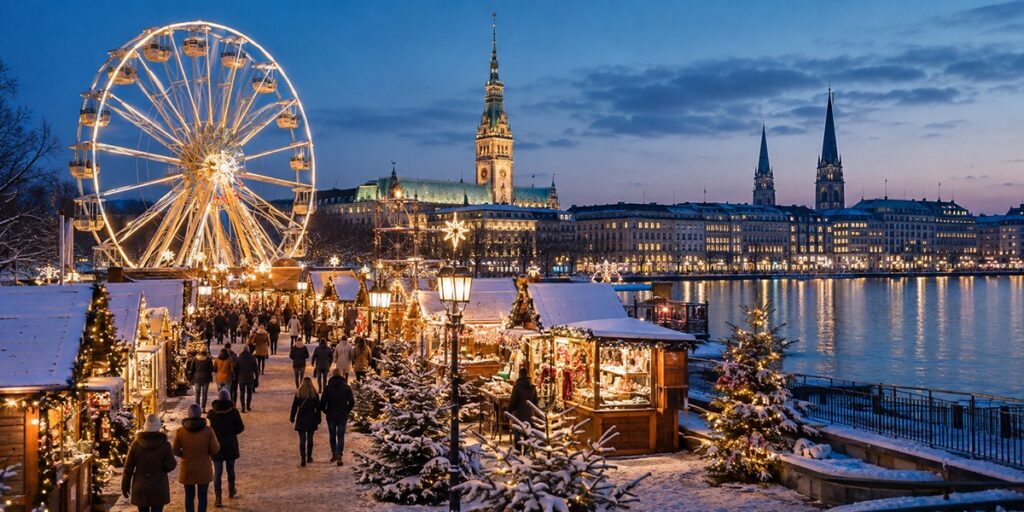
Down on Jungfernstieg beside the Inner Alster, “White Magic” assembles a miniature winter forest against Hamburg’s modern skyline white-lit huts, decorated firs, and a historic Ferris wheel from 1899 that lifts you above the whole thing. Glühwein through to festive jewellery, sold from snowflake-covered booths. The 1899 Ferris wheel detail before republishing.
Stuttgart’s Grand Market
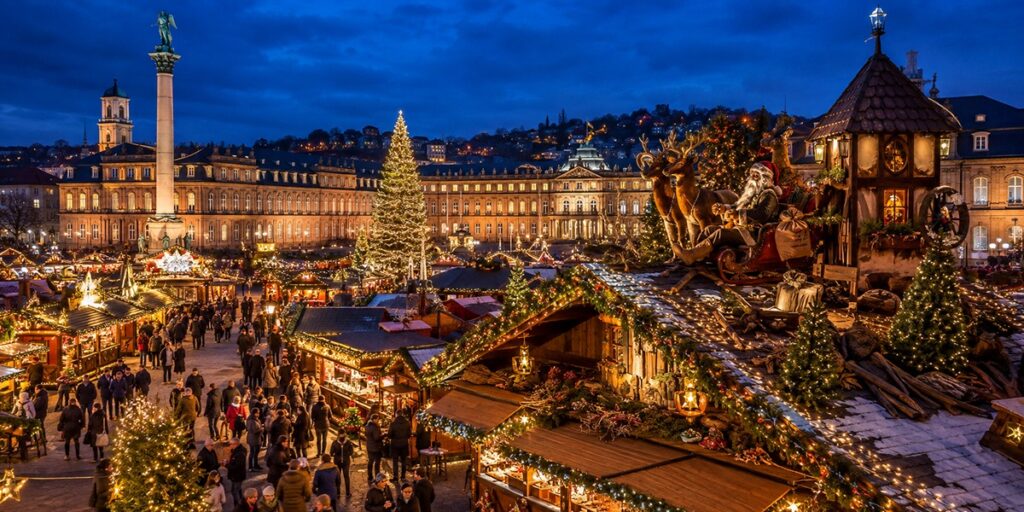
One of Europe’s largest, sprawling across several central squares, officially recorded since 1692. Over 250 stalls ring the Altes Schloss and here’s the detail that explains why Stuttgart photographs so well: it’s one of the only German cities that runs a competition for stall decoration, so the rooftops are genuinely competitive works. By evening the whole of Schlossplatz is lit up.
Markets Famous for Quirky Celebrations
For people who’ve done the traditional circuit and want something odder.
Munich’s Tollwood Winter Festival
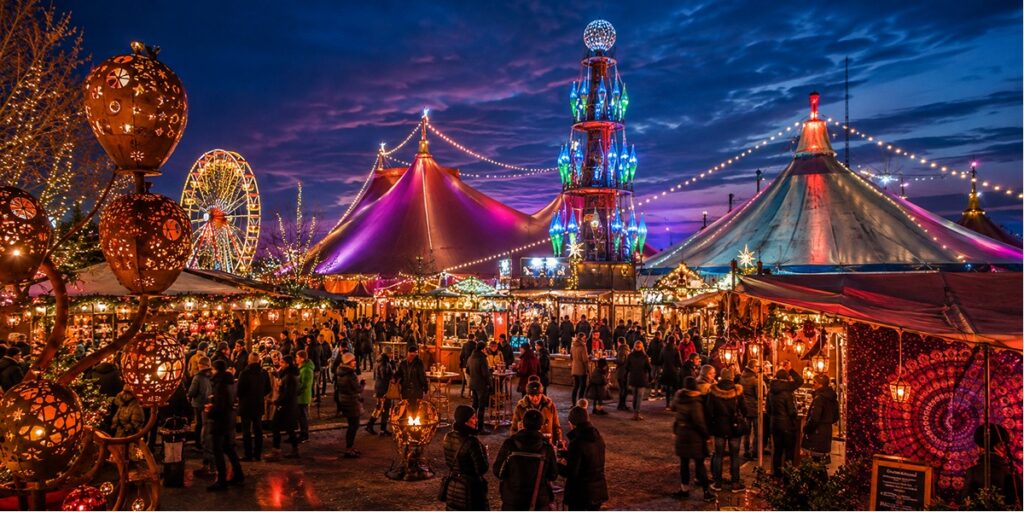
Out on the Theresienwiese, Tollwood is the anti-market and makes no apology for it. Handcrafted jewellery beside spicy curries, bratwurst stalls next to Indian food, concerts, eco-awareness events, and more genuinely good vegetarian and vegan cooking than the rest of Munich’s markets combined. After dark, neon tents and light installations take over the park. It behaves like a festival that happens to sell Glühwein.
It usually runs past Christmas too, and it’s one of the better places in Munich to see in the new year.
Hamburg’s Santa Pauli
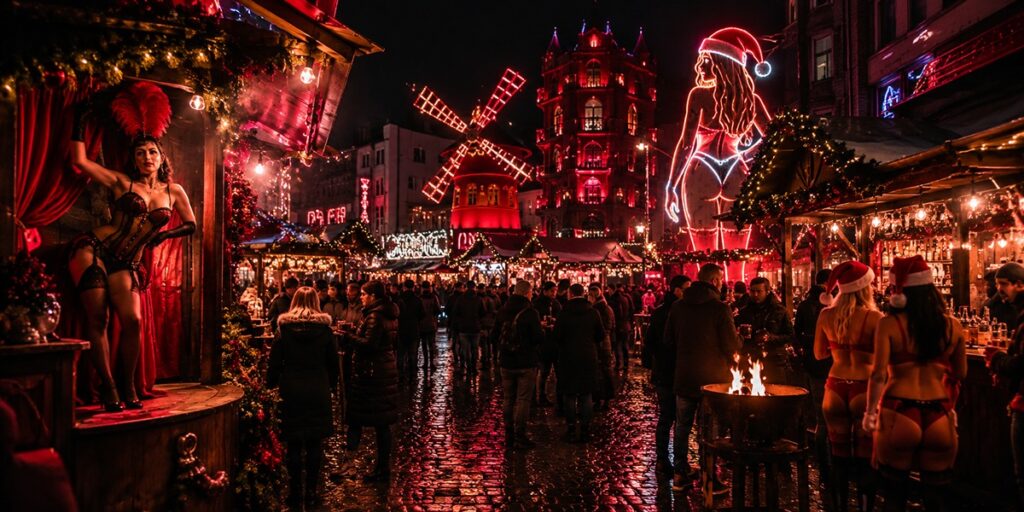
On the Reeperbahn, in the middle of Hamburg’s red-light district, Santa Pauli bills itself as the most erotic Christmas market in Germany and then fully commits. Mulled wine stands sit alongside a burlesque lounge and various 18+ attractions, plus the Winter Deck bar heated, open fire, views over the Reeperbahn.
Not one for the children, and it has no interest in pretending otherwise.
Markets Famous for Festive Feasts
If the food is the reason you booked the flight.
Munich’s Marienplatz Christkindlmarkt
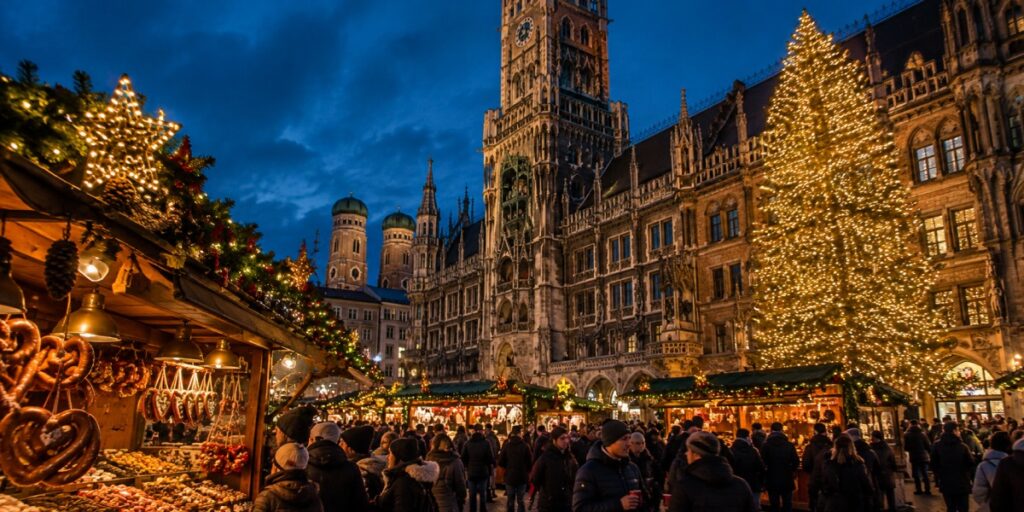
Munich’s flagship, anchored by a fir tree carrying nearly 4,000 lights against the neo-Gothic town hall. Around 100 stalls circle the square selling roasted almonds, hot chestnuts and soft pretzels, and cutting through all of it is the smell of Feuerzangenbowle a flaming rum punch poured over a burning sugarloaf, which is as much a spectacle as a drink.
Munich runs a dozen-plus markets in total, so treat Marienplatz as the anchor of a day rather than the whole of it.
Frankfurt’s Römerberg
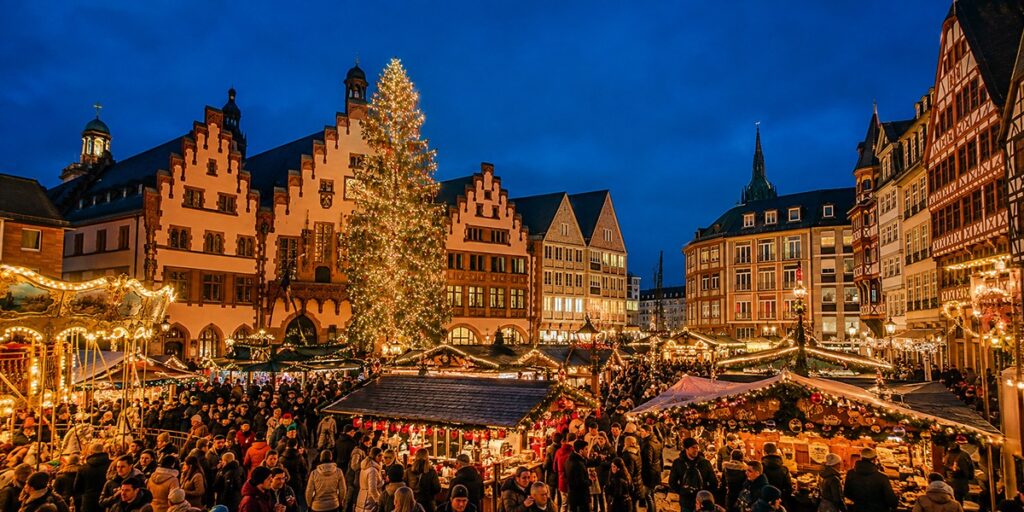
The market threads through the medieval Römerberg and out along the streets around it, over 200 stalls beneath strings of lights and a substantial tree. The thing to eat is Bethmännchen small marzipan pastries ideally warm, with a cup of regional apple wine. Wooden toys, nutcrackers and Frankfurter sausages fill out the rest.
Frankfurt’s real advantage is logistical: its airport makes it the cheapest and easiest market city in Germany to fly into, which is why it works well as a first or last stop.
Leipzig’s Christmas Market
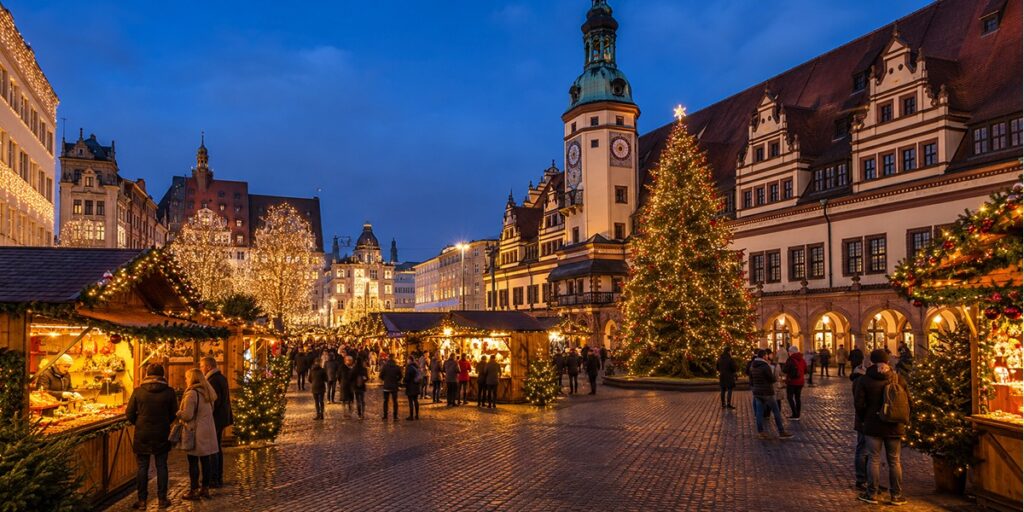
Around 300 stalls packed into the historic centre, with roots reaching back to the 1400s. The Marktplatz holds the main tree beside the Old Town Hall, and Grimmaische Strasse becomes a corridor of lit trees and garlands.
Big, traditional, and the useful part noticeably less overrun than Dresden, which sits about an hour down the line. Pairing the two is one of the best-value moves in German Christmas market travel.
Dortmund’s Christmas Market
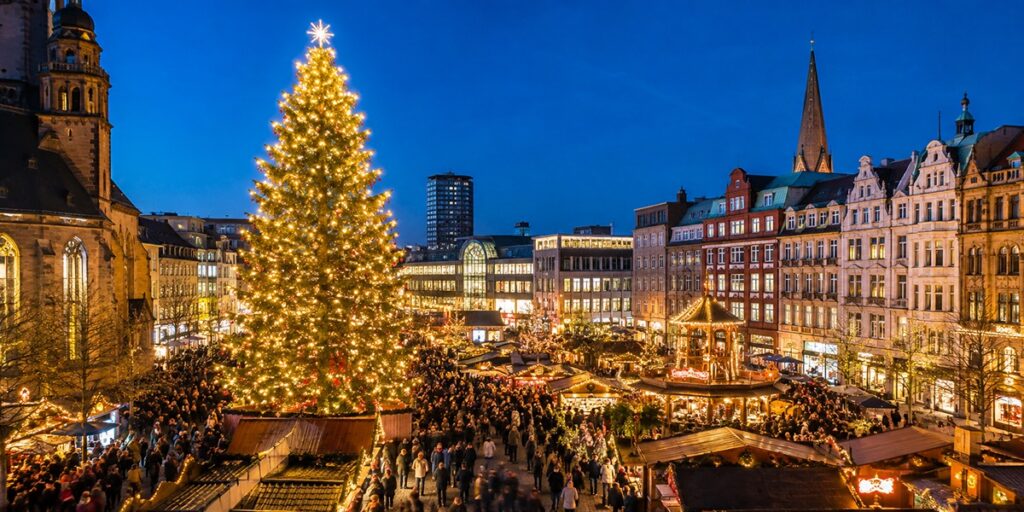
Included for sheer scale. Dortmund pulls roughly 3.6 million visitors a year across ten locations in the city centre, and its centrepiece is the world’s largest Christmas tree at 45 metres, wearing 138,000 LED lights. It also opens earlier than most, which makes it useful for November travellers.
Which Markets Open Early and Which Stay Open After Christmas
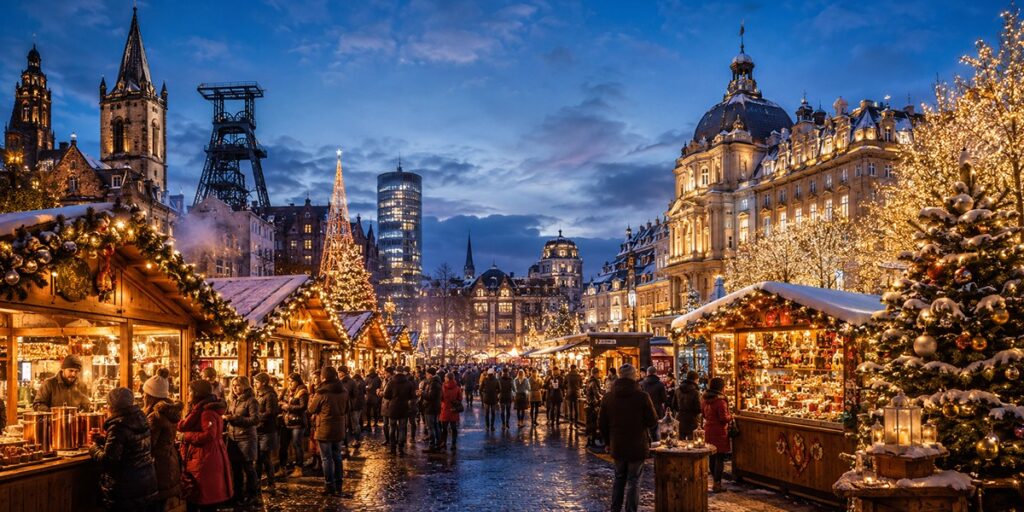
These two lists exist because these are the two ways trips go wrong.
Travelling in mid-November? The Ruhr region is your answer. Dortmund, Essen, Duisburg and Düsseldorf reliably open ahead of the rest of the country Duisburg advertises itself as Germany’s longest Christmas market, which refers to how many days it runs rather than how far it stretches. Aachen, Bochum and Bonn also tend to start early. Nobody is entirely sure why North Rhine-Westphalia jumps the gun, but it does, consistently.
Travelling between Christmas and New Year? Most of the country has packed up by then, which surprises a lot of people booking that week specifically for markets. Your options are Berlin’s Gendarmenmarkt (open to 31 December in 2026), Munich’s Tollwood, Düsseldorf, and Baden-Baden, which usually runs into January.
Practical Tips: Cash, Glühwein Deposits and Getting Between Cities
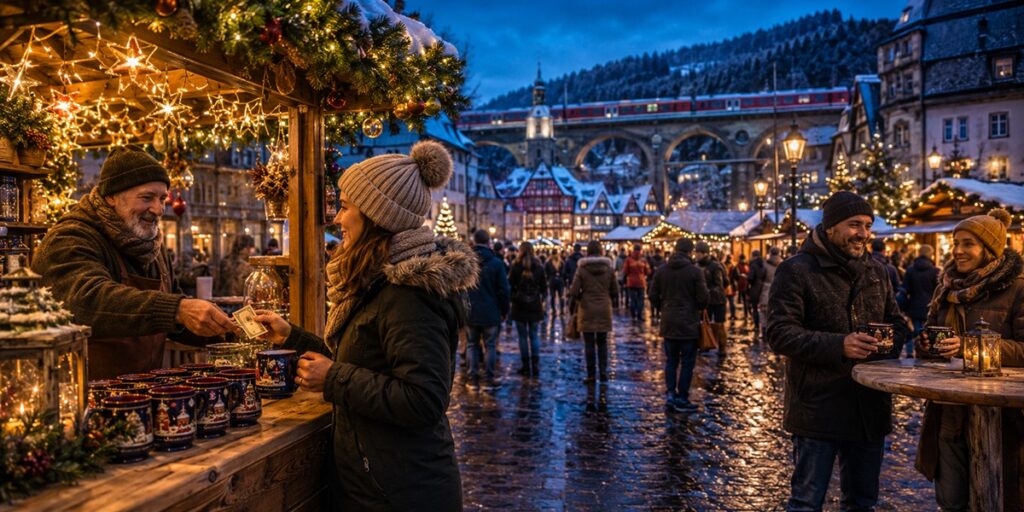
Bring cash. German Christmas markets remain stubbornly cash-based, and this catches out visitors from countries where tapping a card is automatic. Plenty of stalls now take cards. Plenty don’t. Gendarmenmarkt’s entry gate takes nothing else. Assume cash and treat card readers as a bonus.
Learn the Pfand before you order. Your Glühwein arrives in a real ceramic mug, and the price includes a refundable deposit on top of the drink. Hand the mug back at any stall in that market and you get the deposit returned or keep it, which is entirely allowed and quietly the point. The mugs are redesigned and dated every year, and collecting them is a genuine German tradition rather than a tourist upsell. First-timers usually make one of two mistakes: abandoning the mug on a ledge and losing the money, or not realising they were free to take it home.
A few markets charge, and one sells out in hours. Gendarmenmarkt’s €2 is the famous example, and it’s trivial. The one that actually requires planning is Ravenna Gorge in the Black Forest, staged beneath a railway viaduct: entry needs dated, timed tickets booked in advance, and for the 2025 season tickets went on sale on 14 October and were gone by the end of that day. If it’s on your list, the release date matters more than your travel dates.
Chain your markets by rail rather than dragging luggage. Germany’s network makes three or four cities in a week entirely realistic, and some pairings are almost unfairly easy: Dresden and Leipzig sit about an hour apart; Cologne, Düsseldorf and Essen are a short hop from one another in the Rhine-Ruhr; Stuttgart and Esslingen are practically neighbours. Pick one base with good connections and day-trip out it’s cheaper, and it means you’re never checking out of a hotel at 10am in the cold.
Staying Connected and Who Actually Needs an eSIM
Two honest notes before the pitch, because half our readers on this page don’t need what we sell.
If you live in the EU, you almost certainly need nothing. Germany is in the EU, so “Roam Like at Home” means your domestic plan works at domestic rates. Keep your money for Glühwein.
If you’re coming from outside the EU the UK since Brexit, the US, Canada, Australia, most of Asia roaming is a real and avoidable cost, and this is where a travel plan earns its keep. An eSIM Germany plan has you connected on landing. If the trip crosses borders, which Christmas market trips very often do, an eSIM europe regional plan covers the whole route on one install. Check your handset against our eSIM compatible devices list first, and our guide to avoiding roaming charges in Europe walks through the settings.
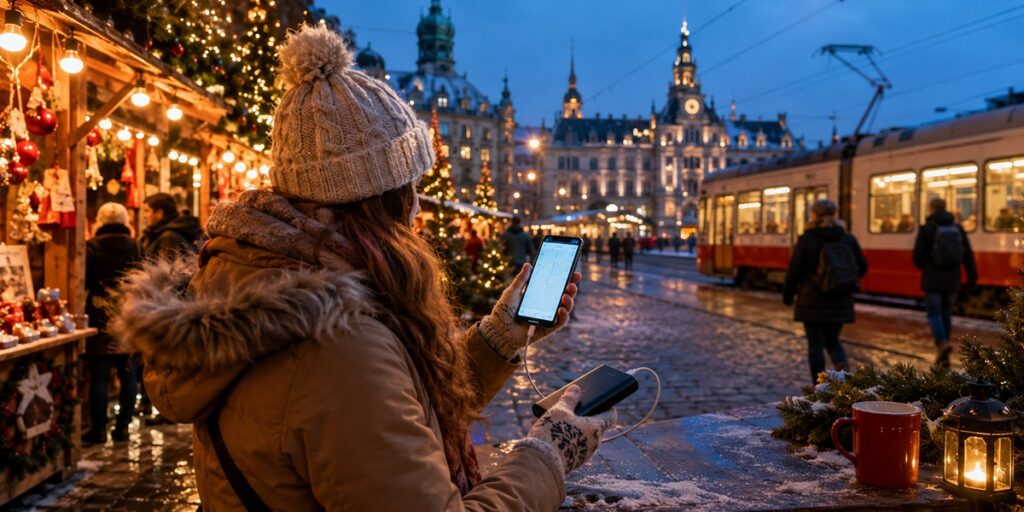
One thing that matters far more in December than it does the rest of the year: cold murders phone batteries. An hour outdoors at −2°C drains a phone dramatically faster than the same hour in July, and you’re leaning on it for maps between markets, transport tickets and photos you’ll actually want. Whatever data plan you choose, carry a power bank alongside it. A plan is worth nothing on a dead handset.
Adding Strasbourg, Vienna, Prague or Basel to the itinerary? Our guide to the best Christmas markets in Europe covers the wider circuit.
FAQs
1. What are the best Christmas markets in Germany?
Nuremberg, Dresden, Munich’s Marienplatz and Cologne’s Cathedral Market are the classics, each for a different reason — history, age, food and setting. The smaller markets at Rothenburg ob der Tauber and Leipzig are every bit as good and far less crowded.
2. When do German Christmas markets open and close in 2026?
The first Sunday of Advent falls on 29 November 2026, so most markets open Friday 27 November, with larger cities starting as early as Monday 23 November. Nuremberg’s Christkindlesmarkt runs from 27 November to 24 December 2026; Berlin’s Gendarmenmarkt runs 23 November to 31 December 2026. Most others close on 23 or 24 December.
3. Are any German Christmas markets closed on a specific day?
Yes. Many close for Totensonntag, which falls on Sunday 22 November in 2026 a national day of remembrance. Some markets delay opening until it has passed.
4. Which German Christmas markets are open after Christmas?
Berlin’s Gendarmenmarkt runs to 31 December 2026. Munich’s Tollwood, Düsseldorf and Baden-Baden also typically continue past Christmas Day, with Baden-Baden usually running into January.
5. Do German Christmas markets charge admission?
Most are free. Berlin’s Gendarmenmarkt charges €2 free on weekdays between 12pm and 2pm, free for under-12s, cash only at the gate. Ravenna Gorge in the Black Forest requires timed tickets booked well ahead.
6. Do I need cash at German Christmas markets?
Yes, bring some. Card acceptance has improved but is nowhere near universal, and some entry gates take cash only.
7. What is the deposit on a Glühwein mug?
A refundable deposit charged alongside the drink. Return the mug at any stall in that market to get it back, or keep the mug they’re redesigned and dated each year, and collecting them is a long-standing tradition.
8. Can I visit several Christmas markets in one trip?
Comfortably. Germany’s rail network makes three or four cities in a week straightforward. Dresden and Leipzig pair well, as do Cologne, Düsseldorf and Essen in the Rhine-Ruhr.
9. Are there guided Christmas market tours in Germany?
Yes, bookable in advance. Operators run single-city tours and multi-city packages, and Rhine river cruises with market stops start as early as 20 November in 2026.
10. Do I need an eSIM for Germany?
Not if you live in the EU your domestic plan roams at home rates. Travelling from outside the EU, a travel eSIM avoids roaming charges, and a regional Europe plan makes more sense if you’re crossing borders.
Start Planning
Choose your markets. Check the 2026 dates against the official sites rather than trusting any single guide, this one included. Book a base city with decent rail links. Bring more cash than feels necessary.
And if you’re travelling from outside the EU, sort your data before you fly Buy eSIM and it’ll be live the moment you land.
Leave a Reply