A guide to the best skiing in France the biggest linked areas, the best resorts for families, experts, luxury and budget, when to go, how to get there, and how to stay connected on the slopes.
France doesn’t ski in halves. Stretched between the high Alps and the Pyrenees are hundreds of resorts everything from a village hill with two drag lifts to the world’s largest linked ski area with Mont Blanc presiding over the lot at around 4,805 m. The thing that quietly sets France apart is altitude. Many of its marquee ski areas sit high in the Alps, which helps support a longer season and more reliable snow, particularly at higher elevations.
That’s the backdrop. What follows is the useful part: the resorts actually worth building a week around, what each one does best, and the small logistic getting there, timing, signal on the mountain that decide whether the trip runs smoothly or not.
The Best Ski Resorts in France
The resorts and linked areas worth planning around, with the quick facts up top and the detail underneath.
| Resort / area | Pistes | Top altitude | Best for | Nearest airport |
|---|---|---|---|---|
| Les 3 Vallées | 600 km | 3,230 m | Everything the biggest all-rounder | Chambéry / Geneva |
| Val Thorens | Part of 3 Vallées | 3,230 m ski area | Snow-sure skiing + big après | Chambéry / Geneva |
| Chamonix | Multi-area | Aiguille du Midi 3,842 m | Experts, off-piste, mountaineering | Geneva |
| Tignes / Val d’Isère | 300 km | 3,450+ m | Confident skiers chasing snow | Chambéry / Geneva |
| Paradiski (La Plagne + Les Arcs) | 425 km | ~3,250 m | Families + varied terrain | Chambéry / Lyon |
| Avoriaz (Portes du Soleil) | 600 km domain | 1,800 m village | Families, car-free, cross-border | Geneva |
| Alpe d’Huez | 250 km | 3,330 m | Sunny slopes, beginners, night skiing | Grenoble / Lyon |
Piste totals, elevations and airport suitability refer to the resort or linked ski area rather than a single village. “Best for” is editorial.
Les 3 Vallées — the world’s largest ski area
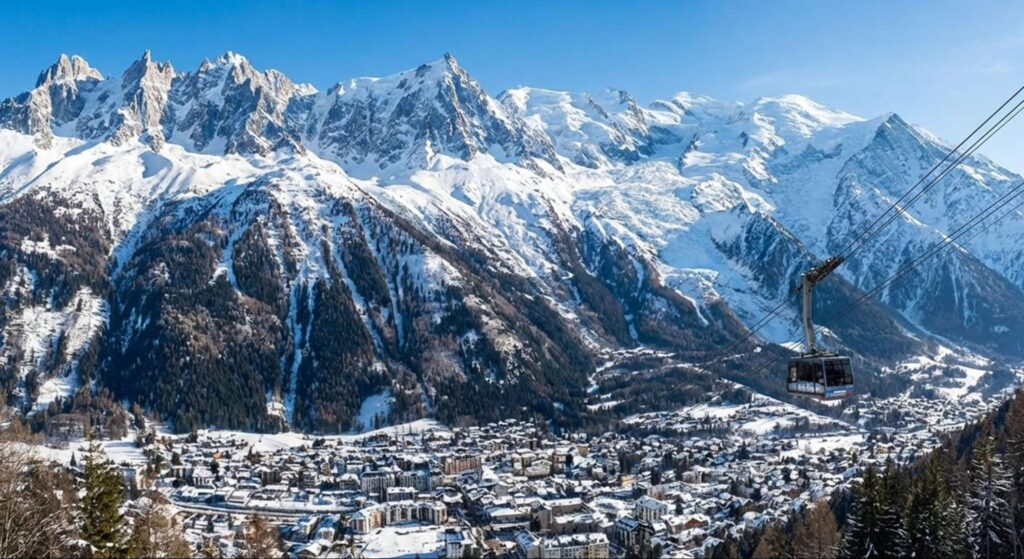
If you’re stuck on which resort, the 3 Vallées usually ends the argument. Seven resorts make up the linked domain, with 600 km of slopes on one ski area enough that you can ski across valleys and explore a different part of the domain every day.
Beginners get wide, approachable pistes and dedicated learning areas; intermediates have an enormous amount of terrain to work through; and experts have challenging descents and off-piste options. Courchevel is the luxury end of it Michelin-starred restaurants and five-star hotels while La Tania and Saint-Martin-de-Belleville can offer a more relaxed base with access to the same wider ski domain.
For the 2026–27 season, the main 3 Vallées ski area is scheduled to run from 5 December 2026 to 18 April 2027, while Val Thorens and Orelle extend their season from 21 November 2026 to 2 May 2027.
Val Thorens — highest in Europe
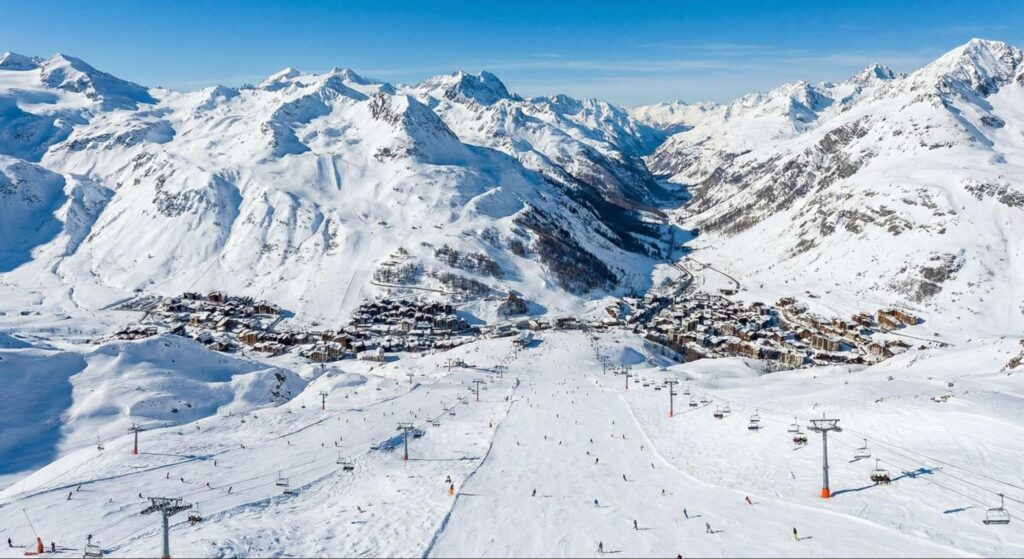
Technically it’s part of the 3 Vallées, but it earns its own entry. Sitting at 2,300 m, Val Thorens is the highest ski resort in Europe, with access to the wider 3 Vallées network.
That altitude is a major reason skiers choose it for snow reliability and late-season trips. The resort is also known for its lively après-ski scene, so it’s a strong choice if you want long days on the slopes followed by busy evenings. If you’d rather have somewhere quieter, another 3 Vallées base may suit you better.
Chamonix — Mont Blanc’s legendary resort
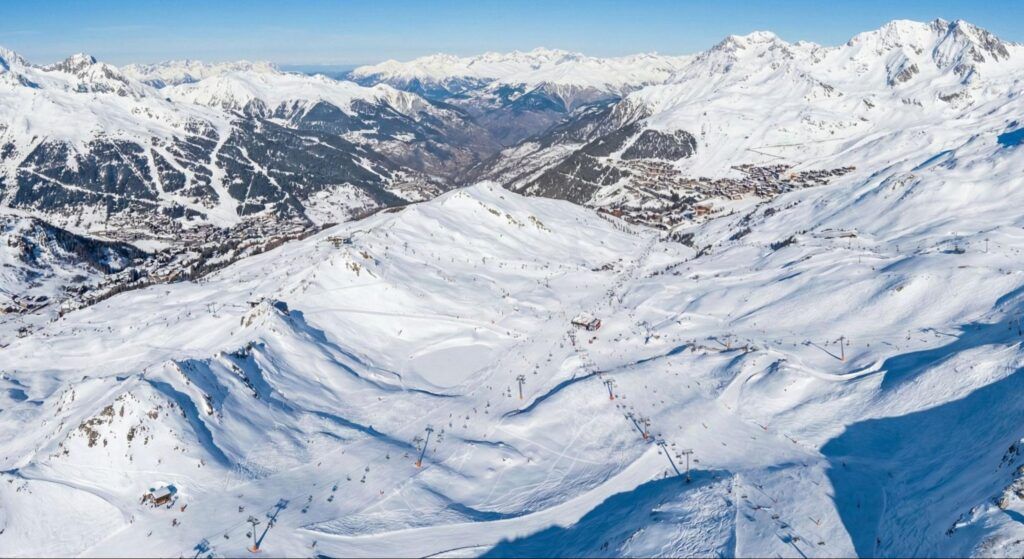
Chamonix sits in the shadow of Mont Blanc and, unlike many purpose-built ski resorts, is a real mountain town with year-round residents and services. Its reputation is built around serious alpine terrain, off-piste skiing and mountaineering.
The Aiguille du Midi rises to 3,842 m and provides access to the legendary Vallée Blanche. The Vallée Blanche is a roughly 20 km high-mountain off-piste route across glaciers, so it isn’t a casual beginner run and inexperienced skiers should go with a qualified guide.
There is skiing for different ability levels around the valley, but Chamonix is particularly compelling for experienced skiers and anyone who wants a broader mountain experience beyond conventional piste skiing.
Tignes & Val d’Isère — high-altitude giants
Together, Tignes and Val d’Isère form the Tignes–Val d’Isère ski area, with around 300 km of marked runs and terrain reaching above 3,400 m.
A large share of the terrain sits above 2,000 m, helping the area maintain reliable snow conditions through much of the season. There is plenty for beginners and families, but the combination of altitude, challenging reds and blacks, glaciers and famous runs such as Face de Bellevarde makes it particularly attractive to confident and advanced skiers.
The 2026–27 winter season is scheduled to run from late November 2026 into early May 2027, depending on the area and conditions.
Paradiski (La Plagne & Les Arcs) — a huge, family-friendly domain
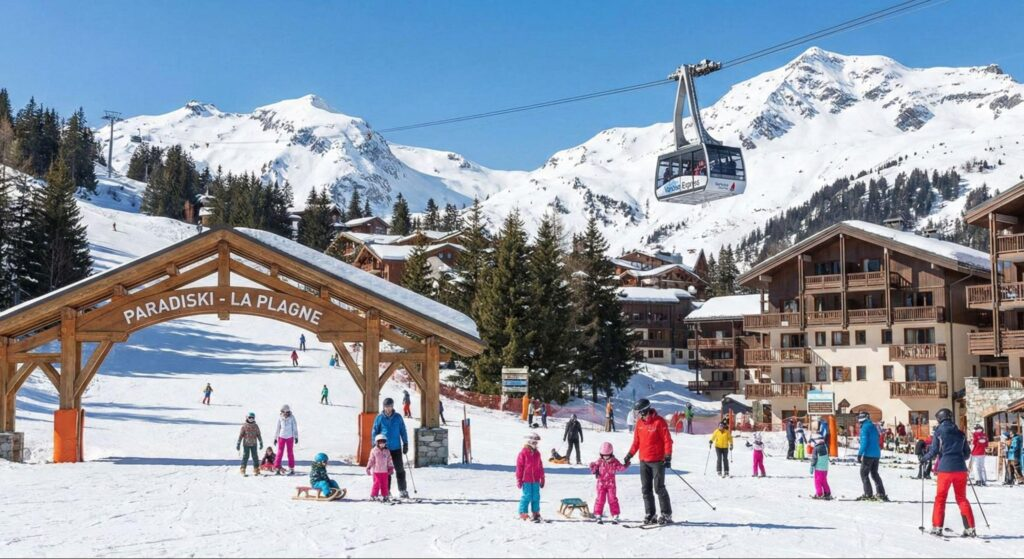
La Plagne and Les Arcs are linked by the Vanoise Express cable car, creating Paradiski a huge ski domain with around 425 km of slopes.
The range is what makes it work for families and mixed groups. There are gentle areas for beginners, long cruising runs for intermediates and more demanding terrain for experienced skiers. La Plagne also has numerous villages and accommodation options, making it easier to choose between a lively base, a quieter village or a more convenient ski-in/ski-out location.
Avoriaz (Portes du Soleil) — car-free and family-first
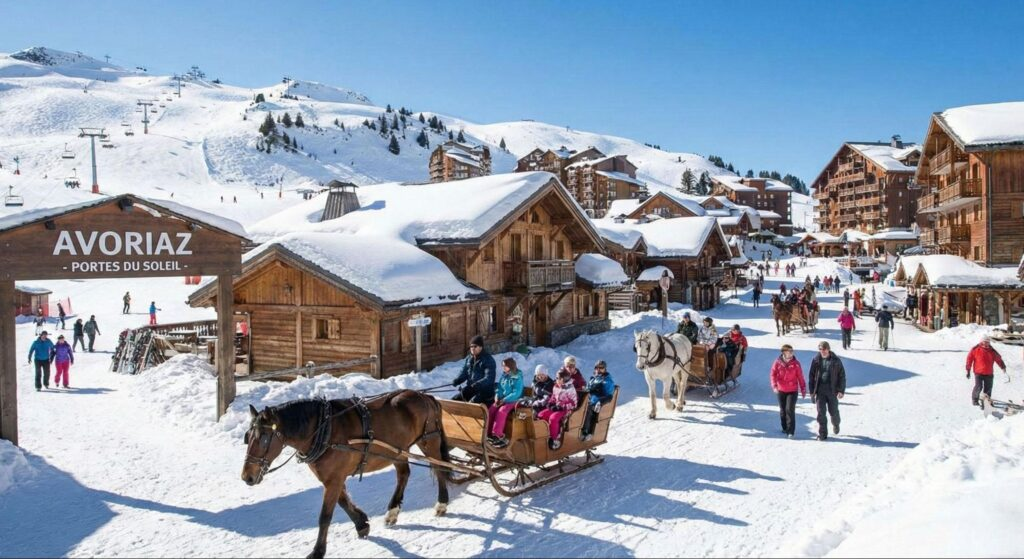
Perched at around 1,800 m, Avoriaz is a purpose-built, largely car-free resort designed around skiing and pedestrian access. That layout makes it particularly convenient for families, while dedicated beginner and children’s areas add to its appeal.
Avoriaz also gives you access to the enormous Portes du Soleil domain, which connects 12 resorts across France and Switzerland and offers around 600 km of skiing. On the same ski trip, you can cross the border on skis and explore both countries.
Alpe d’Huez — sun and gentle blues
They call it “L’Île au Soleil” the Island in the Sun and Alpe d’Huez is known for its sunny position as well as its extensive ski area.
The resort offers around 250 km of connected pistes, with terrain for beginners through to advanced skiers. At the top, Pic Blanc reaches 3,330 m, while the famous Sarenne provides a 16 km descent and is described by the resort as the longest black run in Europe.
Night skiing is also available during selected periods, making Alpe d’Huez a particularly versatile choice for skiers who want more than a standard daytime schedule.
Best Ski Resorts by Type
Choosing by who’s coming with you:
- Best all-rounder: Les 3 Vallées — the sheer size and variety mean it works for almost every ability level.
- Best for experts / off-piste: Chamonix, then Tignes–Val d’Isère.
- Best for families: Avoriaz and Alpe d’Huez — dedicated beginner areas, family-friendly terrain and layouts that are relatively easy to navigate.
- Best for luxury: Courchevel 1850 and Méribel.
- Best for snow security / late season: Val Thorens and Tignes–Val d’Isère.
- Best for après-ski: Val Thorens and Courchevel for lively evenings; Morzine and Les Menuires for something more relaxed.
- Best for budget: Smaller areas such as Les 7 Laux and Prapoutel, or a value-oriented village inside a major domain such as La Tania.
Planning Your Trip: Getting There & When to Go
Getting to the French Alps is relatively straightforward. The main ski regions are served by Geneva, Lyon, Chambéry and Grenoble airports, while rail connections can take you toward gateway towns before an onward transfer by bus, shuttle or taxi.
The exact transfer depends heavily on the resort. Geneva is particularly useful for destinations such as Chamonix and Avoriaz, while Chambéry and Grenoble can be convenient for several resorts in the French Alps. Check the final transfer before booking flights, because a short-looking journey on a map can become much longer in winter traffic.
When to go
The main French ski season generally runs from December through April, although opening and closing dates vary considerably by resort and snow conditions.
January and February are traditionally strong choices for snow conditions, but high-altitude resorts can remain attractive well into spring. Val Thorens, for example, is scheduled to operate into early May for the 2026–27 season, while Tignes–Val d’Isère is also scheduled to continue into spring.
If you’re travelling around Christmas, New Year or French school holidays, book accommodation and lift passes early. These periods can be among the busiest and most expensive weeks of the season.
Staying Connected on the Slopes
In and around resort villages, mobile reception is generally useful for weather checks, trail maps, messages and travel apps. Here’s the honest caveat, though, and it’s the part guides tend to skip: high-alpine terrain, valleys and remote off-piste areas can have weaker or no mobile signal.
Before you head into the mountains, download offline trail maps
1. What is the best ski resort in France?
Les 3 Vallées is one of the best choices for an all-round ski trip. It offers around 600 km of linked slopes, with terrain for beginners, intermediates and advanced skiers.
2. What is the best time to ski in France?
The main ski season runs from December to April. January and February are popular for reliable snow, while high-altitude resorts such as Val Thorens can offer skiing into late April or early May.
3. Which ski resort in France is best for families?
Avoriaz and Alpe d’Huez are excellent choices for families, with beginner-friendly slopes, dedicated children’s areas and convenient resort layouts. La Tania in the 3 Vallées is another good option.
4. Which French ski resort is best for advanced skiers?
Chamonix is a top choice for experienced skiers, particularly for challenging alpine and off-piste terrain. Tignes–Val d’Isère and Val Thorens also offer extensive terrain for confident and advanced skiers.
5. How can I stay connected while skiing in France?
A France travel eSIM is a convenient option for staying connected without relying on expensive roaming. Install it before your trip and use it for maps, weather updates and messaging. Download offline maps too, as mobile coverage can be limited in remote mountain areas.
Leave a Reply