Why frequent travellers and remote workers are switching to eSIMs — buying data before you fly, keeping your home number, juggling plans across countries — and the honest downsides to know first.
The case for an eSIM looks very different depending on how much you move around. If you switch carriers once a year and rarely leave the country, honestly, you’ll barely notice the difference. But the moment your life spreads across borders a work trip here, a month in a new city there, a route that hops through three countries in a fortnight how you get online abroad stops being an afterthought and starts shaping your whole day. That’s the traveller for whom an eSIM isn’t a nice-to-have; it’s the thing that quietly removes a recurring headache. So this isn’t a generic pros-and-cons rundown. It’s the benefits of an eSIM for people who actually travel, the parts that earn their keep on the road, and the real limitations worth knowing before you lean on one. (Want the full head-to-head instead? Our eSIM vs physical SIM comparison
Why Travellers Switch to eSIMs
The pitch really comes down to a handful of things that matter more the more you fly.
- You buy before you fly and land connected. This is the big one. Buy a destination data plan in advance and it switches on the moment you touch down no airport SIM queue, no wandering through arrivals hunting for a shop, no roaming bill waiting for you at the end of the trip. You step off the plane with maps, translation, and messaging already working.
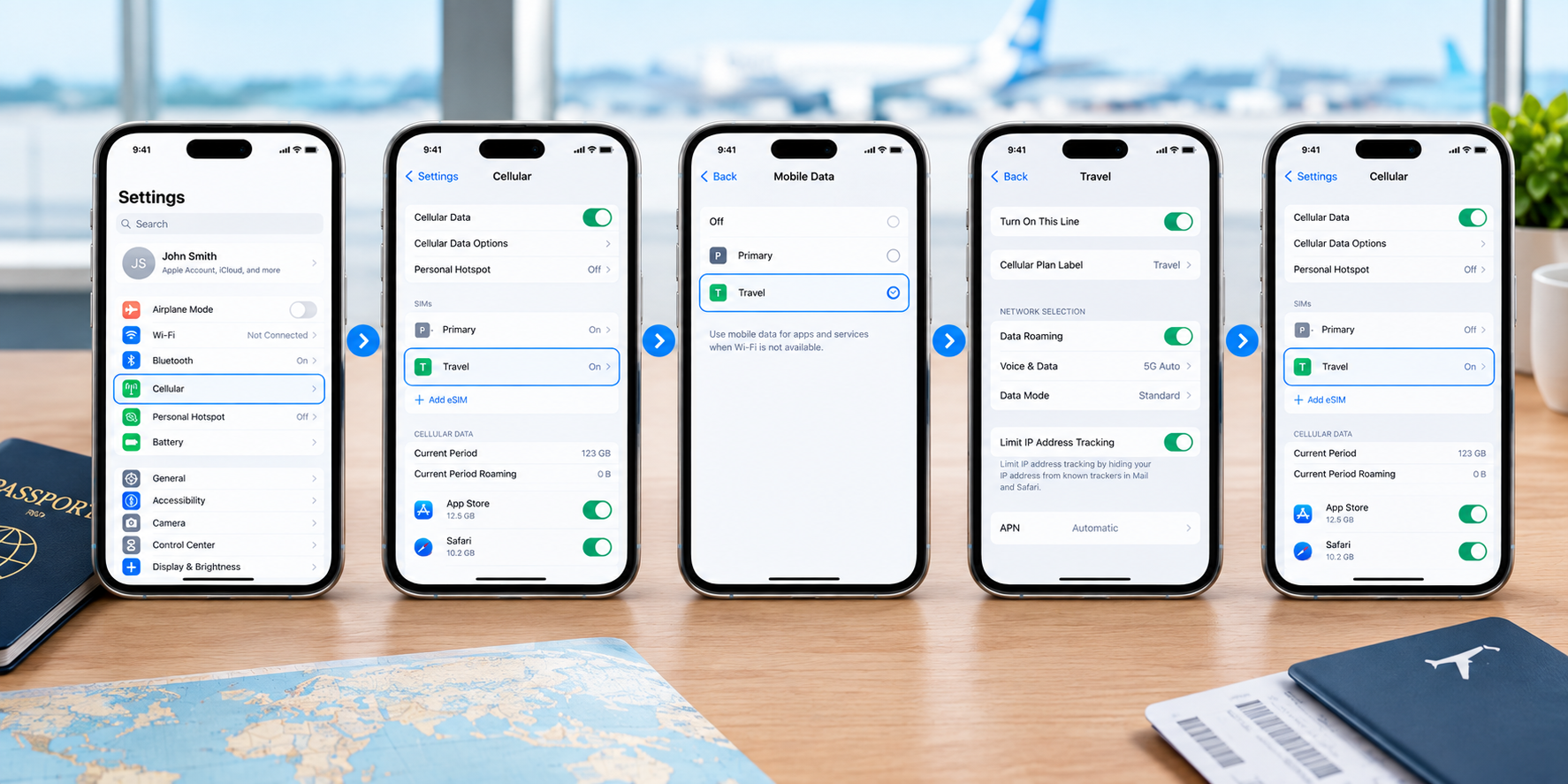
- You keep your home number. On a dual-SIM phone, you add a travel data eSIM alongside your everyday SIM, so your usual number stays live for calls, banking texts, and 2FA codes while your data runs on a cheaper local plan. For a lot of travellers, that single detail is what seals it you’re not trading away your normal life to get online abroad.
- No roaming bills. Running a local plan through an eSIM sidesteps the per-day roaming rates home carriers love to charge the second you cross a border. Over a long trip, that’s not loose change.
- Nothing to lose or break. There’s no fingernail-sized card to drop, snap, or misplace in a hostel dorm at 2 a.m. the eSIM lives inside the phone, full stop.
Managing eSIMs on the Road
This is where eSIMs quietly rewire how you travel long-term. A modern phone holds several eSIM profiles at once, so you can carry a home line, a plan for wherever you are, and another queued up for wherever you’re headed next. Cross from Spain into Morocco and on to Portugal, and you’re switching plans in a few taps in your settings not tracking down a phone shop in each new place and fumbling a fresh plastic SIM into a tray. For anyone who spends real time across borders remote workers, long-haul travellers, people who live out of a single carry-on that’s the whole difference between connectivity being a chore you manage and something you never think about. A regional or Global eSIM covers a whole multi-country stretch on one plan, which is often simpler still.
The Honest Downsides
An eSIM isn’t the right call for everyone, and a guide that pretends otherwise isn’t much use to you. The real trade-offs:
- Your phone has to support it. Older handsets simply don’t have the hardware. If yours is a few years old, check before you count on an eSIM abroad here’s a quick way to do it.
- Support is still patchy in places. Not every carrier or region handles eSIM equally well, so in a handful of destinations a local physical SIM is still the more dependable option. Check before you travel, and somewhere genuinely remote, it’s worth having a physical SIM tucked away as backup.
- Switching phones takes a few extra steps. With a physical SIM you pop the card out and into the new phone in seconds. With an eSIM you usually deactivate on the old device and reinstall on the new one not difficult, but worth knowing if you upgrade mid-trip.
None of these are dealbreakers for a traveller on a recent phone. They’re just the honest fine print, and reading it upfront is how you dodge the one nasty surprise.
eSIM vs Physical SIM, in Brief
For a normal trip on a modern phone, the eSIM wins on convenience buy ahead, land connected, keep your number, no card to swap. The physical SIM still earns its place with older phones, destinations where eSIM support is thin, or if you like moving one card between devices. For the full side-by-side signal, security, cost, device support our dedicated eSIM vs physical SIM guide.
FAQs
1. Is an eSIM better than a physical SIM for travel?
For most travellers on a recent phone, yes you can buy a plan before you fly, land connected, keep your home number active, and skip roaming. A physical SIM still wins if your phone doesn’t support eSIM or you’re heading somewhere eSIM support is thin.
2. Can I use more than one eSIM plan while travelling?
Yes most recent phones store several eSIM profiles, so you can keep a home line and a travel plan (or plans for several countries) and switch between them in your settings.
3. Do eSIM plans include phone calls?
It depends on the eSIM plan. Some eSIMs are data-only, while others include voice calls and SMS. Before buying, check the plan details to see whether calls are included and whether a local phone number is provided.
4. How much data do I need for a trip?
It depends on your habits. For light use maps, messaging, a bit of browsing around 5–10 GB a week is usually plenty; if you stream or work online heavily, look at 10–20 GB or more.
5. What are the disadvantages of an eSIM?
It only works on newer phones, support is still limited with some carriers and in some countries, and moving it to a new phone takes a few extra steps compared with swapping a physical card.
Leave a Reply