The honest answer to “which travel SIM should I buy” is that it depends on three things, and only one of them is price. Your handset decides whether one whole option is even available to you. Your destination decides whether anyone will ask for your passport. And whether someone local needs to actually ring you decides more than most people realise until they’re standing outside a restaurant that can’t reach them.
There are four realistic routes: a travel SIM card, a travel eSIM, a local SIM bought on arrival, and simply roaming on your existing plan. This guide compares all four, including the parts that usually get skipped what “unlimited” really means, whether you get a phone number, which phones can’t run an eSIM at all, and the specific cases where a physical SIM card is still the better purchase.
We sell eSIMs. Those cases are flagged plainly below rather than quietly left out.
Your Four Options
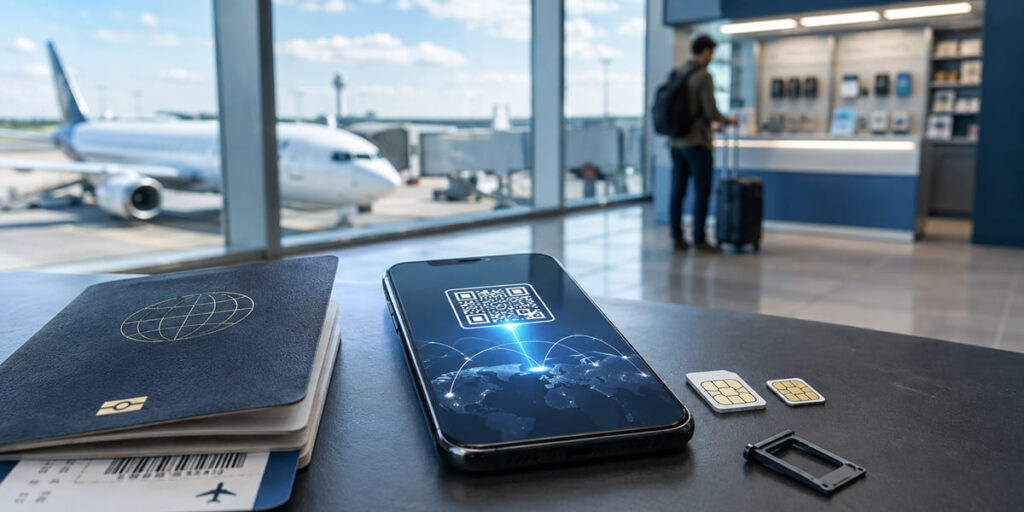
- A travel SIM card is a physical chip you buy before departure, usually online and posted to you, that works across a long list of countries. Providers like One Sim Card and Sim Corner have built entire businesses on them. You swap it in when you land and put your home SIM somewhere you won’t lose it which, for the record, is not the seat pocket.
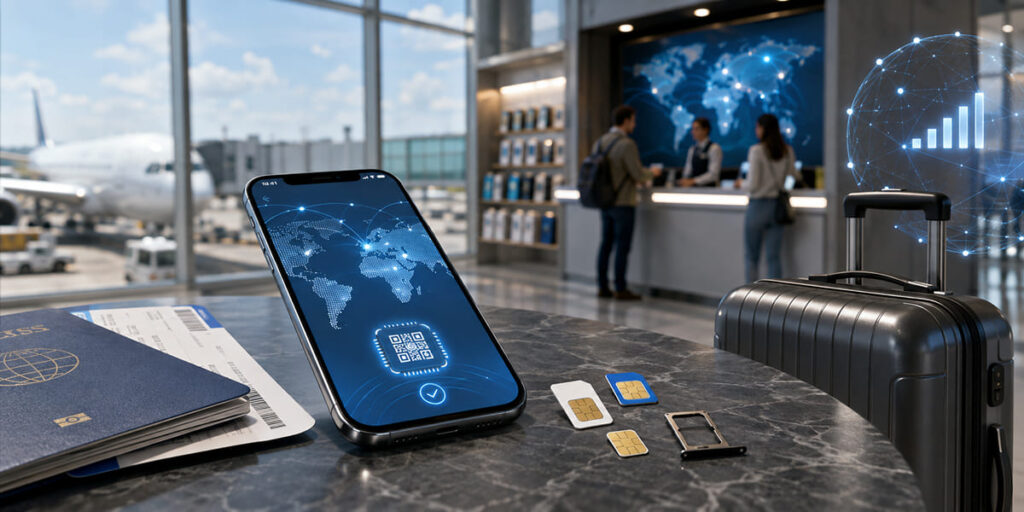
- A travel eSIM does the same job digitally. Buy a plan, get a QR code, install it before you fly, and it activates on arrival. Nothing to post, nothing to swap, nothing to leave behind in a hotel.
- A local SIM bought on arrival — airport kiosk, carrier store, supermarket almost always wins on price per gigabyte, and usually includes a local phone number into the bargain. What it costs you instead is time, and in some countries, a photocopy of your passport.
- Roaming on your existing plan takes zero effort, and occasionally costs nothing: EU residents roam across the EU at domestic rates, and a number of US and UK plans include limited international allowances. Outside those arrangements, it’s typically the most expensive option available, often by a considerable margin.
Comparison at a Glance
| Feature | Travel eSIM | Travel SIM Card | Local SIM | Roaming |
| Setup | Online, minutes | Order ahead, delivered | Buy on arrival | No setup |
| Ready when you land | Yes | Yes | No | Yes |
| Phone number | Usually data-only | Often included | Usually included | Keep your own |
| eSIM support needed | Yes | No | No | No |
| Multi-country | Yes | Yes | Usually one country | Depends on plan |
| Cost | Low–moderate | Low–moderate | Lowest per GB | Usually highest |
| ID required | Rarely | Rarely | Often | No |
| AirHub pricing* | Global Plans start around $7.40 (varies by country, data & validity) | — | — | — |
Will Your Phone Work?
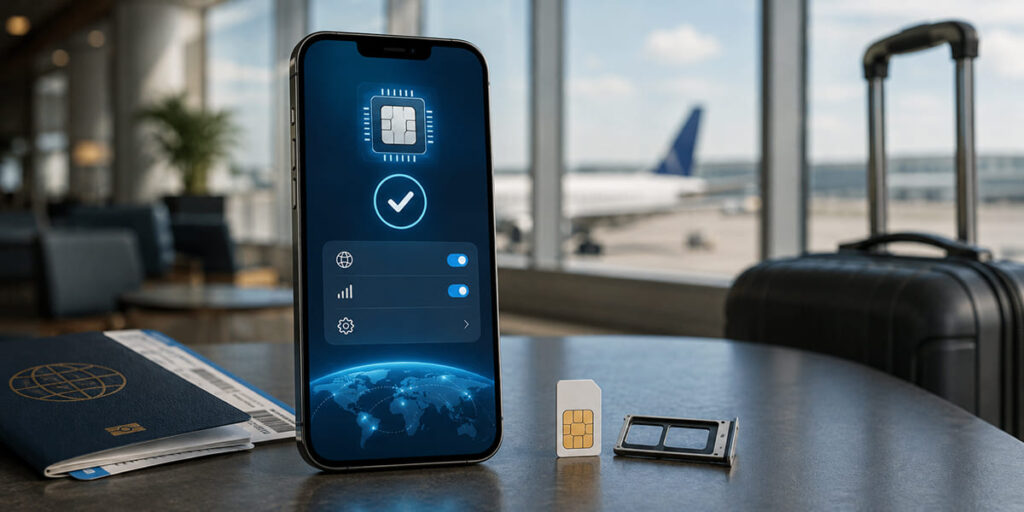
Start here, because for some readers this removes an entire option from the table.
The fastest check takes about ten seconds: dial *#06#. If an EID number appears alongside your IMEI, your phone runs eSIM. On iPhone you can also look under Settings → Cellular → Add eSIM; on most Androids it’s Settings → Connections → SIM Manager.
The broad picture is generous iPhone XS and newer, Google Pixel from the 3 onward, Samsung Galaxy S20 and later, and most flagship Androids since. But “most recent phones” and “all recent phones” are very different statements, and the gap between them catches people out. A great many mid-range and budget Android handsets released in the last few years carry no eSIM support at all. Phones bought directly from a carrier are sometimes locked and will refuse a third-party profile outright. Certain models sold in mainland China ship without eSIM entirely.
If your phone falls into any of those categories, a physical travel SIM card isn’t a backup plan. It’s the plan. Which is exactly why the established providers still sell both formats rather than quietly retiring the plastic.
Our eSIM compatible devices list has the model-by-model detail.
What “Unlimited” Actually Means
This gets its own section because it’s the most misused word in the category, and being straight about it is worth more than any marketing line.
Almost no unlimited travel plan is unlimited at full speed. That applies to eSIMs precisely as much as it applies to a SIM card bought at an airport counter the format changes nothing. What sits behind nearly all of them is a fair-use policy: a fixed amount of high-speed data per day or per plan, after which the connection continues at a reduced speed rather than cutting out.
Where providers differ isn’t whether they throttle. It’s whether they tell you. Some publish the daily threshold and the reduced speed openly; others concede that throttling exists while carefully declining to name a number. For context, a throttled speed around 1Mbps handles maps, messaging and standard-definition video without complaint. It does not handle video calls or large uploads.
So when you’re weighing an esim with unlimited data against a fixed-data plan, the figure that matters isn’t the word “unlimited” at all. It’s the daily high-speed allowance, and what happens once you cross it. Ask for both before you buy from us or from anyone else.
Worth saying plainly: for most trips a fixed-data plan works out cheaper and never throttles at all. You can compare eSIM data plans by destination and size.
Do You Get a Phone Number?
Most travel eSIMs are data-only, and for a great many travellers that’s entirely sufficient. WhatsApp, FaceTime and iMessage all run over data and cover the people you already know.
Where it falls down is when something local needs to reach you. The restaurant confirms your table. The driver circled the wrong entrance. A delivery. And most commonly of all: an SMS verification code from a service that flatly refuses international numbers.
There are two ways around it, depending on your phone. On a dual-SIM handset, keep your home line switched on for calls and texts while the travel plan carries all your data but turn data roaming off on that home line, because that’s where the genuinely alarming bills originate. Incoming SMS is free on many home plans and billable on others, so it’s worth two minutes checking yours. If you actually need a local number, you want a plan that includes voice and SMS rather than data alone, or a local SIM bought on arrival.
Where to Buy and What Airports Really Cost
Airport kiosks have a reputation for being expensive, and on the whole that reputation is deserved. Convenience carries a premium in an airport for the same reason a bottle of water does: you’re a captive customer with luggage, limited time and no easy way to comparison shop. Carrier stores in town generally price better on the same networks, and buying online before departure usually beats both.
That’s the accurate version. What isn’t accurate and gets repeated constantly in this category, often by people selling eSIMs is the suggestion that airport SIM counters are running scams. They’re regulated retail outlets selling legitimate products at convenience prices. That’s a reason to compare before you buy, not a reason to be frightened of them. Land at 11pm in an unfamiliar city with no data and no plan, and an airport kiosk will get you online in ten minutes, which is worth something.
The real argument for sorting it in advance is duller and more persuasive than any warning: you’ll pay less, you’ll actually understand what you bought because you had time to read the terms, and you won’t be making a financial decision while jet-lagged in a queue.
Registration and ID Requirements
A number of countries require real name registration for locally-issued SIM cards, which means handing over a passport at the point of sale. India, China, Turkey, the UAE, Vietnam and Indonesia are among them, and the details shift.
Now the part that’s routinely explained wrong. Travel eSIMs usually sidestep this but not because eSIM technology is somehow exempt from identity law. A travel eSIM typically roams on a foreign carrier’s network rather than being issued locally, so local registration rules don’t attach to it in the same way. Buy a locally-issued eSIM in a country with KYC requirements and you’ll do exactly the same paperwork as you would for plastic. The exemption comes from the roaming arrangement, not the format.
The practical upshot is fewer passport photocopies circulating, which is a perfectly reasonable thing to prefer.
When a Physical Travel SIM Is Still the Better Choice
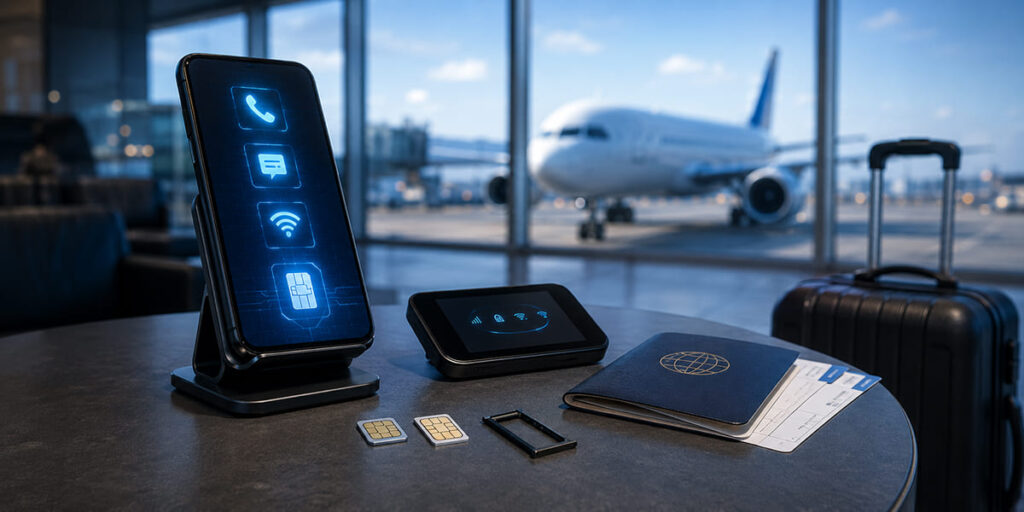
We’d rather you bought the right thing than the thing we happen to sell. There are four situations where a physical SIM wins outright.
- Your phone doesn’t support eSIM: There’s no clever workaround here a travel SIM card or a local SIM is simply the answer.
- You need a local number for calls and texts: Local SIMs almost always include one. Most travel eSIMs don’t.
- You’re staying more than about a month: Past that point a local prepaid plan is usually cheaper and considerably less restricted than any travel plan, eSIM included. What you give up is convenience: you’ll sort it after arrival, occasionally with ID in hand.
- You’re connecting something that isn’t a phone: Older tablets, mobile hotspots and cameras frequently accept a physical SIM and nothing else.
If none of that describes your trip, an eSIM is almost certainly the simpler and cheaper route.
How to Set Up an eSIM Before You Fly
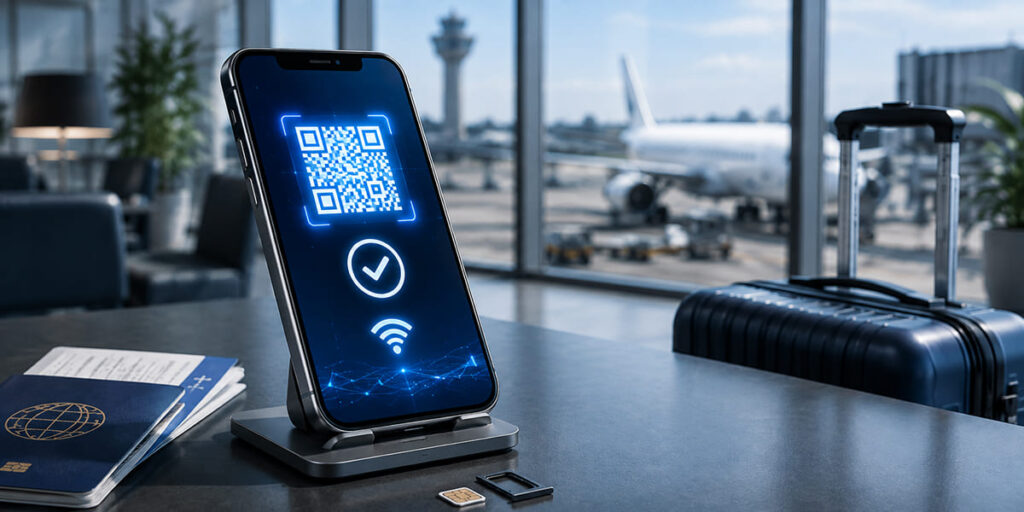
Do this at home, on Wi-Fi, rather than in an arrivals hall.
- Choose your plan, checking the destination coverage and the validity period.
- Receive your QR code by email with installation instructions.
- Install it. iPhone: Settings → Cellular → Add eSIM → Use QR Code. Android: Settings → Connections → SIM Manager → Add eSIM.
- Label the line something you’ll recognise in three months. A destination name beats “Secondary” once you’ve accumulated a few of these.
- Set your data line to the travel eSIM, then turn Data Roaming on for that line only. This is the step people skip, and then spend twenty minutes at baggage reclaim wondering why nothing loads.
If the plan sits on “Activating…” before you travel, that’s normal behaviour rather than a fault. It connects when you land.
Our full guide on how to install an eSIM handles the edge cases, and avoiding roaming charges covers the settings on your home line.
FAQs
1. Is it better to buy a SIM card at the airport or online?
Online is usually cheaper and less stressful — you can compare properly and land already connected. Airport kiosks are convenient but typically carry a markup, and carrier stores in town often price better on the same networks.
2. What’s the difference between a travel SIM card and an eSIM?
A travel SIM card is a physical chip you swap into your phone. An eSIM is the same product delivered digitally: you scan a QR code and the profile downloads. The eSIM needs a compatible handset; the SIM card doesn’t.
3. Does my phone support eSIM?
Dial *#06# and look for an EID number. Broadly, iPhone XS and newer, Pixel 3 and newer, and Galaxy S20 and newer support it, along with most flagship Androids since. Many mid-range and budget Androids do not, and some carrier-locked phones won’t accept a third-party eSIM.
4. Is unlimited data really unlimited?
Not at full speed, with almost any provider. Most unlimited plans run a fair-use policy a daily high-speed allowance, after which speeds drop, often to around 1Mbps. Ask for the daily figure and the throttled speed before buying.
5. Do travel eSIMs give you a phone number?
Most are data-only. If you need to receive local calls or SMS codes, look for a plan including voice and SMS, or keep your home line active on a dual-SIM phone for texts.
6. Will I still get my bank’s verification codes?
Yes, provided your home line stays switched on. Keep data roaming off on that line to avoid charges, and check whether your home carrier bills for incoming SMS abroad.
7. Do I need an ID to buy a travel SIM or eSIM?
Usually not. Some countries require real-name registration for locally issued SIMs, which is why a local shop may ask for your passport. Travel eSIMs generally avoid this because they roam on a foreign network rather than being issued locally.
8. Can I use one plan across several countries?
Yes — regional and global plans exist in both eSIM and physical formats. Check the exact country list before buying, because coverage varies between plans that look almost identical.
9. Are eSIMs more secure than SIM cards?
In one narrow sense, yes: there’s no physical card to pull out of a lost or stolen phone. But SIM-swap fraud works by socially engineering a carrier’s account team rather than by stealing the card, so the format alone doesn’t protect you from it. Strong account security and app-based two-factor authentication matter far more than which kind of SIM you’re carrying.
10. Can I disable an eSIM remotely if my phone is stolen?
That depends on your device-level security tools, such as Find My iPhone, and the support options available from your eSIM provider.
11. How long does activation take?
Usually minutes. Install before you fly, and the plan connects when you land and enable data roaming on that line.
12. Can I get a hotspot from a travel eSIM?
Often, though, policies vary and some providers cap or restrict tethering particularly on unlimited plans, which is inconveniently the plan you’d want it on. Check first if a laptop is travelling with you.
Before You Book
Confirm your phone supports eSIM. Decide whether you need a phone number or only data. If you’re buying unlimited, get the fair-use figure in writing before you pay. And whichever route you take, settle it before you fly rather than in an arrivals queue.
If an eSIM turns out to be the right fit, you can browse esim data plans by destination and have it installed before you leave the house.
Leave a Reply