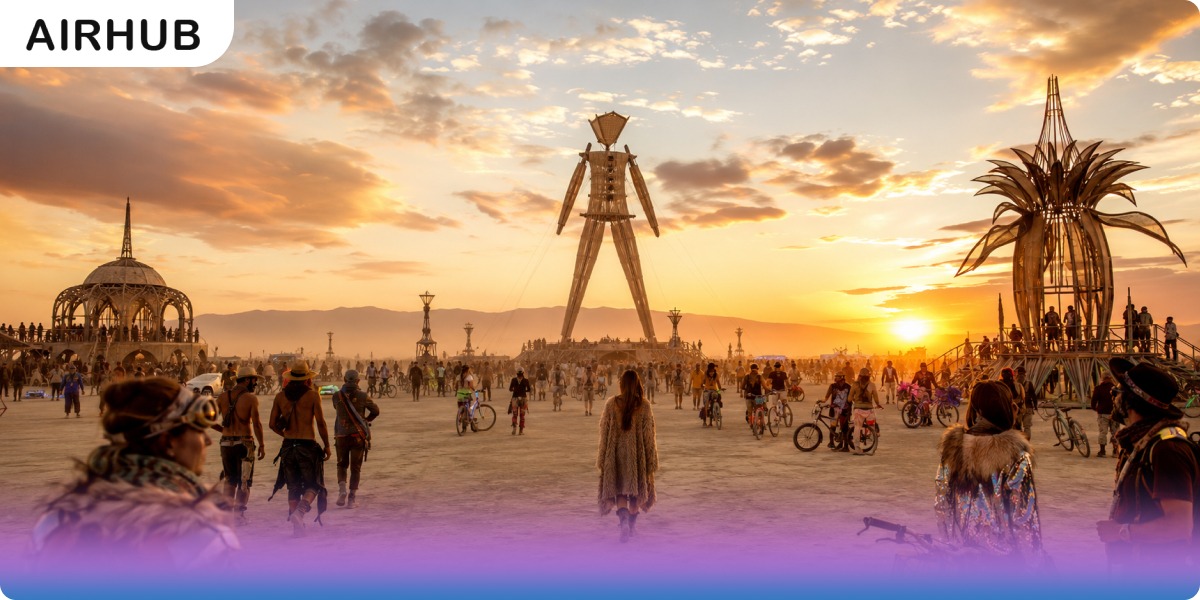
Describe Burning Man accurately to someone who’s never been and it sounds like an elaborate lie. Seventy thousand people build a city in a Nevada dry lakebed, live in it for nine days, burn most of it, and leave so little behind that a satellite couldn’t tell they’d been there. Nothing is for sale. Nobody is performing for you.
Here’s what matters if you’re reading this in July: Burning Man 2026 runs 30 August to 7 September, and four of the five ticket sales have already closed. The OMG Sale is the last public chance and it lands within weeks.
So this is the current state of play tickets, dates, how you physically reach the place, what to wear, and the costume rule that trips up nearly every first-timer.
What Is the Burning Man Festival, Really?
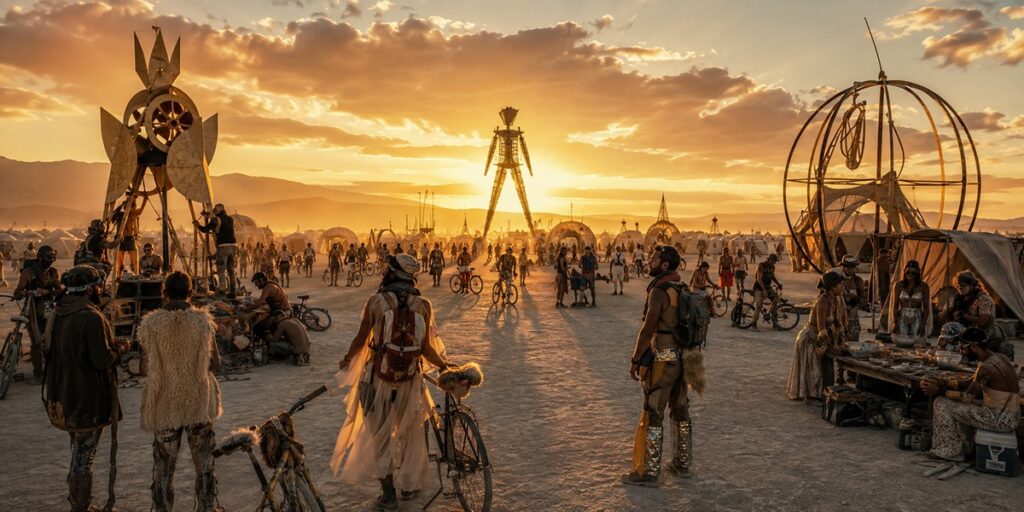
Not a music festival, whatever the framing suggests. There are no headliners, no main stage, no lineup to check the night before. What exists instead is a temporary city of roughly 70,000 people that rises in the Black Rock Desert, functions for nine days, and then disappears completely.
Ten principles govern the whole thing: radical inclusion, gifting, decommodification, radical self reliance, radical self expression, communal effort, civic responsibility, leaving no trace, participation and immediacy. The practical upshot is that nobody attends as an audience member. Everyone brings something: a camp, an artwork, a skill, a pot of soup. That single difference explains most of what’s strange about the event to outsiders.
Burning Man 2026: Dates, Location and Theme
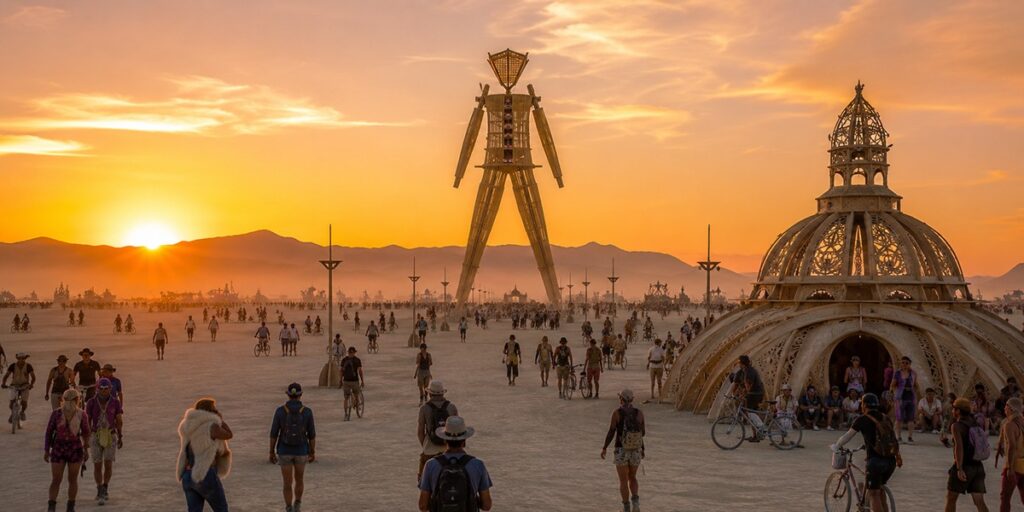
Burning Man 2026 runs from Sunday 30 August to Monday 7 September, in the Black Rock Desert near Gerlach, Nevada about 100 miles north of Reno.
Those dates aren’t chosen fresh each year. Burning Man always ends on Labor Day, with the Man burning the Saturday night before and the Temple on the Sunday. Labor Day 2026 falls on 7 September, which makes this a nine-day event rather than the week most people assume a distinction that matters considerably when you’re booking return flights and haven’t budgeted time for teardown.
This year’s theme is Axis Mundi: the cosmic axis, the fixed point around which everything else turns. The Man stands at the centre of Black Rock City and the entire street grid radiates from him, so the theme is fairly literal in its architecture. The two headline structures are the Temple of the Moon where people leave written tributes and mementos before it burns on the final night and the Man Pavilion, Cryptomeria.
The setting is deliberately unforgiving. The playa is a flat, alkaline dry lakebed with no shade and no water. Daytime highs run 38–40°C (100–105°F) before dropping to around 4°C (40°F) overnight, which catches people out far more often than the heat does. Whiteout dust storms arrive without warning and can erase visibility in seconds. It’s genuinely hard, and that difficulty is not incidental to why people return.
Most people build a wider American trip around this our USA travel guide covers the rest of the itinerary.
Tickets: Where Things Stand Right Now
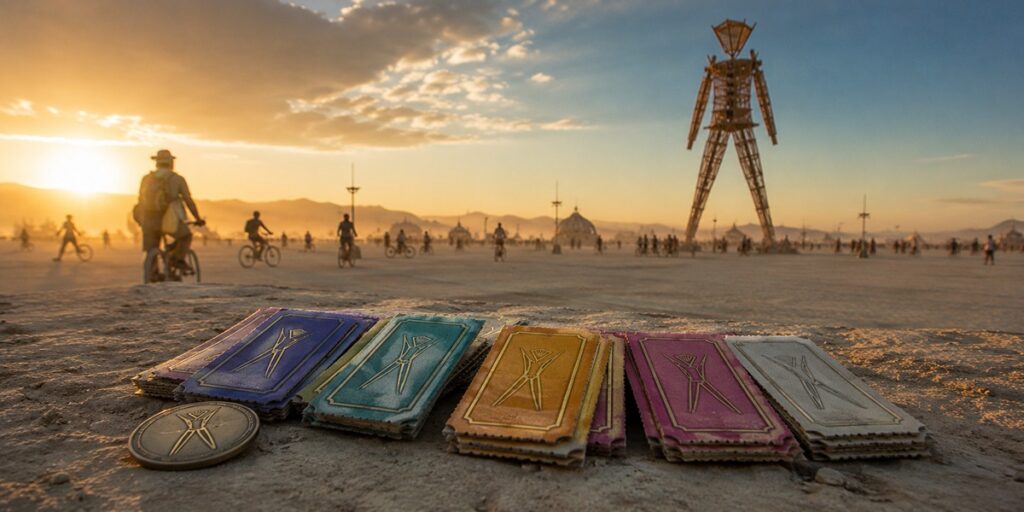
There’s no single on-sale date for Burning Man. Tickets are released across several separate sales through the year, each with its own registration window that closes before the sale itself opens and understanding that structure is, quite literally, the difference between going and not going.
Where 2026 stands as of July:
| Sale | When | Price Range | Status |
| Sunrise Sale | 4 February 2026 | $675 – $3,000 | Closed |
| Stewards Sale | 4 March – 20 April 2026 | $550 – $3,000 | Closed |
| Main Sale | 29 April 2026 | $550 – $3,000 | Closed |
| Ticket Aid | Application-based | $250 | Check availability |
| OMG Sale | 29 July 2026 | All tiers | Final public sale |
Official tiers run $550, $675, $775, $975, $1,500 and $3,000, with $775 representing the genuine cost per participant. Worth correcting a misconception plenty of guides repeat: the OMG Sale is not a scramble over leftover expensive tickets. Burning Man states that because of purchases in the earlier sales, tickets in all price tiers will be available in this one.
Nothing happens without a Burner Profile. Create one free at profiles.burningman.org and complete every field a partially filled profile doesn’t count as complete, and people discover this on sale day. Then register separately for the sale. That registration window opens weeks ahead and shuts before the sale begins, so missing it locks you out entirely, no matter how quickly you refresh in the morning. Registering also isn’t first-come-first-served and doesn’t guarantee you anything.
Two more details that catch people. Each profile is capped at two tickets and one vehicle pass order. And driving onto the playa requires a separate vehicle pass at $165 not bundled, not optional, and forgotten by first-timers with impressive regularity.
Every ticket grants identical access. No VIP, no priority entry, no better camp placement. The tiers exist purely because of the gifting principle: people who can pay more subsidise those who can’t.
Getting There
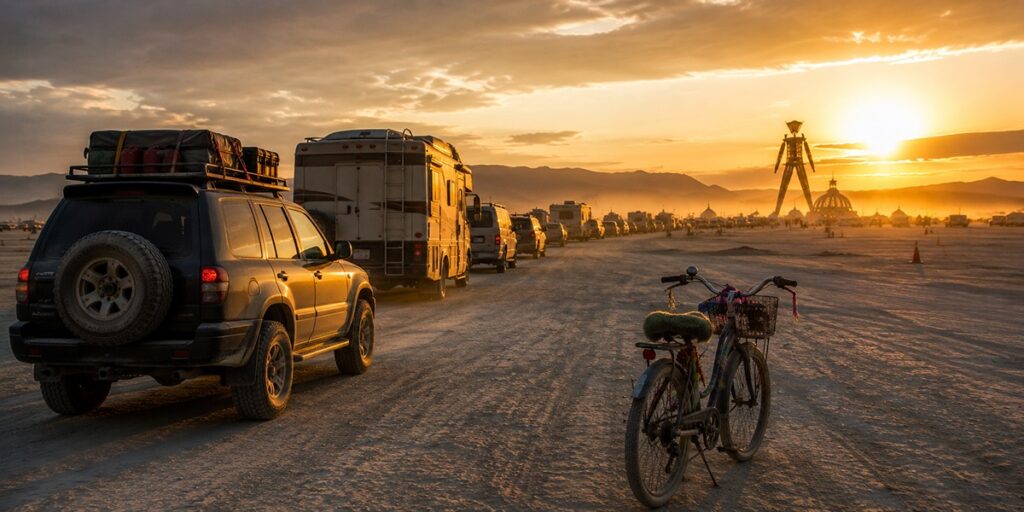
Black Rock City is remote in a way that catches out people who’ve read about the art but not the drive, and this is the part most guides skip entirely.
Most attendees drive. It’s roughly 120 miles from Reno, about three hours in clear conditions but budget far more than that, because gate queues on peak arrival days routinely run for hours. Reno and Fernley are your final opportunities to buy food, water and fuel. After Fernley there is nothing you’d call a shop.
If you’re flying in, the Burner Express Bus is the least stressful route by a distance. It runs round trips from San Francisco and Reno straight into Black Rock City, carries your bike and gear, sidesteps the vehicle-pass requirement and skips the worst of the gate. Flying itself means Reno-Tahoe International for almost everyone, though some route through San Francisco or Sacramento and drive up. Private aircraft can land at the temporary Black Rock City Airport, which is precisely as niche as it sounds.
International arrivals have one extra thing to settle before the flight, and it’s easier done at home than at a Reno rental desk: check your phone will actually take a travel eSIM.
Our eSIM compatible devices list has the model-by-model detail, and it takes about ten seconds to confirm.
RV rental is popular and sells out early. The budget for the post-event cleaning too alkali dust gets everywhere and rental companies charge accordingly. Whatever you’re driving, prepare it properly: spare tyres, extra fuel, emergency supplies, and the acceptance that it will need a serious wash afterwards.
One thing nobody should arrive without: a bicycle. Black Rock City is far too large to cross on foot and a bike is simply how everyone moves. Fit lights for night visibility, and make it identifiable somehow you’ll be finding it in a rack of two thousand others, in the dark, probably tired.
What Happens at Burning Man
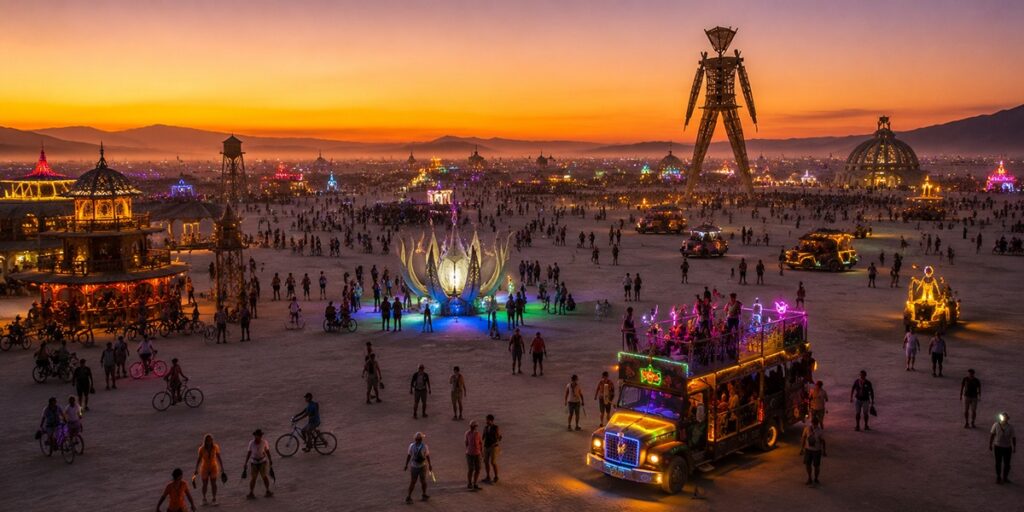
The hardest question to answer, but here’s a genuine attempt.
Days are for exploring. Black Rock City is a semicircular grid of named streets and hundreds of theme camps, every one built and run by attendees. One might be serving free pancakes at 7am. Another might be a fully functioning spa, or an installation you walk through and emerge from slightly rearranged. Center Camp, at 6:00 and Esplanade, functions as a gallery, open stage and general social anchor and unlike almost everything else out there, it doesn’t burn.
The art is world class, and that’s not hyperbole. Large scale sculpture, interactive installations and fire pieces spread across the open playa, much of it built specifically to be destroyed. The Man burns Saturday night in a genuinely communal celebration. The Temple burns quietly on Sunday, and the contrast between the two is the whole event in miniature. People leave tributes to those they’ve lost. It’s silent. Ask returning attendees what stayed with them and many of them name the Temple, not the Man.
After dark it becomes something else entirely. Mutant vehicles, cars and trucks rebuilt into roving art pieces with serious sound systems move through the city hosting parties that materialise and dissolve. Well known artists do occasionally play, always unannounced and never on a bill.
What to Wear and What’s Banned
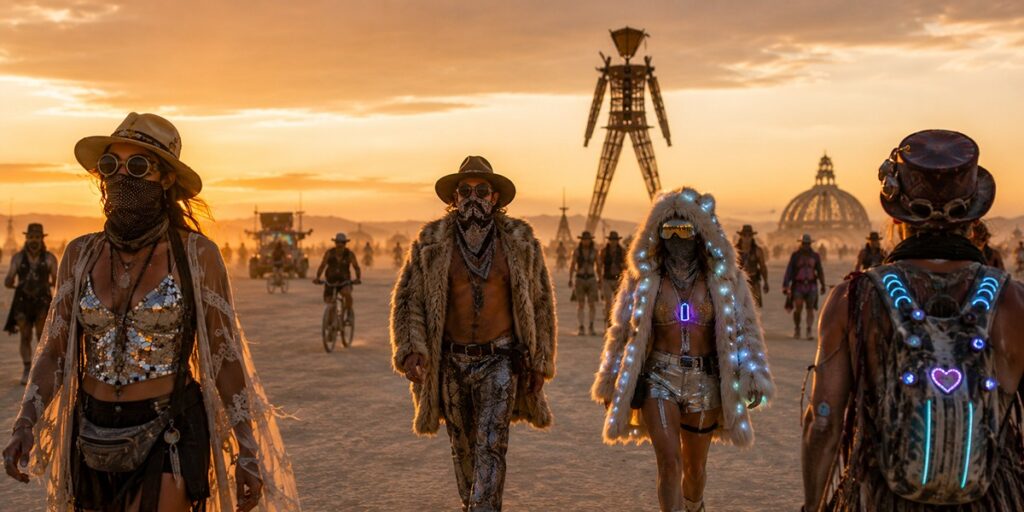
Normal clothing doesn’t function here. What you wear is a safety decision before it’s a creative one.
Daytime priorities are sun, dust and heat loose breathable fabrics in light colours, a wide-brim hat, UV-protective goggles, a proper dust mask or respirator, and closed-toe shoes or boots. Footwear matters more than people anticipate; the playa surface is rough, hot, and unkind to anything flimsy.
At night the temperature drops fast and the emphasis shifts. Faux fur, capes, heavy layers, LED lights and EL wire, and whatever elaborate thing you’ve been assembling since February.
And now the rule that catches nearly everyone. Glitter, sequins and loose feathers are effectively banned. They’re textbook MOOP Matter Out Of Place and Leave No Trace isn’t aspirational language here, it’s the operating condition of the whole event. Anything that sheds becomes someone else’s cleanup and stays in the desert long after you’ve gone home. Build costumes that hold together.
Read the full prohibited list before you pack, but the headlines are: no firearms or weapons, no fireworks, no high-powered laser pointers, no glass containers, no pets, no drones without permission, no single-use plastics.
Last thing on clothing everything you bring will end up coated in fine white alkali dust that never entirely comes out. Don’t pack anything you’d be sad to lose.
Preparing for a Week on the Playa
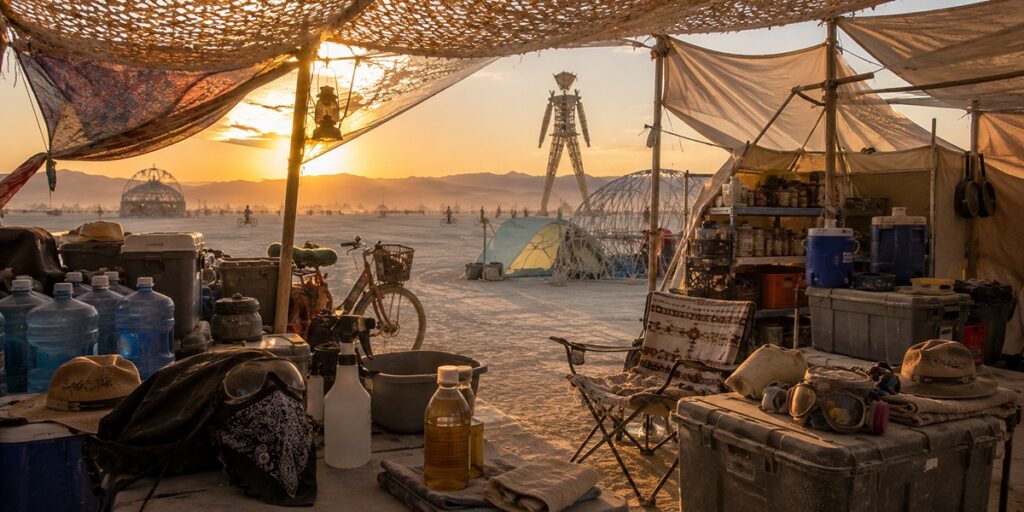
First-timers underestimate this consistently, and the ones who cope best are the ones who over-prepared.
- Water is non-negotiable: at least 1.5 gallons per person per day, covering drinking and washing. More if you’re running a camp.
- Food works the same way everything you eat, you carry in and carry out. There are no vendors beyond a coffee camp and an ice distributor, and that’s decommodification working as designed rather than an oversight.
- Shade isn’t a luxury. The sun is relentless from 9am to 5pm and a shaded camp structure is the difference between functioning and hiding in a tent.
- Dust protection means covering everything: electronics, food, clothes, your face. A vinegar and water solution, roughly one part vinegar to three parts water, neutralises playa dust on skin. That’s the sort of tip that only ever comes from people who’ve actually been.
- Leave No Trace applies to every scrap, food waste included.
And if a whiteout hits, get to shelter immediately and use the goggles and mask you packed. Too far from cover? Sit down, turn your back to the wind, wait. In a vehicle, stop and stay stopped visibility can vanish in seconds, and driving blind is how people get hurt out there.
Anything requiring an internet connection belongs on this list too, done at home rather than in a queue. Installing a travel data plan is a five-minute job on your own wifi and an unpleasant one on airport Wifi. How to install an eSIM walkthrough covers it, including what to do when a QR code refuses to scan.
Most first-timers find day one overwhelming and the last day transformative. Leave yourself room to adjust rather than scheduling every hour.
Staying Connected in the Desert
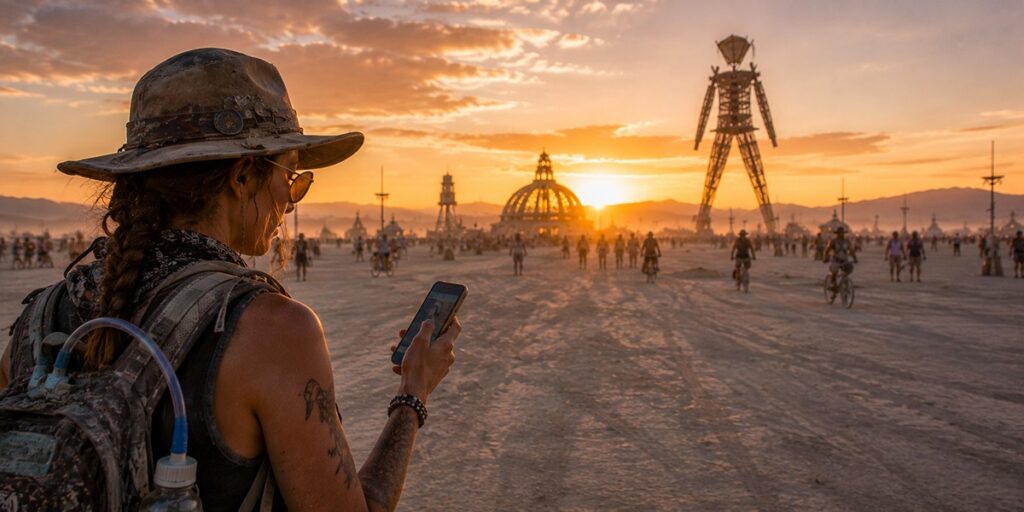
Let’s be straight, because this is the section where an eSIM company has an obvious incentive to oversell.
Connectivity on the playa is poor and nothing fixes that. The Black Rock Desert is one of the most remote places in the continental United States, carriers offer limited signal at the best of times, and it degrades further when 70,000 people converge on the same few cells. No eSIM changes physics. Plan on being offline for most of the event the overwhelming majority of attendees consider that the point rather than a problem.
Where data genuinely earns its keep is everything on either side:
- Reno, where most people land, buy supplies and make their last reliable calls.
- The drive in three hours through the country with thin, patchy coverage.
- The gate queue, which runs for hours and is exactly when you need to reach the people you’re meeting, and exactly when the signal starts thinning out.
- Agreeing a camp meet-up plan while you still have bars, because you won’t once you’re through the gate.
- Travel days out, when you’re back in Reno covered in dust and rebooking something.
An eSIM USA plan installed before departure means you’re connected the moment you land at Reno-Tahoe, rather than hunting for a SIM counter after a long-haul flight.
FAQs
1. When is Burning Man 2026?
30 August to 7 September 2026, in the Black Rock Desert near Gerlach, Nevada. The event always ends on Labor Day, with the Man burning the Saturday before and the Temple on Sunday.
2. Can I still get Burning Man tickets?
As of July, the OMG Sale is the last public sale late July into early August. Contrary to its reputation, all price tiers are available in it. You’ll need a completed Burner Profile and to register within the window before the sale opens.
3. What is the Burning Man ticket price for 2026?
Tiers run $550, $675, $775, $975, $1,500 and $3,000, with $775 representing the actual cost per participant. A vehicle pass costs $165 extra if you’re driving in. Low income Ticket Aid tickets were $250, but that application window has closed.
4. How do I buy Burning Man festival tickets?
Create a free Burner Profile at profiles.burningman.org, complete every field, then register separately for the sale. Registration closes before the sale opens and isn’t first-come-first-served. Buy only through burningman.org resale scams are common.
5. How do I get to Burning Man?
Most people drive: about 120 miles and three hours from Reno, plus a gate queue that can run for hours. The Burner Express Bus runs from San Francisco and Reno. Flying means Reno-Tahoe International for almost everyone.
6. What should I wear to Burning Man?
Daytime: light breathable layers, wide-brim hat, goggles, dust mask, closed-toe boots. Night: heavy layers, faux fur, lights. Avoid anything that sheds glitter, sequins and loose feathers count as MOOP and breach Leave No Trace.
7. What’s banned at Burning Man?
Firearms, fireworks, high-powered laser pointers, glass containers, pets, drones without permission, single-use plastics, and anything that sheds and becomes MOOP.
8. Do I need a bike at Burning Man?
Yes. Black Rock City is too large to cross on foot. Bring one with lights, and make it identifiable.
9. Is there a phone signal at Burning Man?
Barely. Coverage on the playa is limited and worsens as tens of thousands arrive. Sort your connectivity for the travel days either side and plan to be offline during the event. Comparing esim data plans by size before you fly is the simplest way to handle it.
10. What makes Burning Man different from other festivals?
No headliners, no sponsors, no vendors beyond ice and coffee. Everyone attending participates rather than watches, and the whole thing runs on gifting, self-reliance and leaving no trace.
Ready for Burning Man 2026?
Six weeks out, the order of operations is straightforward. Set up a Burner Profile and register for the OMG Sale it’s the only public sale left, and the registration window closes before the sale opens. Then sort your vehicle pass or Burner Express booking. Then your camp. Then water, shade and dust. Costumes come last, however tempting it is to start there.
And sort your data before you fly rather than after you land. Install an eSIM USA plan at home and you’ll be connected the moment you reach Reno which is, for practical purposes, the last place you’ll properly have a signal for a while.
The dust gets into everything and never quite leaves. The art will stop you where you stand. And somewhere in those nine days you’ll understand why people keep going back.
Leave a Reply