The top 10 waterfalls in the world, explained simply — how big they are, when they roar loudest, how to reach them, and how to stay connected while you’re standing in the mist.
Try to picture water falling for 979 metres. It’s genuinely hard to hold in your head that’s nearly a full kilometre, and it’s Angel Falls. Now picture the Zambezi River, 1,708 metres wide, tipping off a cliff all at once: that’s Victoria Falls, and the mist it kicks up can be seen 20 kilometres away. Some places you don’t read about. You go and stand in front of them.
What follows is our list of the top 10 waterfalls in the world, and for each one you’ll get the details that actually shape a trip how big it is, the best months to catch it at full roar, how to reach it, and how to stay online once you’re out there. Because here’s the thing most of these giants have in common: they sit nowhere near a city. That’s half their appeal. It’s also exactly why your phone plan is worth a moment’s thought before you leave home.
A World of Waterfall Wonders
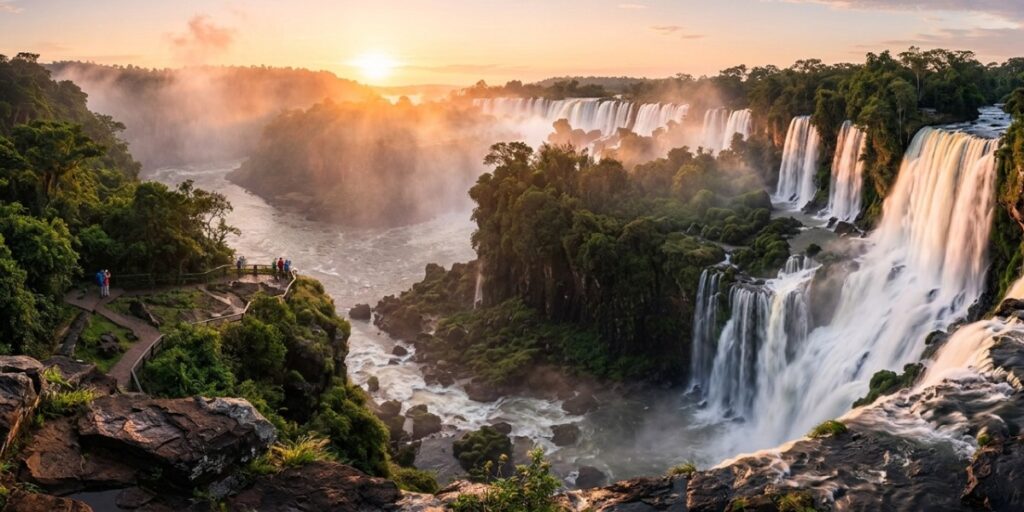
Strip it back and a waterfall is a simple thing: a river meets a cliff, gravity handles the rest. Yet the results get dramatic enough that two of the falls on this list carry official “wonder” titles. Victoria Falls sits among the Seven Natural Wonders of the World. Iguazu earned its place in the New7Wonders of Nature after a global vote that drew hundreds of millions of ballots. Whenever the conversation turns to the natural wonders of the world, waterfalls come up fast — and by the end of these ten, you’ll see why.
The Top 10 Waterfalls at a Glance
| # | Waterfall | Where | Claim to fame | Best months |
| 1 | Angel Falls | Venezuela | World’s tallest waterfall (979 m) | Jun–Nov |
| 2 | Iguazu Falls | Argentina / Brazil | ~275 falls across nearly 3 km | Year-round; fullest Dec–Mar |
| 3 | Victoria Falls | Zambia / Zimbabwe | Largest sheet of falling water (1,708 m wide) | Feb–May |
| 4 | Niagara Falls | Canada / USA | Highest flow volume in North America | Jun–Aug |
| 5 | Kaieteur Falls | Guyana | Giant single drop (226 m) in pristine rainforest | Year-round |
| 6 | Yosemite Falls | USA | North America’s tallest (739 m) | Apr–Jun |
| 7 | Gullfoss | Iceland | Two-tier “Golden Falls” of the Golden Circle | Jun–Aug |
| 8 | Plitvice Waterfalls | Croatia | 16 lakes linked by 90+ falls, UNESCO-listed | Apr–Jun, Sep |
| 9 | Dettifoss | Iceland | Europe’s most powerful waterfall | Jun–Sep |
| 10 | Jog Falls | India | India’s second-highest plunge (253 m) | Jul–Sep |
Our Top 10 Must-See Waterfalls
Pick any of these ten and your next trip more or less plans itself. Here they are, one by one.
1. Angel Falls — Canaima National Park, Venezuela
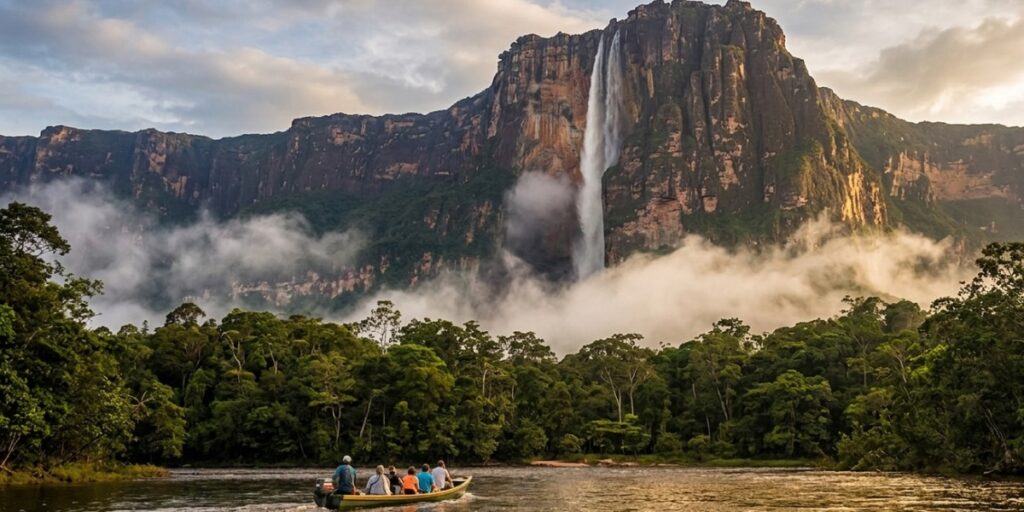
Let’s start with the big one the tallest waterfall on Earth. Angel Falls pours 979 metres off Auyán-tepui, a flat-topped mountain that rears out of the Venezuelan rainforest like an island in the sky. The drop is so long that much of the water never actually lands; it turns to mist somewhere on the way down. And here’s the strange part: there’s no great river feeding it. Just rain and cloud wrung out on the summit. That’s the entire engine.
There are no roads to Angel Falls. None at all. You fly from Caracas to a camp called Canaima, take a motorised canoe upriver, and walk a short jungle trail to the viewpoint or book a flyover and watch the mist peel off the cliff from the air. Either way, getting there ends up being half the story you tell afterwards.
Plan your visit: Go June to November, when the rains keep the falls full and the rivers deep enough for canoes. In the dry season it can thin to a ribbon and the boat trips often stop. Fly Caracas → Canaima, then join a guided river-and-trek trip.
2. Iguazu Falls — Border of Argentina & Brazil
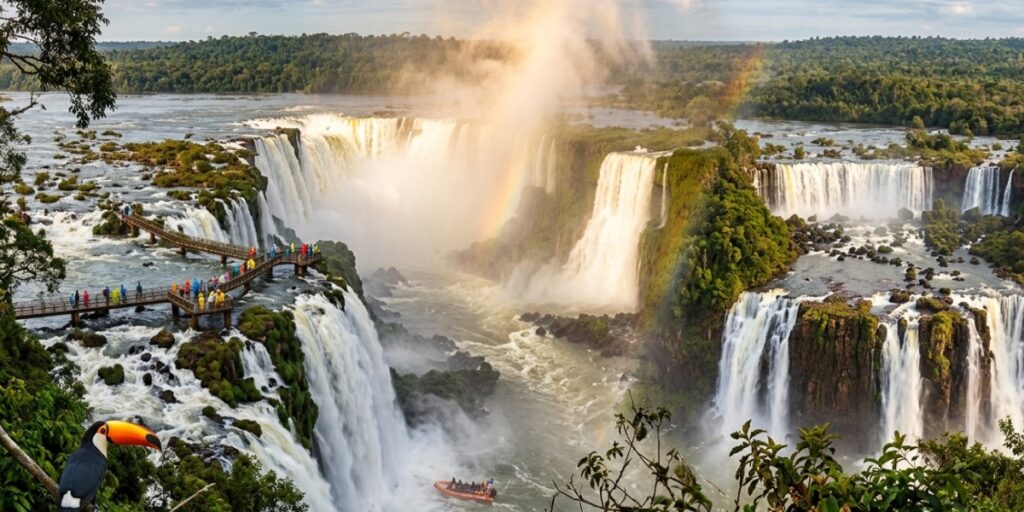
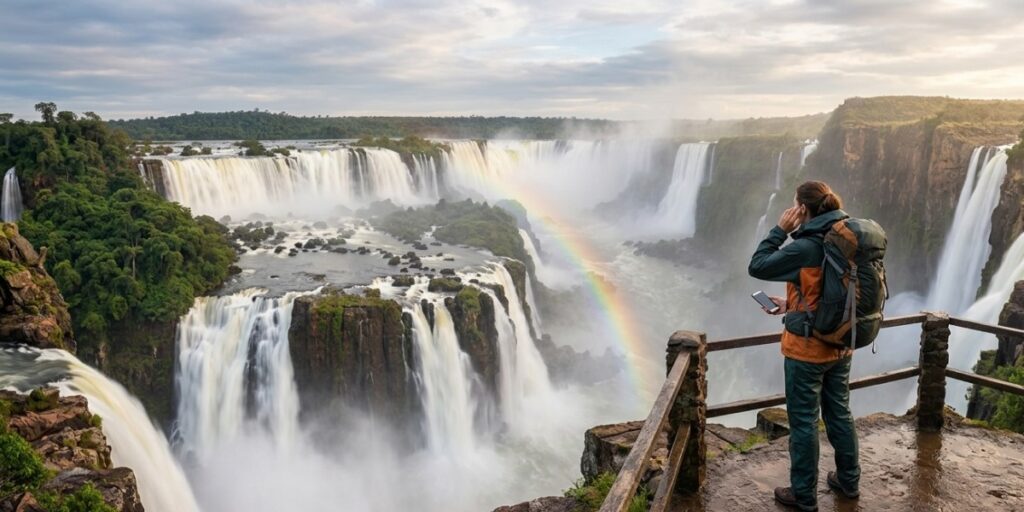
Iguazu isn’t one waterfall it’s somewhere around 275 of them, strung across nearly 3 kilometres of jungle on the Argentina–Brazil border. The showpiece is a vast horseshoe gap called the Devil’s Throat, where the river simply drops out of sight. It stands taller than Niagara and more than twice as wide, and the surrounding parks are UNESCO-listed rainforest, so expect toucans overhead and coatis casing your snacks. Don’t feed them. Seriously.
Do both sides if you possibly can. Brazil hands you the sweeping postcard panorama; Argentina puts you on metal catwalks right over the water, close enough to get wet. Two days covers it comfortably. And take one of the boat rides that motor straight into the spray you’ll get soaked, and you’ll love every second.
Plan your visit: Impressive year-round. The water peaks December to March after the rains, but that’s also the hottest, most crowded window April–May is the sweet spot. Fly into Puerto Iguazú (Argentina) or Foz do Iguaçu (Brazil); the parks are minutes from either town.
3. Victoria Falls — On the Zambezi River, between Zambia & Zimbabwe
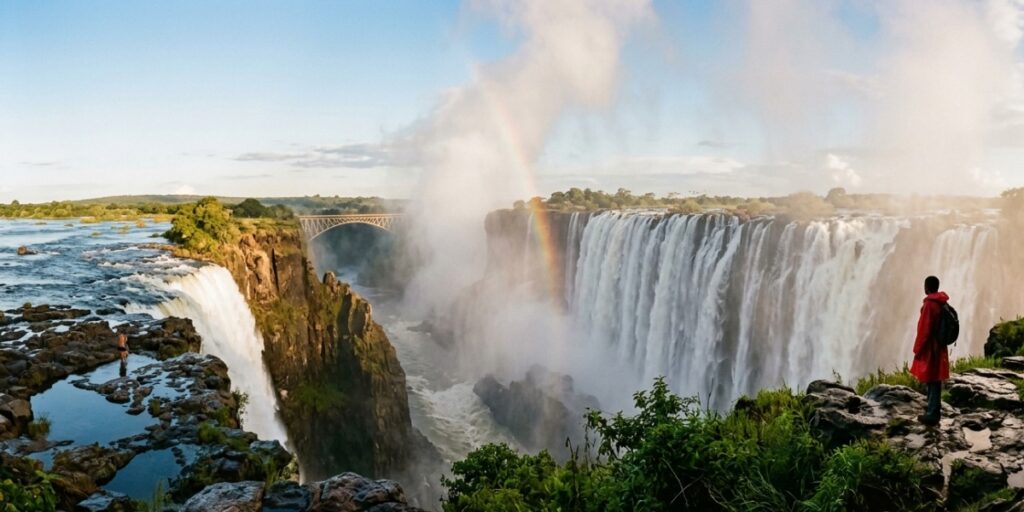
The local name gets it exactly right: Mosi-oa-Tunya The Smoke That Thunders. Victoria Falls is the largest sheet of falling water on the planet a single curtain, 1,708 metres wide and 108 metres tall, dropping into a narrow gorge on the Zambia–Zimbabwe border. It’s both a Seven Natural Wonder and a UNESCO World Heritage Site, and at peak flow the spray climbs so high it drifts over the town like its own weather system.
Timing is everything here. February to May, straight after the rains, it runs full pack a raincoat, because that “mist” is closer to a shower. Later in the year the water eases off and the bare rock face shows through. And from roughly August to December, over on the Zambia side, you can swim in Devil’s Pool, a natural rock basin perched right on the lip of the falls. Yes the actual lip.
Plan your visit: February–May for the thunder, August–December for clearer views and Devil’s Pool. Fly into Livingstone (Zambia) or Victoria Falls town (Zimbabwe); both sit practically at the gate, and you can walk the border bridge to take in both sides.
4. Niagara Falls — Border of Ontario, Canada & New York, USA
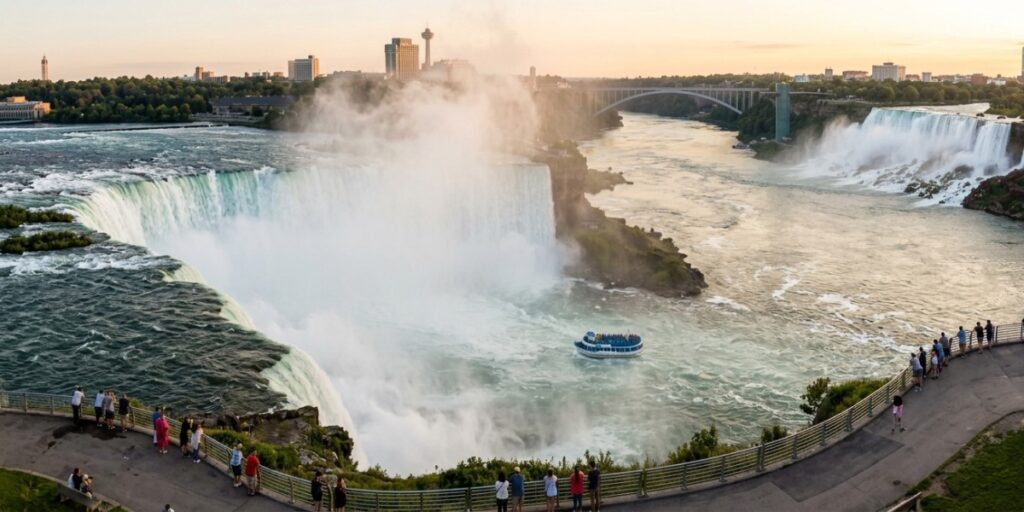
Niagara is really three falls shoulder to shoulder: Horseshoe, American, and Bridal Veil. It isn’t the tallest on this list not remotely but nothing in North America moves more water, and standing at the railing on the Canadian side, you feel it in your chest a beat before you properly hear it.
It’s also the easiest giant here to reach, and there’s no shame in that. Drive about 90 minutes from Toronto, or fly into Buffalo. Take the boat down to the base and get drenched, walk the tunnels behind the falls on the Canadian side, then hang around for the coloured lights after dark and, in summer, the fireworks.
Plan your visit: June–August for warm weather with everything open. Winter freezes the edges into ice sculpture a different show entirely. The Canadian side holds the panoramic views.
5. Kaieteur Falls — Kaieteur National Park, Guyana
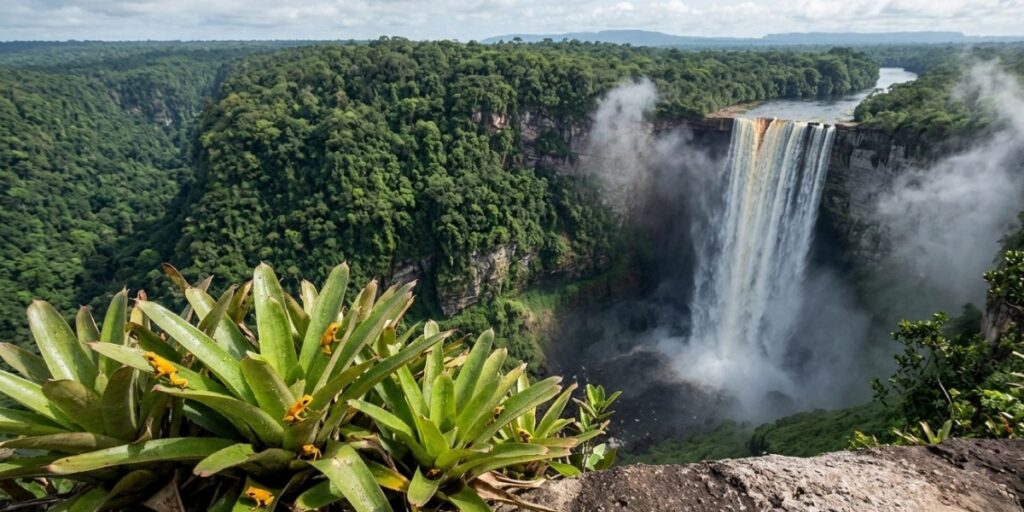
This next one sounds invented, but it holds up: more people visit Niagara in a single day than reach Kaieteur in an entire year. And yet Kaieteur is one of the most powerful single-drop waterfalls anywhere on Earth. The Potaro River falls 226 metres in one clean plunge roughly four times Niagara’s height into rainforest that still looks the way rainforest is meant to. Stand at the viewpoints and you can feel the ground hum underfoot.
No railings. No crowds. No souvenir stalls. Just the roar, the mist, and if you peer into the giant bromeliads near the top tiny golden rocket frogs that live nowhere else on the planet.
Plan your visit: It flows year-round and swells hard after the rains (roughly May–June and December–January). Most people fly in on a small-plane day trip from Georgetown; the plane sets down a short walk from the falls. Comfortably one of South America’s most underrated adventures.
6. Yosemite Falls — Yosemite National Park, California, USA
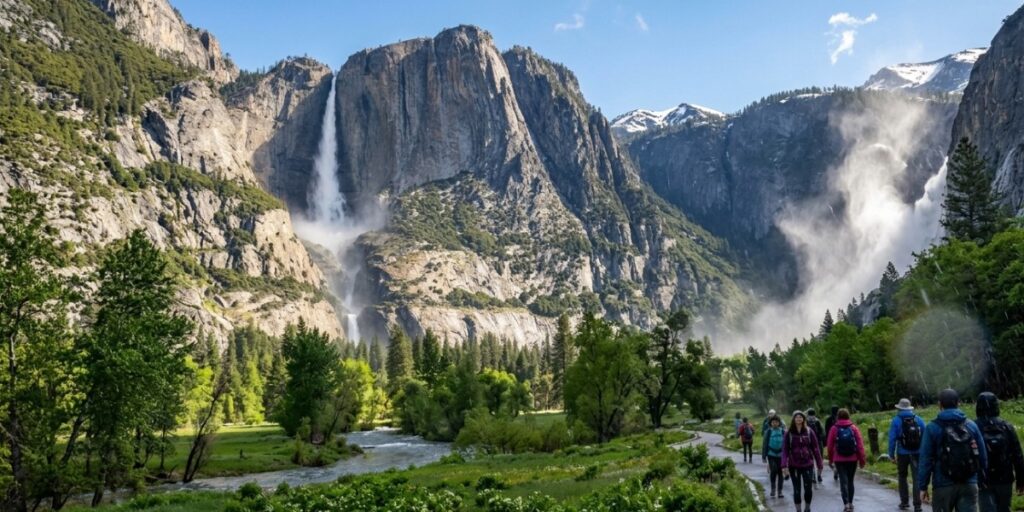
739 metres, three tiers, straight down the granite wall of Yosemite Valley. That makes it the tallest waterfall in North America and, of everything here, the pick for hikers. The flat loop to the base takes twenty minutes and puts spray on your face; the trail to the top eats half a day and burns your legs the whole way up. The view at the summit squares the account.
Here’s the bit most lists skip over: this waterfall runs on a season. It’s fed by melting snow. April to June, it’s at full blast; by late August it can slow to a trickle or shut off entirely until the rains come back. Every year, people turn up in September and find themselves staring at a damp streak on a cliff. Don’t be one of them go in spring.
Plan your visit: April–June, at peak snowmelt. About 4 hours’ drive from San Francisco. Check the park’s current entry-reservation rules before peak season.
7. Gullfoss (Golden Falls) — Hvítá River, Southwest Iceland
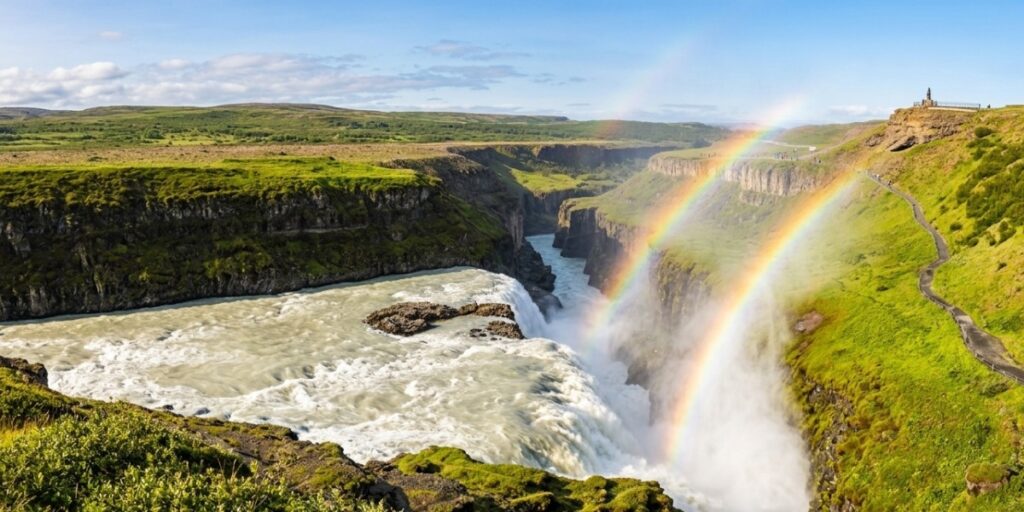
Gullfoss is odd in the best possible way. The glacial Hvítá river drops in two steps set at right angles to one another, then plunges into a canyon so abruptly that, from the upper path, the river seems to just swallow itself into the ground. On a clear day, rainbows sit in the spray. Golden Falls the name earns itself.
There’s a fine human story tucked in here, too. In the early 1900s, investors wanted to dam Gullfoss for electricity. A farmer’s daughter, Sigríður Tómasdóttir, fought them for years, and Icelanders now remember her as one of the country’s first environmentalists. Her memorial stands above the falls she helped save.
Plan your visit: June–August is the easy season, with long daylight hours; winter sheathes the canyon in ice and is stunning in a wholly different register. It’s 90 minutes from Reykjavík on the Golden Circle route, alongside Geysir and Þingvellir. Entry is free.
8. Plitvice Waterfalls — Plitvice Lakes National Park, Croatia
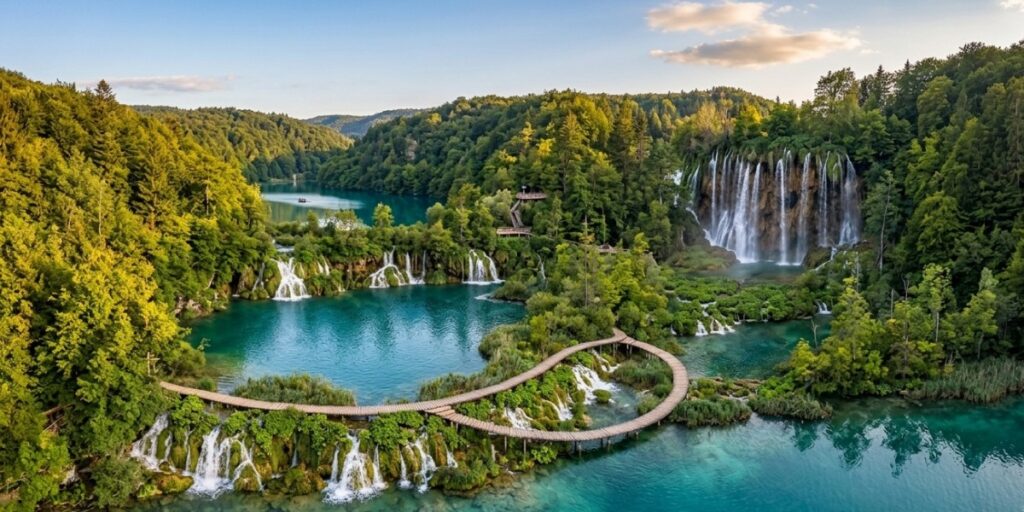
Plitvice is less a single waterfall than a whole valley made of water: sixteen turquoise lakes stepping down through the forest, laced together by more than 90 falls. The largest, Veliki Slap, is Croatia’s tallest at 78 metres. Wooden boardwalks carry you over and around the water for most of the route, and the park has held UNESCO status since 1979.
Of everything on this list, this is the one for travelling slowly. The trails are well signposted, the electric boats and panoramic trains come bundled with your ticket, and there are cafés at the entrances. Two hard-won tips: get in before 9 am, because the tour buses arrive mid-morning and those boardwalks are narrow; and leave the swimsuit at home swimming isn’t allowed.
Plan your visit: April–June for full spring flow, September for golden light and thinner crowds. Book timed tickets online in summer. About 2 hours from Zagreb by car or bus.
9. Dettifoss — Vatnajökull National Park, Iceland
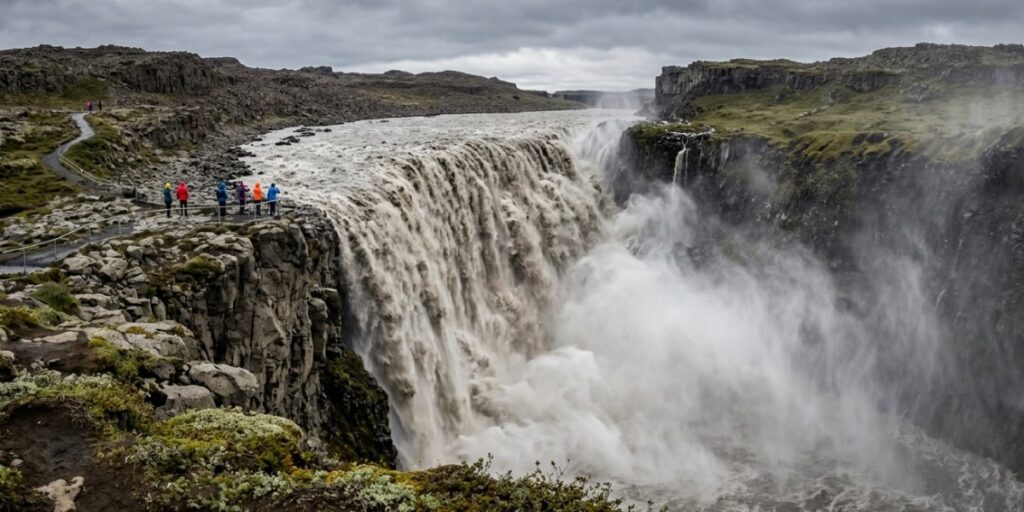
You feel Dettifoss before you properly see it the ground genuinely trembles at the viewpoints. This is Europe’s most powerful waterfall: a grey wall of glacial meltwater about 100 metres wide, hurling itself 44 metres into the Jökulsárgljúfur canyon at an average of nearly 200 cubic metres a second. If it looks familiar, there’s a reason it opens the film Prometheus.
Hikers get a three-for-one here. The same river holds Selfoss just upstream and Hafragilsfoss just downstream, so a single walk delivers three major waterfalls along what Icelanders call their answer to the Grand Canyon.
Plan your visit: June–September, when the access roads are reliably open. Take the paved Route 862 on the west side that’s the easy way in. Dettifoss sits on the Diamond Circle in North Iceland, about 45 minutes from Lake Mývatn.
10. Jog Falls — Sharavathi River, Karnataka, India
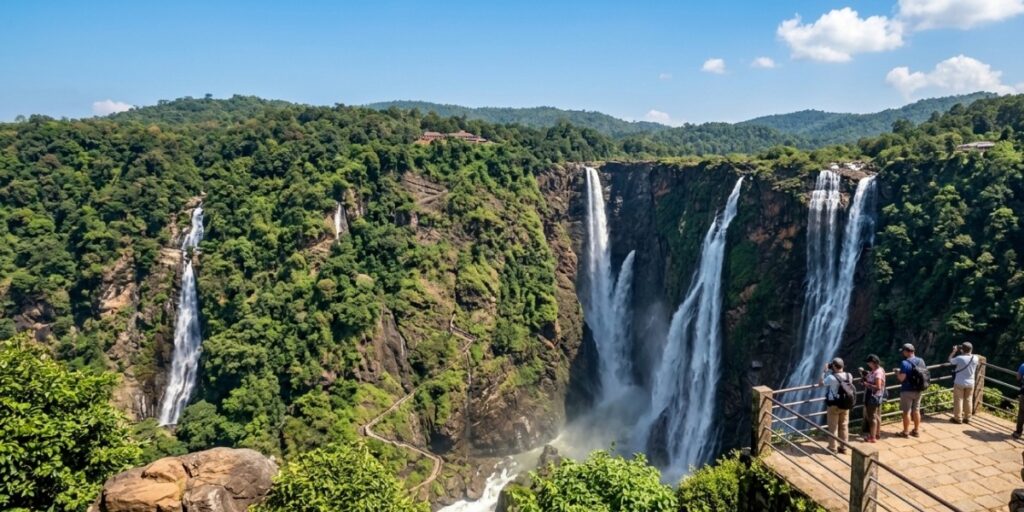
And finally, India. In the monsoon, the Sharavathi river flings itself 253 metres off the Western Ghats in four separate streams locals know each one by name: Raja, Rani, Rover, and Rocket. Together they make Jog the second-highest plunge waterfall in India, and at full July–September flood the four merge into a single white wall of noise you’ll hear long before the viewpoint comes into sight.
There are two good windows. Monsoon, for raw power and swirling mist. Or October–November, when the skies clear and you can watch all four streams doing their own thing. If your knees are willing, a long stairway drops to the base of the gorge every step down gets repaid on the climb back up. Worth it.
Plan your visit: July–September for peak flow, October–November for clear views. About 400 km from Bengaluru; the nearest town is Sagara, with the viewpoints a short drive from the entrance.
Staying Connected on the Road to the Falls
Look again at where these falls actually sit: a fly-in camp in Venezuela, a rainforest plateau in Guyana, a canyon in North Iceland, border country on the Zambezi. Chasing waterfalls pulls you a long way from cities which is the entire point and it also makes staying online genuinely awkward. Swapping SIM cards at each border. Hunting for Wi-Fi in the middle of a national park. Roaming bills that sting worse than the flight did.
A travel eSIM takes care of most of that. It’s a SIM already built into your phone: you load a data plan before you fly and land connected no shop, no queue, no fiddly plastic tray. And because a fair few of these trips straddle borders (Iguazu across Argentina and Brazil; Victoria Falls across Zambia and Zimbabwe), a regional or Global eSIM often covers a whole route on one plan. New to eSIMs? Here’s how to install one and a quick device compatibility check.
Three small habits earn their keep out here:
- Download offline maps before the signal goes deep inside these parks, even the locals drop off the grid.
- Waterproof your phone. Anywhere near the mist (Victoria and Iguazu will soak you), keep it zipped in a dry pouch.
- Screenshot your tickets in advance, because park gates don’t always have coverage.
Before You Go
Ten waterfalls, five continents, and not one of them lets you down in person. Choose your months with care most of these run on a season, and showing up in the wrong one is the difference between a wall of thunder and a damp streak on a cliff. Sort the route, download the maps, and get your data working before you clear the airport. Then, once you’re finally standing there, put the phone down for a minute and just listen. The photos can wait. You’ll take a few hundred regardless.
FAQs
1. What are the best waterfalls in the world?
Ask ten travellers and the same four names keep surfacing: Angel Falls (the tallest), Victoria Falls (the largest sheet of falling water), Iguazu (the widest system, around 275 separate falls), and Niagara (North America’s most powerful). Which one is “best” comes down to what you’re chasing height, power, beauty, or sheer ease of reaching it.
2. Where is the largest waterfall in the world?
It depends what you mean by largest. The tallest is Angel Falls in Venezuela, at 979 metres. The biggest single sheet of falling water is Victoria Falls 1,708 metres wide and 108 metres tall on the Zambia–Zimbabwe border.
3. When is the best time to visit these famous waterfalls?
Match the trip to the water source. Monsoon falls like Jog peak July–September. Snowmelt falls like Yosemite peak April–June. Victoria thunders hardest February May, after the rains. Iceland’s Gullfoss and Dettifoss are easiest to reach June September.
4. Which waterfalls are counted among the natural wonders of the world?
Victoria Falls is one of the traditional Seven Natural Wonders of the World, and Iguazu was voted into the New7Wonders of Nature. Both hold UNESCO World Heritage status too about as strong as “wonder” credentials get.
5. How do I stay connected while travelling to waterfalls in other countries?
A travel eSIM is the easiest way it connects to local networks the moment you land, with no SIM swapping at borders. Download offline maps before you enter remote parks, since even locals lose signal deep inside some of them.
6. Which is the most powerful waterfall in Europe?
Dettifoss, in North Iceland glacial meltwater over a 44-metre drop, with enough force to shake the ground at the viewpoints. It sits on the Diamond Circle route and is best visited June–September.
Leave a Reply