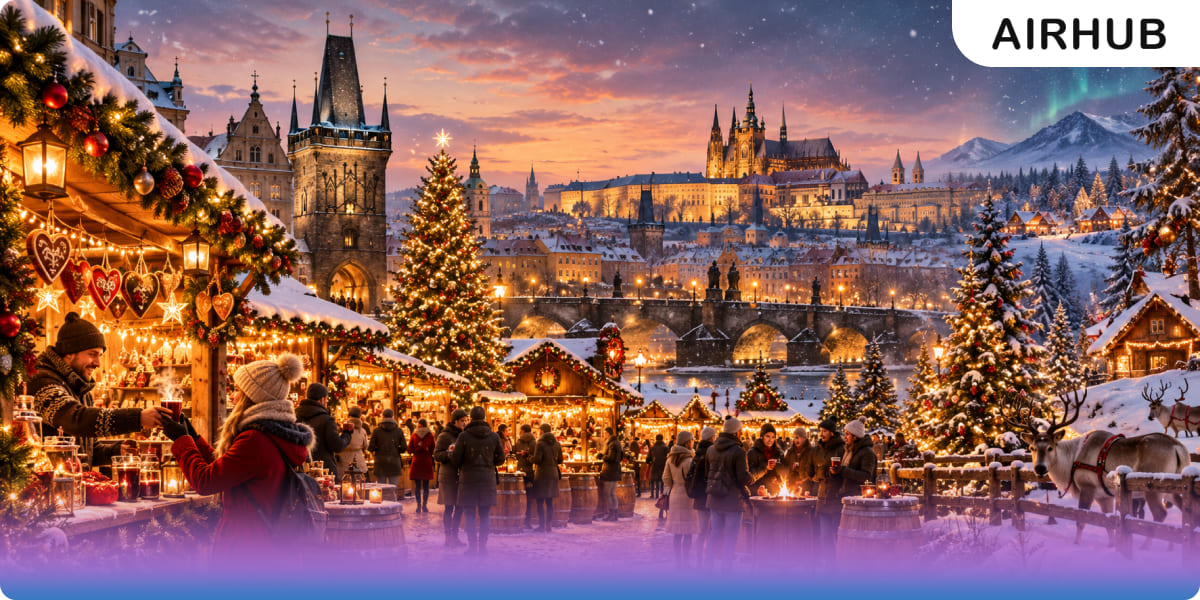
Most lists of Europe’s best Christmas destinations are really lists of Christmas markets. That’s fine if all you want is an evening of mulled wine and wooden stalls. But a Christmas trip usually lasts longer than one evening, and markets in much of Germany and France close on 23 or 24 December, just as many travellers arrive.
So this guide asks a different question: where in Europe is Christmas worth spending, not just visiting? The answer depends on what you want from the days around it, whether that’s a Mozart concert, a steaming thermal pool, a husky ride under the northern lights or a New Year street party.
Market dates for each place are in the table below. If markets are your main reason for travelling, our Christmas markets guide covers more than a dozen of them in detail.
Europe at Christmas: At a Glance
| Destination | Best for | Main market, 2026 | Festive season runs past Christmas? |
| Vienna, Austria | Concerts and imperial grandeur | Rathausplatz: 13 Nov – 26 Dec | Yes; Schönbrunn’s market runs to 6 Jan |
| Salzburg, Austria | Silent Night and Alpine scenery | Domplatz: 19 Nov – 1 Jan | Yes, to New Year’s Day |
| Budapest, Hungary | Thermal baths and value | St Stephen’s Basilica: 13 Nov – 1 Jan | Yes, to New Year’s Day |
| Prague, Czechia | Gothic old town and Czech traditions | Old Town Square: expected 28 Nov – 6 Jan | Yes, to Epiphany |
| Strasbourg and Colmar, France | Alsatian Christmas traditions | Strasbourg: not yet announced; Colmar: 23 Nov – 29 Dec | Colmar yes; Strasbourg usually closes 24 Dec |
| Copenhagen, Denmark | Families and hygge | Tivoli: 13 Nov – 3 Jan (closed 24 Dec) | Yes |
| Rovaniemi, Finland | Santa, snow and the aurora | Santa Claus Village open all year | Yes |
| Zermatt, Switzerland | A snow-sure Alpine Christmas | Ski season under way by mid-December | Yes, through the ski season |
| Edinburgh, UK | Christmas plus Hogmanay | 14 Nov – 3 Jan | Yes, into Hogmanay |
Opening hours on 24, 25 and 31 December are usually shorter, and some stalls close entirely on Christmas Day, so check before you plan a specific day around a market.
Prague, Czechia: Gothic Spires and Czech Traditions
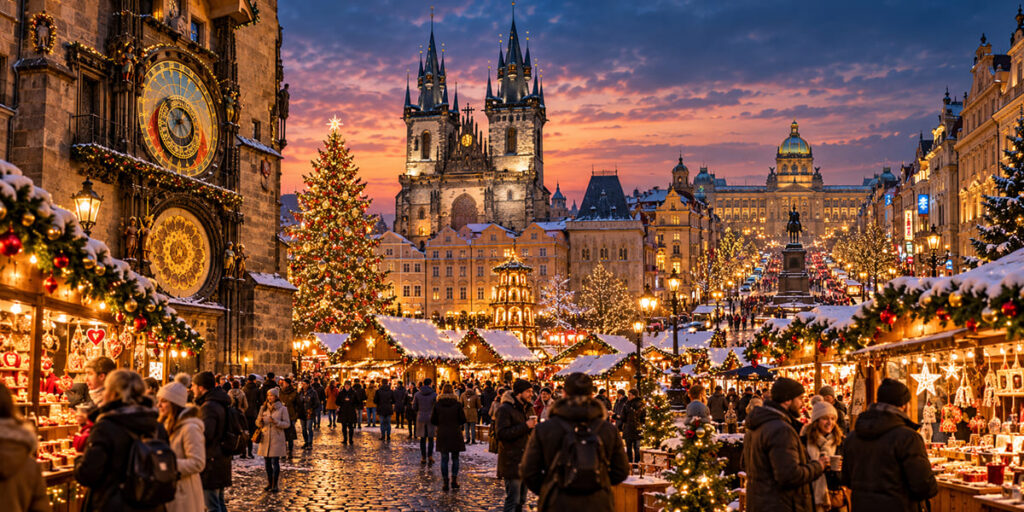
Prague’s skyline of spires looks as if it was built for December, and its two main markets, on Old Town Square and Wenceslas Square, are expected to run from 28 November 2026 to 6 January 2027. That long run is Prague’s great advantage: it’s one of the few big market cities still in full festive swing during Christmas week.
It’s also a good place to see a Christmas tradition that surprises most visitors. In the days before Christmas, stalls appear on street corners selling live carp from water tanks. Fried carp with potato salad is the traditional Czech Christmas Eve dinner, and Christmas Eve, not Christmas Day, is when the main celebration happens. Expect restaurants and shops to close early on 24 December.
Evenings are for music. Classical concerts are held in churches across the city through December, including St Nicholas in the Lesser Town, and few settings suit Bach and carols better.
Vienna, Austria: Christmas Set to Music
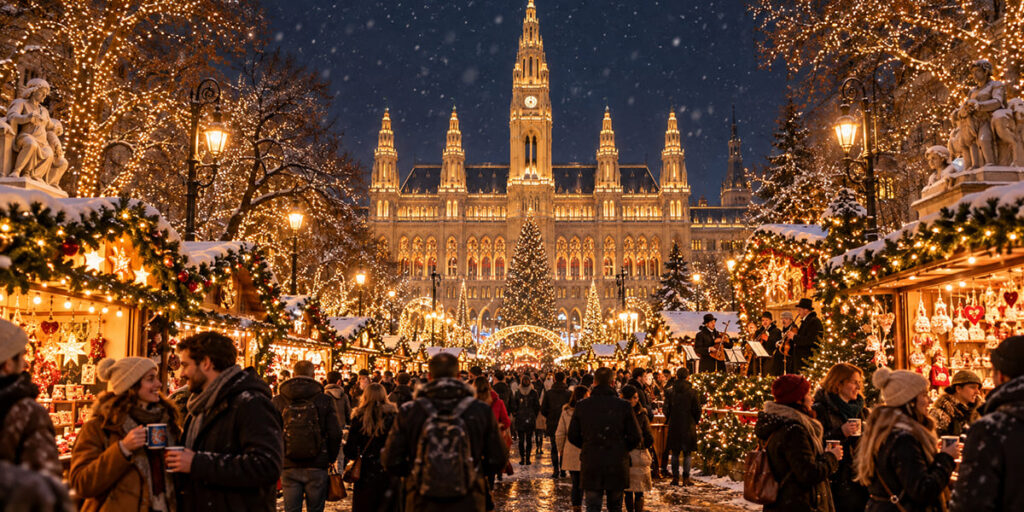
Vienna’s markets are excellent. The one on Rathausplatz, in front of the floodlit neo-Gothic City Hall, runs from 13 November to 26 December 2026, with an ice trail looping through the park behind it. But the real reason to spend Christmas in Vienna is what happens indoors.
Through Advent, churches and palaces host concerts of Mozart, Strauss, Bach and choral music almost every evening. On Sundays, the Vienna Boys’ Choir sings Mass at the Hofburg Chapel. And the season ends with a flourish: the Silvesterpfad, a New Year’s Eve trail of music and food stalls through the old town, followed on 1 January by the Vienna Philharmonic’s New Year’s Concert. Tickets for that are allocated by lottery months ahead, but the city’s cafés and big screens make it easy to share in.
In between, Vienna is a city for slowing down. An afternoon in a traditional coffeehouse with a Melange and a slice of Sachertorte is as much part of a Viennese Christmas as any market.
Good to know: Rathausplatz closes at 6.30pm on Christmas Eve. If you’re staying into early January, Schönbrunn Palace’s market runs until 6 January.
Salzburg, Austria: Where Silent Night Began
Salzburg has the setting most people imagine when they think of an Alpine Christmas: a baroque old town, a fortress on the hill and mountains behind. Its Christkindlmarkt on Domplatz and Residenzplatz traces its roots to 1491 and runs from 19 November 2026 to 1 January 2027.
What makes Salzburg special at Christmas, though, is a song. “Silent Night” was first performed on Christmas Eve 1818 in the village of Oberndorf, about 20 kilometres north of the city. A small memorial chapel now stands where the church was, and a short ceremony is held there every Christmas Eve. It’s an easy trip from Salzburg and, for many visitors, the emotional centre of the season.
For a very different mood, the Krampus run on 5 December (6.30pm) sends horned, fur-clad figures through the old town, a reminder that Alpine Christmas folklore has a darker side.
Good to know: Salzburg is about 2 hours 30 minutes from Vienna by train, so the two pair easily in a week.
Strasbourg and Colmar, France: An Alsatian Christmas
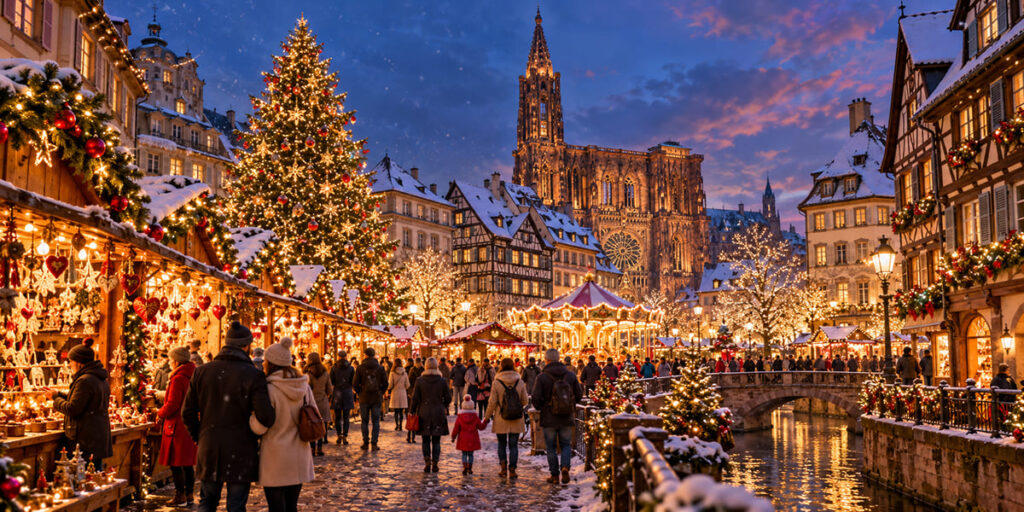
Alsace has a strong claim to being the home of Christmas in France. Strasbourg’s Christkindelsmärik has run since 1570, and today more than 300 chalets spread across the old town, with the towering Grand Sapin tree on Place Kléber and the cathedral lit up behind. The city hadn’t confirmed 2026 dates at the time of writing; last year’s market ran from 26 November to 24 December.
Colmar, 30 minutes away by train, is smaller and, many would say, prettier. Its canals and half-timbered houses are lit up, and the markets spread across several squares, including a children’s market in the Petite Venise quarter. It runs from 23 November to 29 December 2026, later than Strasbourg.
What makes Alsace worth more than a day trip is the region around them. The wine villages along the Route des Vins, such as Riquewihr and Kaysersberg, decorate their streets for Advent and are easy to reach from Colmar. And the food is distinctly Alsatian: bredele biscuits, pain d’épices (spiced bread) and white vin chaud made with local wine.
Book early. Colmar in particular has limited rooms, and December weekends sell out months ahead.
Copenhagen, Denmark: Hygge and Tivoli
Copenhagen is the strongest choice in Europe for a Christmas trip with children. Tivoli Gardens, one of the world’s oldest amusement parks, reopens for Christmas from 13 November 2026 to 3 January 2027, with rides, Santa’s house, ice skating and thousands of lights. It’s ticketed and closed on 24 December.
Beyond Tivoli, Copenhagen is the place to understand hygge, the Danish idea of cosiness: candlelit cafés, warm drinks and long evenings indoors. December is also the season of julefrokost, long Christmas lunches with herring, roast pork and aquavit that many restaurants offer to visitors too.
Danes celebrate on the evening of 24 December, often joining hands to dance around the tree. Shops and many restaurants close from Christmas Eve until 26 December, so plan your meals ahead.
Rovaniemi, Finland: Santa and the Northern Lights
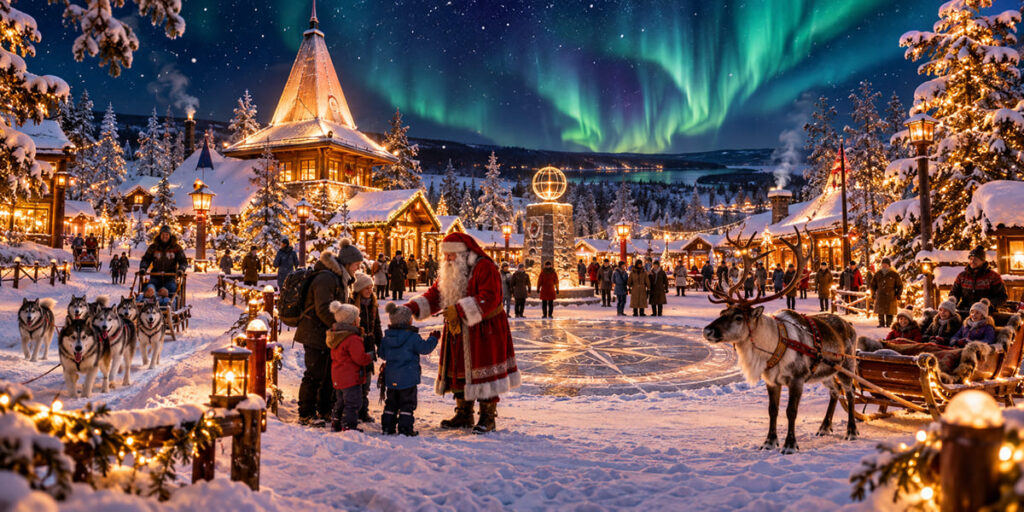
If the point of the trip is Santa, there’s really only one answer. Rovaniemi sits on the Arctic Circle in Finnish Lapland and promotes itself as Santa Claus’s official hometown. Santa Claus Village is open all year and free to enter, so children can meet Santa, post a letter at his post office and step across the painted Arctic Circle line in a single visit.
The rest of the trip belongs to the Arctic. Husky and reindeer safaris, snowmobiling and nights in glass-roofed cabins are the classic activities, and clear nights bring a genuine chance of the northern lights. Snow is close to guaranteed.
Go prepared, though. Around the solstice, daylight shrinks to a few hours of soft twilight and temperatures sit well below freezing, often around −10°C or colder. Most tour operators rent thermal outer layers, and it’s worth taking them up on it. Christmas week is the busiest and most expensive time of year here, so book flights and accommodation as early as you can.
Zermatt, Switzerland: A Snow-Sure Alpine Christmas
Snow at Christmas is far from guaranteed in Europe’s cities. Vienna and Prague see a white Christmas only some years. If snow matters, you need altitude, and Zermatt has plenty of it.
The village sits at about 1,600 metres with the Matterhorn rising directly above it. There are no private cars, only electric taxis and the occasional horse-drawn sleigh, so even a full village stays quiet. The ski season is normally well under way by Christmas, and if you don’t ski, the Gornergrat railway climbs above 3,000 metres to one of the finest viewpoints in the Alps.
Zermatt is expensive, even by Swiss standards, and Christmas week books up early. Switzerland also sits outside the EU, which matters for prices and for phone roaming.
Edinburgh, UK: Christmas Rolling Into Hogmanay
Edinburgh is the pick for anyone who wants Christmas and New Year in the same trip. Edinburgh’s Christmas runs from 14 November 2026 to 3 January 2027, with the main market in East Princes Street Gardens, below the castle, and an ice rink on George Street.
The real draw is what follows. Hogmanay, Scotland’s New Year celebration, is one of the biggest in the world. The Torchlight Procession winds through the city on 29 December, and the Street Party fills the centre on 31 December. Tickets for the main events sell out, so book well ahead.
Two practical points. Most visitors from outside the UK and Ireland now need an Electronic Travel Authorisation (ETA) before arriving. And the UK is outside EU roaming rules, so if you’re coming from the continent, a UK eSIM is worth sorting before you fly.
Budapest, Hungary: Markets and Thermal Baths
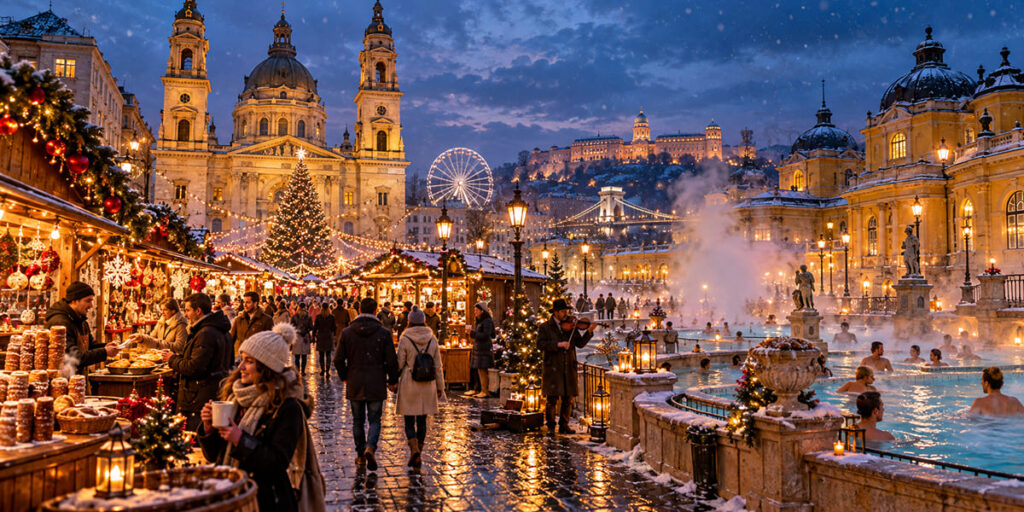
Budapest offers something no other city on this list can: you can spend the afternoon at a Christmas market and the evening soaking outdoors in steaming thermal water, with snow on the ground around you.
The Advent Feast in front of St Stephen’s Basilica (13 November 2026 to 1 January 2027) has topped the European Best Destinations vote for Christmas markets several times, helped by the light shows projected onto the basilica façade. A few minutes’ walk away, Vörösmarty Square runs the city’s longest-established market, with a focus on Hungarian crafts. Try kürtőskalács (chimney cake) and lángos (fried flatbread) at either.
Then go to Széchenyi Baths in City Park, one of Europe’s largest bath complexes, with 15 indoor pools and three outdoor ones. The outdoor pools stay open in winter, and there are few better ways to warm up after a cold day.
Good to know: Hungary uses the forint, and food, drink and hotels cost noticeably less than in Vienna or Germany. Vienna to Budapest is about 2 hours 40 minutes by train.
Planning a Christmas Trip to Europe
With the destination chosen, a few decisions make the difference between a relaxed trip and a stressful one.
- Choose your dates around the calendar, not just the market. Early December gives you the full festive atmosphere with smaller crowds and lower prices. Christmas week itself works best in places where the season keeps going, such as Prague, Vienna, Budapest, Salzburg, Copenhagen, Edinburgh, Rovaniemi or Zermatt. Remember that much of Central and Northern Europe celebrates on the evening of 24 December, so shops and restaurants often close early that day.
- Book early, especially for small places. Colmar, Rovaniemi and Zermatt have limited accommodation, and Christmas week fills months ahead. Flights between about 20 and 27 December are among the most expensive of the year.
- Use the train. Vienna, Salzburg and Budapest link easily by rail, as do Strasbourg and Colmar. Pairing two places within a few hours of each other usually beats one destination and two flights.
- Pack for standing still. Much of a European Christmas happens outdoors in temperatures around freezing, and Lapland is far colder. Warm boots, gloves and layers matter more than one heavy coat, and a power bank helps, since cold drains phone batteries quickly.
- Sort your phone before you go. You’ll rely on it for maps after dark, train times and translating menus. Roaming between EU countries is simple for EU-based SIMs, but Switzerland and the UK sit outside that zone, and travellers from outside Europe pay roaming everywhere. An Airhub eSIM Europe plan covers multiple European countries under one plan; set it up at home and it connects when you land.
FAQs
1. What is the best Christmas destination in Europe?
It depends on what you want from the trip. Vienna is best for music and atmosphere, Prague for a long festive season, Budapest for value and thermal baths, Rovaniemi for Santa and snow, and Edinburgh for combining Christmas with New Year.
2. Where in Europe is best to spend Christmas Day itself?
Choose somewhere the festive season continues past 24 December. Prague, Vienna, Budapest, Salzburg, Copenhagen, Edinburgh, Rovaniemi and Zermatt all keep going, though many restaurants close or run short hours on 24 and 25 December. Book Christmas meals in advance.
3. Where can I get a white Christmas in Europe?
Lapland (Rovaniemi) and high Alpine resorts such as Zermatt are the safest bets. Lowland cities like Vienna, Prague and Budapest get snow at Christmas only in some years.
4. When do Christmas markets in Europe open in 2026?
Most open between 13 and 28 November 2026. Vienna and Budapest open on 13 November, while Prague is expected to open on 28 November. Our Christmas markets guide lists the full dates.
5. Is Europe expensive at Christmas?
Christmas week is peak season, especially in Switzerland, Lapland and small towns like Colmar. Budapest and Prague offer the best value, and travelling in early December rather than Christmas week saves noticeably on hotels and flights.
6. Do I need a different SIM card for each country?
No. A multi-country travel eSIM covers several European countries under one plan. Check coverage for non-EU stops such as Switzerland and the UK.
For ideas further afield, from New York to a beach Christmas in Sydney, see our guide to Christmas destinations around the world.
Leave a Reply