The first Sunday of Advent falls on 29 November 2026, and most of Europe’s big Christmas markets open in the fortnight before it. Vienna and Cologne start mid-November, Nuremberg waits until 27 November, and Edinburgh, Vienna’s smaller squares and Zagreb keep going into January.
This guide covers the best Christmas markets in Europe for 2026: confirmed dates for each, what to eat or buy, and which ones pair easily by train. Use the dates table to shortlist, then the itinerary section to build the trip.
Christmas Market Dates 2026 at a Glance
Vienna and Budapest open first, on 13 November; Zagreb closes last, on 7 January 2027. Dates are from each organiser’s official site as of 10 October 2026, sorted by opening day.
| Market | Country | 2026 dates | Open after Christmas? |
| Vienna, Rathausplatz | Austria | 13 Nov – 26 Dec | Yes, to 26 Dec |
| Budapest, St Stephen’s Basilica | Hungary | 13 Nov – 1 Jan 2027 | Yes |
| Edinburgh, East Princes Street Gardens | UK | 14 Nov – 3 Jan 2027 | Yes |
| Cologne, Cathedral market | Germany | 16 Nov – 23 Dec (closed 22 Nov) | No |
| Salzburg, Domplatz | Austria | 19 Nov – 1 Jan 2027 | Yes |
| Munich, Marienplatz | Germany | 20 Nov – 24 Dec | No |
| Colmar | France | 23 Nov – 29 Dec | Yes, to 29 Dec |
| Dresden, Striezelmarkt | Germany | 25 Nov – 24 Dec | No |
| Basel | Switzerland | 26 Nov – 23 Dec | No |
| Nuremberg, Christkindlesmarkt | Germany | 27 Nov – 24 Dec | No |
| Brussels, Winter Wonders | Belgium | 27 Nov – 3 Jan 2027 | Yes |
| Prague, Old Town Square | Czechia | 28 Nov – 6 Jan 2027 (expected) | Yes |
| Zagreb, Advent u Zagrebu | Croatia | 28 Nov – 7 Jan 2027 | Yes |
| Strasbourg, Christkindelsmärik | France | Not yet announced (2025: 26 Nov – 24 Dec) | Usually no |
Berlin is left out of the table because each of its 60-plus markets sets its own dates. Strasbourg and Prague had not published final 2026 dates on their official sites at the time of writing, so check before booking.
Why the dates cluster: the first Sunday of Advent is 29 November 2026, and most markets open in the week before it. German markets that open early, like Cologne, close on Sunday 22 November for Totensonntag, a day of remembrance.
The Best German Christmas Markets in 2026
Germany is where the Christmas market tradition took shape, and its big four still set the benchmark. For a deeper dive, see our full guide to Christmas markets in Germany.
Nuremberg Christkindlesmarkt (27 November to 24 December)
Up to 180 stalls with red-and-white striped roofs fill the Hauptmarkt in front of the Frauenkirche, drawing more than two million visitors a year. The city keeps the stock traditional: wooden toys, prune-figure “Zwetschgenmännle” and handmade ornaments.
- Eat: three Nuremberg bratwurst in a roll (“Drei im Weggla”) and Lebkuchen gingerbread.
- Don’t miss: the opening on Friday 27 November at 5.30pm, when the Nuremberg Christkind reads the prologue from the Frauenkirche balcony.
- Hours: 10am to 9pm daily; 10am to 2pm on 24 December.
Dresden Striezelmarkt (25 November to 24 December)
First documented in 1434, the Striezelmarkt is Germany’s oldest recorded Christmas market, and 2026 is its 592nd edition. It fills the Altmarkt with more than 200 stalls and a 14-metre wooden Christmas pyramid.
- Eat: Dresdner Christstollen, the fruit bread the market is named after.
- Don’t miss: the Stollen Festival parade on the Saturday before the second Advent, when a giant Stollen is cut on the Altmarkt.
- Tip: the smaller Neumarkt market beside the Frauenkirche is less crowded and has a historic theme.
Munich Christkindlmarkt (20 November to 24 December)
Munich’s market dates back to the 14th century and fills Marienplatz and Rindermarkt with about 130 stalls under the neo-Gothic town hall. In 2026 it opens a week earlier than usual, on the Friday before Totensonntag.
- Buy: nativity figures at the Kripperlmarkt by St Peter’s church, one of the largest of its kind in Germany.
- Don’t miss: the Krampus Run, when about 300 costumed Krampus figures parade through the old town.
- Tip: the Medieval Market at Wittelsbacherplatz and the Pink Christmas market are good second stops.
Cologne (16 November to 23 December)
Cologne runs six or seven themed markets at once, so it suits travellers who want several markets without changing hotel. The flagship sits on Roncalliplatz beneath Cologne Cathedral; Heinzels Wintermärchen fills Alter Markt and Heumarkt, and the Harbour market sits on the Rhine by the Chocolate Museum.
- Eat: Reibekuchen (potato pancakes with apple sauce) and Glühwein in the year’s collectible mug.
- Tip: the Heumarkt ice rink and the Harbour market stay open into January (provisional dates: Heumarkt to 10 January, Harbour to 3 January 2027).
Berlin (dates vary by market, roughly late November to late December)
Berlin has more than 60 markets spread across its neighbourhoods rather than one centrepiece, so it’s the pick for variety over tradition. Gendarmenmarkt (WeihnachtsZauber) charges a small entry fee for a polished setting, while Charlottenburg Palace and Alexanderplatz are free.
Which German market for you? Nuremberg for tradition, Dresden for history, Munich for Bavarian atmosphere, Cologne for market-hopping in one city, and Berlin for choice.
Famous Christmas Markets in Europe Beyond Germany
Germany’s neighbours run markets that rival or beat the originals, and several stay open past Christmas Day.
Strasbourg, France (dates to be announced)
Strasbourg has held its Christkindelsmärik since 1570, making it France’s oldest Christmas market, and it bills itself as the “Capitale de Noël”. More than 300 chalets spread across about a dozen squares on the UNESCO-listed Grande Île, with the main market on Place Broglie and the giant Grand Sapin tree on Place Kléber.
- Eat: bredele (Alsatian Christmas biscuits), pretzels and white vin chaud.
- Tip: the city had not confirmed 2026 dates as of October; 2025 ran 26 November to 24 December, so expect a similar window.
Colmar, France (23 November to 29 December)
Colmar’s medieval centre is small enough to cross on foot, and its markets are spread over several squares, so the whole old town becomes the venue. It runs five days past Christmas, later than most of its Alsatian and German neighbours.
- Don’t miss: the children’s market in the canal-side Petite Venise quarter.
- Tip: hotels sell out early; stay in Strasbourg and take the 30-minute train.
Vienna, Austria (13 November to 26 December)
The Wiener Christkindlmarkt on Rathausplatz sits in front of the floodlit neo-Gothic City Hall, with an ice trail of around 3,000 m² winding through the park behind it. Opening hours are 10am to 10pm daily, with an early 6.30pm close on 24 December.
- Drink: Punsch, the Austrian alternative to mulled wine.
- Tip: Spittelberg, Am Hof and the Freyung are a short walk away and much calmer than Rathausplatz on weekends. Schönbrunn Palace’s market runs 6 November to 6 January 2027.
Salzburg, Austria (19 November to 1 January 2027)
With roots in a market first held in 1491, the Salzburger Christkindlmarkt fills Domplatz and Residenzplatz with about 100 stalls in front of the cathedral, inside the UNESCO-listed old town. It runs through New Year’s Eve and closes on 1 January.
- Don’t miss: the Krampus run on 5 December at 6.30pm.
- Tip: the Silent Night Chapel in Oberndorf, where the carol was first sung in 1818, is a short trip from the city.
Prague, Czechia (expected 28 November to 6 January 2027)
Prague’s two main markets fill Old Town Square and Wenceslas Square, a ten-minute walk apart. Old Town Square has the astronomical clock, the Gothic Týn Church and a towering spruce lit on opening day.
- Eat: klobása sausages, svařák (Czech mulled wine) and roast ham carved from the spit.
- Tip: both main markets stay open until Epiphany, which makes Prague one of the best bets for a week between Christmas and New Year.
Budapest, Hungary (13 November to 1 January 2027)
The Advent Feast in front of St Stephen’s Basilica has been voted Europe’s best Christmas market several times, with nightly light projections on the basilica façade and an ice rink around the tree. The Vörösmarty Square market, a short walk away, runs to the same dates and focuses on Hungarian crafts.
- Eat: kürtőskalács (chimney cake) and lángos (fried flatbread).
- Tip: Hungary uses the forint, and food and drink cost noticeably less than in Vienna or Germany.
Brussels, Belgium (27 November to 3 January 2027)
Brussels’ Winter Wonders stretches about two kilometres from the Grand-Place to the old fish market (Vismet), with 238 chalets, a Ferris wheel and an ice rink. The sound-and-light show on the Grand-Place guild houses is the highlight.
- Eat: Belgian waffles, frites and croquettes.
- Tip: stalls open noon to 10pm and close at 6pm on 24 and 31 December.
Basel, Switzerland (26 November to 23 December)
Basel splits its market between Barfüsserplatz and Münsterplatz in front of the cathedral, open daily from 11am to 8.30pm. It’s one of the calmest big-city markets on this list.
- Eat: Basler Läckerli, the city’s spiced honey biscuits.
- Tip: Switzerland uses the franc and isn’t in the EU, so check your roaming plan before crossing from France or Germany.
Zagreb, Croatia (28 November to 7 January 2027)
Advent u Zagrebu spreads across the main square, parks and the Upper Town, and is closer to a city-wide winter festival than a single market. It has won the European Best Destinations Christmas market vote several times and runs later than anywhere else here.
- Eat: fritule (small doughnuts) and kuhano vino (mulled wine).
- Tip: it’s the best-value option on this list, and Croatia uses the euro.gether that a single rail pass covers most of the route.
Edinburgh Christmas Market: The UK’s Best (14 November to 3 January 2027)
Edinburgh’s Christmas runs for seven weeks across three sites, with the main market in East Princes Street Gardens beneath the castle and beside the Scott Monument. Around 70 free-to-enter stalls sell handmade gifts, Scottish food and mulled wine.
- Ride: the LNER Big Wheel, Scotland’s largest Ferris wheel, for views over the castle and Old Town.
- Skate: the ice rink on George Street, which also hosts a Scottish Christmas fair.
- Families: West Princes Street Gardens has the funfair and Santa’s Stories (20 November to 24 December).
- Stay on for Hogmanay: the market rolls straight into Scotland’s New Year celebrations, with the Torchlight Procession on 29 December and the Street Party on 31 December.
Edinburgh doesn’t pair easily with continental markets in a single trip, so treat it as its own city break. Most visitors outside the UK and Ireland now need an Electronic Travel Authorisation (ETA) before arriving, so apply in advance.
What to Know Before You Go
A few practical details make the difference between a magical evening and a frustrating one.
- Go on a weekday, early. Opening weekend and the last two weekends before Christmas are the busiest everywhere. A Tuesday at 4pm feels like a different market from a Saturday at 7pm.
- Use the mid-November window. Vienna, Budapest, Edinburgh and Cologne are fully open by 16 November, before school holidays and before hotel prices peak.
- Expect a mug deposit. Most German, Austrian and Swiss stalls add a deposit of about €3 to €5 on each hot drink. Return the mug for a refund or keep it as a souvenir; many markets design a new one each year.
- Carry a little cash. Cards are widely accepted, but some small craft and food stalls are cash-only, and coins speed up mug returns.
- Check closing dates, not just opening dates. German markets usually close on 23 or 24 December. Vienna, Colmar, Salzburg, Budapest, Prague, Brussels, Edinburgh and Zagreb all stay open after Christmas.
- Watch for Totensonntag. German markets that are already open close on Sunday 22 November 2026.
- Budget for a meal, not a snack. Two hot drinks, a sausage and a small gift add up to roughly €25 to €35 per person in Germany or Austria; Zagreb and Budapest cost noticeably less.
- Dress for standing still. You’ll spend hours outdoors in temperatures near freezing, so warm boots and gloves matter more than a heavy coat.
- Mind your pockets. Crowded squares attract pickpockets; keep phones and wallets in front pockets or zipped bags.
Planning a Multi-Country Christmas Market Trip
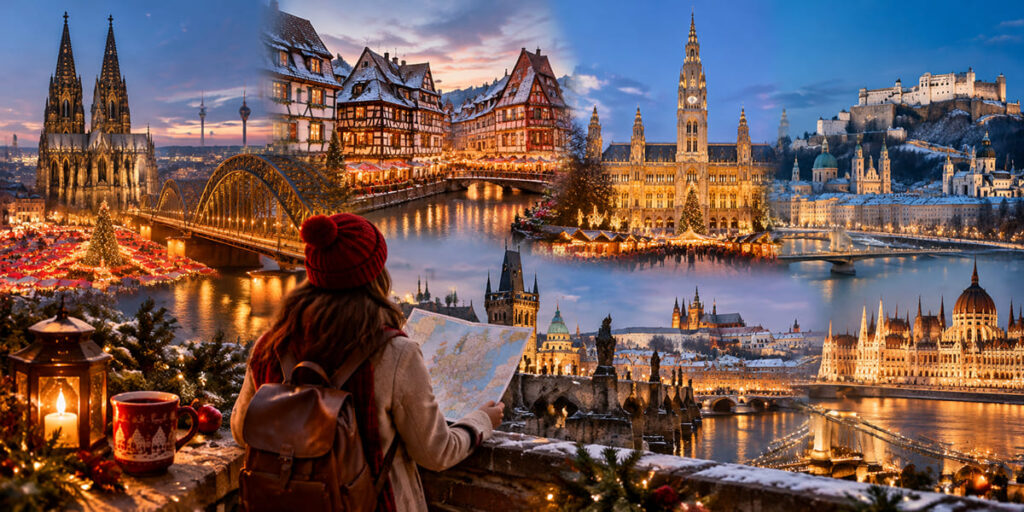
Pairing markets by train is the easiest way to see three or four in a week without flying. These routes are all direct or near-direct; times are typical fastest journeys.
| Route | Train time | Best for |
| Strasbourg – Colmar | About 30 min | A two-market Alsace weekend |
| Colmar – Basel | About 45 min | Adding Switzerland to Alsace |
| Cologne – Brussels | About 1 h 50 min | Germany + Belgium in one trip |
| Salzburg – Munich | About 1 h 30 min | An Austria–Bavaria loop |
| Vienna – Salzburg | About 2 h 30 min | Two Austrian classics |
| Dresden – Prague | About 2 h 15 min | History and Gothic spires |
| Munich – Nuremberg | About 1 h 10 min | Two Bavarian benchmarks |
| Vienna – Budapest | About 2 h 40 min | The best-value pairing |
Three ready-made routes:
- Alsace and Switzerland (4–5 days): Strasbourg, Colmar and Basel. Best from 26 November, when all three are open.
- Bavaria and Austria (6–7 days): Nuremberg, Munich, Salzburg and Vienna. Go between 27 November and 23 December, when all four are open.
- Central Europe after Christmas (5–6 days): Prague, Vienna and Budapest between 26 December and 1 January, when most German markets have closed. In Vienna, head to Schönbrunn Palace, which stays open to 6 January; Rathausplatz closes on 26 December.
Book rail tickets early for December weekends, especially Munich–Nuremberg and Cologne–Brussels, which fill up during market season.
Why Business Travellers Are Catching the Christmas Market Bug Too
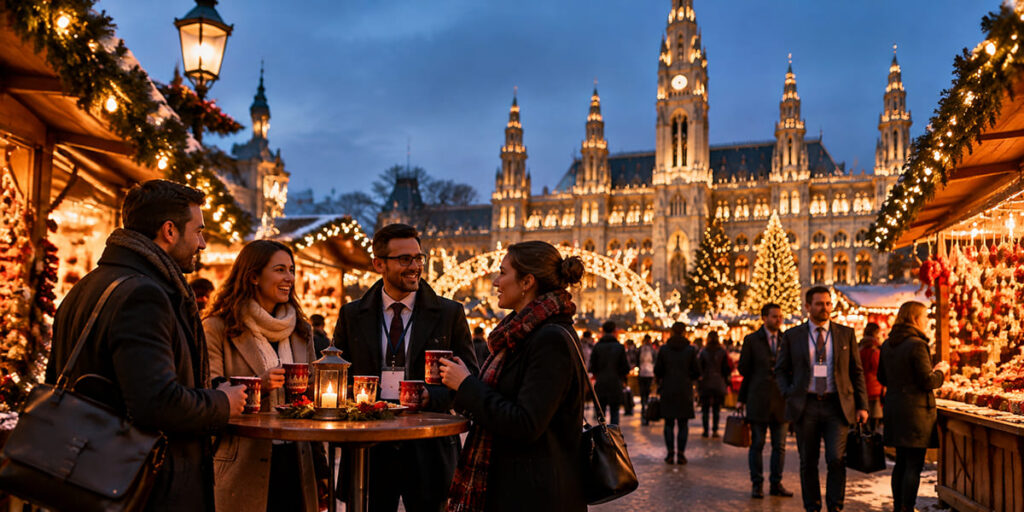
The Christmas market season isn’t purely a leisure story anymore. November and December line up directly with a dense stretch of the European conference and client-visit calendar, and a growing number of companies are building end-of-year offsites, client entertainment evenings, and team trips around cities that happen to double as some of the best Christmas markets in Europe; Vienna, Cologne, and Edinburgh in particular see a real bump in corporate bookings through this period. It’s an easy internal sell: a team offsite in Strasbourg or a client dinner near Vienna’s Rathausplatz does double duty as a business trip and a genuinely memorable experience. The planning challenge is a familiar one for any team crossing multiple countries in a short window, and it’s rarely the market dates that trip people up.
Staying Connected Across Borders, Whether You’re Sightseeing or Working
A multi-country market trip means crossing borders every day or two, and that’s where mobile data gets complicated. EU roaming rules cover travel between EU countries for EU-based SIMs, but Switzerland and the UK sit outside that zone, and travellers from outside Europe pay roaming on every leg.
You’ll lean on data more than you expect: live train times, maps between squares after dark, translating menus and booking last-minute rooms when Colmar sells out.
- An Airhub eSIM Europe plan covers multiple European countries under one plan, so you don’t need a new SIM at each border.
- Planning Edinburgh or Basel? Check that your plan includes them, or add an eSIM UK or Switzerland plan for those legs.
- Install it at home before you fly; it activates when you land, and the cost is fixed upfront rather than arriving as a roaming bill.
Sorting data before departure leaves one less thing to deal with in a crowded square. Browse Airhub eSIM plans for your route.
Which Christmas Market Should You Choose?
- First trip, want the classic: Nuremberg or Strasbourg.
- Want several markets in one city: Cologne or Vienna.
- Travelling after Christmas: Zagreb, Prague, Budapest, Salzburg or Brussels.
- On a budget: Zagreb or Budapest.
- Want a fairy-tale small town: Colmar.
- Staying in the UK: Edinburgh, then Hogmanay.
Pick a region, check the dates table, and build the route around realistic train times. Book accommodation early: the best-located hotels in Nuremberg, Colmar and Strasbourg fill months ahead.
FAQS
1. Which are the best Christmas markets in Europe for 2026?
Nuremberg, Strasbourg, Vienna, Prague, Cologne, and Edinburgh consistently top most rankings for 2026, each for a different reason: tradition, atmosphere, scale, photogenic settings, or sheer size.
2. When do Christmas markets in Europe open in 2026?
Most open between 13 and 28 November 2026. Vienna and Budapest open first on 13 November, and Nuremberg opens on 27 November, the Friday before the first Sunday of Advent.
3. Which Christmas markets are open after Christmas Day?
Zagreb (to 7 January), Prague (to 6 January), Edinburgh and Brussels (to 3 January), Salzburg and Budapest (to 1 January), Colmar (to 29 December) and Vienna’s Rathausplatz (to 26 December). Most German markets close on 23 or 24 December.
4. When does the Edinburgh Christmas Market open in 2026?
It runs from 14 November 2026 to 3 January 2027 in East Princes Street Gardens, with the ice rink on George Street.
5. What are the best German Christmas markets?
Nuremberg’s Christkindlesmarkt, Dresden’s Striezelmarkt, Munich’s Christkindlmarkt and Cologne’s cathedral market are the country’s most famous.
6. Are European Christmas markets free to enter?
Nearly all are free. A few special venues, such as Berlin’s Gendarmenmarkt, charge a small entry fee.
7. Do I need a different SIM card for each country?
No. A multi-country travel eSIM covers several European destinations under one plan. Check coverage for non-EU stops like Switzerland and the UK.
Leave a Reply