
Most guides bury the one fact that actually matters, so here it is up front: there is no single best time to visit Malaysia, because the country runs two opposite weather systems at the same time. While one coast is basking in blue skies, the other is very likely taking a monsoon soaking — which means the real question was never when to go, but where. Line up the right coast with the right month and you can catch great weather in Malaysia in almost any month of the year. Below, the whole thing broken down by region and by month, with the festivals worth timing a trip around and quick answers to the questions everyone asks — Kuala Lumpur, the islands, and doing it on a budget.
Malaysia’s Climate and the Two Coasts
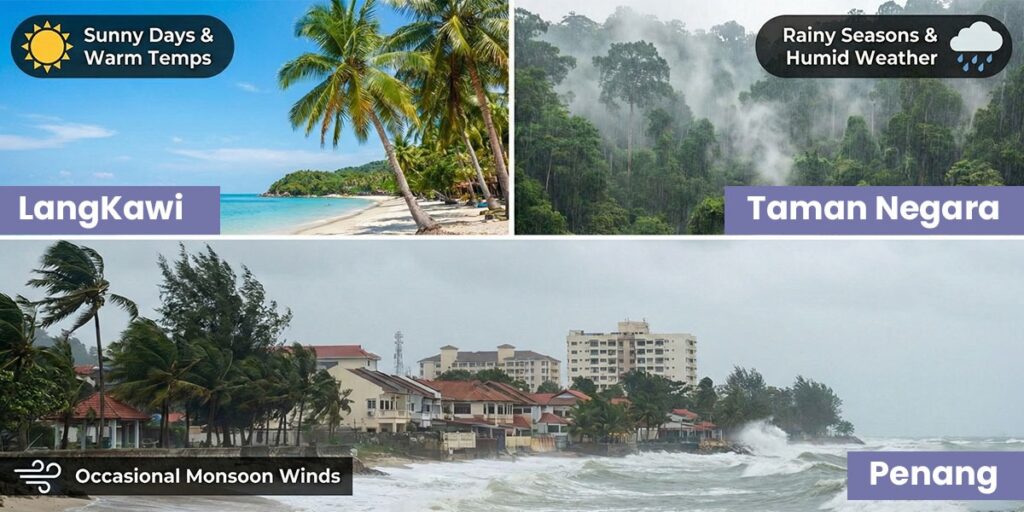
Sitting right on the equator, Malaysia skips the four-seasons routine entirely. It’s hot and humid the whole year — daytime highs around 30–33°C, and a sea that hovers near a bathwater 29°C — so what actually shapes a trip isn’t temperature, it’s rain.
The catch is that the rain doesn’t fall everywhere at once. Three zones keep their own calendars:
- West Coast, Peninsular Malaysia (Kuala Lumpur, Penang, Langkawi) — driest December to April; wetter April–October.
- East Coast, Peninsular Malaysia (Perhentian, Redang, Tioman) — driest April to September/October; then the monsoon rolls in November to February, bringing heavy rain, rough seas, and shuttered island resorts.
- Borneo (Sabah & Sarawak) — no strict monsoon, but drier and better for trekking roughly March to October.
Get that one idea straight — match your coast to your month — and the rest of this guide is just detail.
Best Time to Visit West Coast Malaysia (Kuala Lumpur, Penang, Langkawi)

If you want to visit places like Kaula Kumour, Georgetown or the beautiful Langkawi islands, the best time to visit Malaysia’s west coast is December to April
Why this period works best:
- Hot but less humid
- Blue skies most days
- Perfect for beaches and island hopping
- Great for food tours and city sightseeing
Though even outside of these months, it is still manageable. It’s just that December to April will give you the best mix of comfort and sunshine.
Best Time to Visit by Region

West Coast (Kuala Lumpur, Penang, Langkawi) — December to April
This is the west coast at its best: blue skies most days, heat that’s actually comfortable, and calm seas — perfect for Langkawi’s beaches, Georgetown’s street food, and unhurried city sightseeing. It stays perfectly doable outside these months; December to April simply gives you the surest run of sunshine.
East Coast islands (Perhentian, Redang, Tioman) — April to September
The east coast is the country’s most monsoon-sensitive corner, and its window is the mirror image of the west’s. April to September is when the water turns clear, the beaches look faintly unreal, and the ferries run on schedule. Steer clear of November to February, when the rain, the swell, and closed resorts take the islands off the table entirely.
Borneo (Sabah & Sarawak) — March to October
Borneo plays by looser rules — rain can arrive any day — but the drier March-to-October stretch is when its big-ticket experiences come good: orangutan sanctuaries, river cruises, wildlife spotting, and the climb up Mount Kinabalu, all with safer trails and clearer views. Pack a rain layer regardless.ber.
Month-by-Month: When to Visit Malaysia
Already got your dates? Here’s which region is peaking each month, and the festival to expect if there is one:
| Month | Best region(s) | Notes / festival |
| January | West Coast, Borneo | Dry west coast; east-coast monsoon tail |
| February | West Coast, Borneo | Great all-round; Chinese New Year (dates vary) |
| March | West Coast, Borneo | Excellent, shoulder pricing |
| April | Both coasts + Borneo | Sweet spot — the coasts briefly overlap |
| May | East Coast, Borneo | East-coast islands open up; diving strong |
| June | East Coast, Borneo | Dry east coast |
| July | East Coast, Borneo | Peak island season; drier in KL too |
| August | East Coast, Borneo | Peak diving visibility |
| September | East Coast, Borneo | Last of the reliable east-coast window |
| October | Borneo, shoulder | Low season, cheaper; west coast easing wetter |
| November | West Coast | East-coast monsoon begins — skip its islands |
| December | West Coast | West-coast dry season starts; peak-price holidays |
Festivals Worth Planning Around
Weather is only half the timing puzzle. Malaysia’s multicultural calendar quietly decides how crowded, how expensive, and how memorable your dates turn out to be — so it pays to know what’s on:
- Chinese New Year (Jan/Feb) — a spectacular time to be here, but book well ahead; flights and hotels jump.
- Ramadan & Hari Raya Aidilfitri — Ramadan means glorious night food bazaars; Hari Raya sends much of the country home to family, so transport and lodging fill up and some businesses shut.
- Thaipusam (Jan/Feb) — a genuinely striking Hindu festival, at its most dramatic at Batu Caves just outside KL.
- Deepavali (Oct/Nov) — the festival of lights, marked nationwide.
Best Time to Visit Kuala Lumpur

Kuala Lumpur is the country’s beating heart — skyscrapers, night markets, temples, malls all elbowing together — and because it sits inland on the west coast, it shrugs off the monsoon far better than the islands do. The driest, most comfortable stretch is December to April (crisp Petronas Towers views, easy walking tours, proper rooftop-bar weather), with July and August offering a second drier window. That said, KL barely has a bad season: a rainy afternoon just nudges you indoors, and there’s no shortage of it — malls, cafés, museums, aquariums, endless food halls.
Best Time by Travel Style
If you’d rather plan around the kind of trip you’re after, here’s the quick version — and once the timing’s settled, our guide to places to visit in Malaysia covers where to actually point yourself.
- City breaks (Kuala Lumpur, Penang): December–April for the driest sightseeing, street food, and clear skyline shots.
- West-coast beaches (Langkawi, Penang): December–April — these are west-coast islands, so they run on the west-coast dry season, not the east’s.
- East-coast beaches & diving (Perhentian, Tioman, Redang): May–August for the calmest seas and the sharpest underwater visibility.
- Jungle trekking (Borneo): March–October for drier, safer trails and better wildlife odds.
- Budget travel: April, May, and October — shoulder months when flights and hotels ease off.
Quick Summary
| Window | Weather | Best for |
| December–April | Dry & sunny (West Coast) | Kuala Lumpur, Langkawi, Penang |
| April–September | Dry season (East Coast) | Perhentian, Tioman, Redang |
| March–October | Drier (Borneo) | Sabah, Sarawak wildlife & trekking |
| November–February | Monsoon (East Coast) | Skip the east-coast islands; head west |
Splitting the trip across regions? Just hold onto the one rule that governs all of it — the coasts peak at opposite times — and plan the route around that.
Staying Connected in Malaysia

Malaysia is an easy place to get around, and reliable data smooths the last rough edges — you’ll want it for rideshares, for navigating both the cities and the jungle, for translation, and, fittingly, for checking the very rain forecasts this whole guide is about. Instead of joining the SIM-card queue on arrival, plenty of travelers now set up an eSIM Malaysia plan before they fly: buy it in minutes, scan a QR code, and walk out of the airport already online, with no roaming bill trailing you home.
When Should You Go? The Bottom Line
It really comes down to where you’re headed: west coast December–April, east-coast islands April–September, Borneo March–October. If you want a single all-round window to aim for, February to March is the one — dry across most of the country, lower humidity, and shoulder pricing before the peak crowds arrive.
And if you’re the sort who’ll be bouncing between coast and jungle and burning through data as you go, it’s worth a quick look at whether an esim with unlimited data fits your trip.
FAQs
1. What is the best time to visit Malaysia overall?
February to March is the strongest all-round window — dry across most of the country, lower humidity, and not yet peak-priced. The honest answer, though, is that it depends on your region: west coast December–April, east-coast islands April–September, Borneo March–October.
2. What’s the best time to visit Malaysia for beaches?
Depends which coast. West-coast islands (Langkawi, Penang) are best December–April; east-coast islands (Perhentian, Redang, Tioman) are best April–September. The two never peak together.
3. When is the best time to visit Kuala Lumpur?
December to April is the driest, most comfortable stretch, with July–August a second drier window. That said, KL is enjoyable year-round thanks to its sheer amount of indoor life.
4. What’s the best time to visit Malaysia on a budget?
The shoulder months — roughly April, May, and October — bring lower flight and hotel prices. Setting up your data with an eSIM before you fly also spares you pricey airport SIMs and roaming.
5. When is the best season for Malaysia’s islands?
East-coast islands: April–September. West-coast islands like Langkawi and Penang: December–April. Match the island to its coast and you can’t go far wrong.
6. Is the monsoon a bad time to visit Malaysia?
Only for the east-coast islands (November–February), where resorts close and the seas turn rough. Stick to Kuala Lumpur, Langkawi, or Penang in those months and the monsoon barely registers — it’s actually the west coast’s driest, sunniest time.
7. How do I stay connected while traveling in Malaysia?
Set up an eSIM before you arrive rather than leaning on public Wi-Fi or hunting for a local SIM. It activates from a QR code and keeps maps, rideshares, and translation running from the moment you land.
Leave a Reply