Nearly every guide on how to become a digital nomad opens with the same image: laptop, beach, flexible hours, someone looking suspiciously well rested. It’s the wrong end of the problem entirely.
What actually determines whether this works is far duller. What will you do for money? And can you do enough of it from a different time zone, on an unfamiliar wifi connection, without anyone standing over you? Visas, banking, packing, which country to start in all of that is logistics, and logistics only matter once the income question is answered.
So we’ll start with work, then the honest version of the money. After that, a transition path that doesn’t involve resigning on Friday and boarding a plane on Monday, plus the admin nobody enjoys and everybody needs.
One thing worth saying before any of it: this is a good life, not an easy one. You’re swapping a stable income, a pension and paid holidays for autonomy, competition and a great deal of self management. Plenty of people make that trade happily. Very few make it well by accident.
What Digital Nomads Actually Do for Work
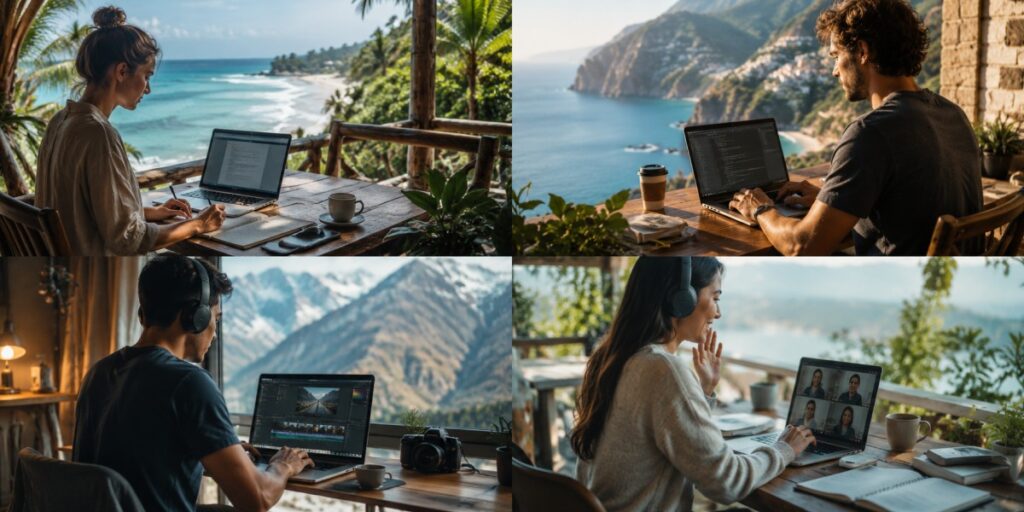
Being a digital nomad isn’t a profession. It’s a working arrangement, and the job has to come first, specifically, a job a client or employer is genuinely happy to receive from anywhere.
The roles that travel well fall into four rough groups.
- Writing and language work covers freelance writing, copywriting, editing and translation. Every business on earth needs blog posts, web copy, email campaigns and newsletters, and none of that has ever required sitting in a specific building. Translation is worth a look if your genuinely bilingual software handles a first pass now, but native speakers are still needed for syntax, tone and everything machines get subtly wrong.
- Technical work means web and app development, QA, data work. Demand here is consistent for an unglamorous reason: it’s very difficult to find a business without a website that needs maintaining. The barrier is skill, not opportunity.
- Creative and marketing work graphic design, video and photo editing, social media management, SEO are among the most travelled routes, simply because the output is entirely digital and the tools fit in a bag.
- Service and support work rounds it out: virtual assistance, customer service, admin, bookkeeping, online tutoring and teaching English. That last one suits nomads far better online than in person, since you can schedule lessons around your travel instead of committing to a term in one city.
How you actually get the first client
Here’s where most guides go quiet, and it’s precisely where people stall.
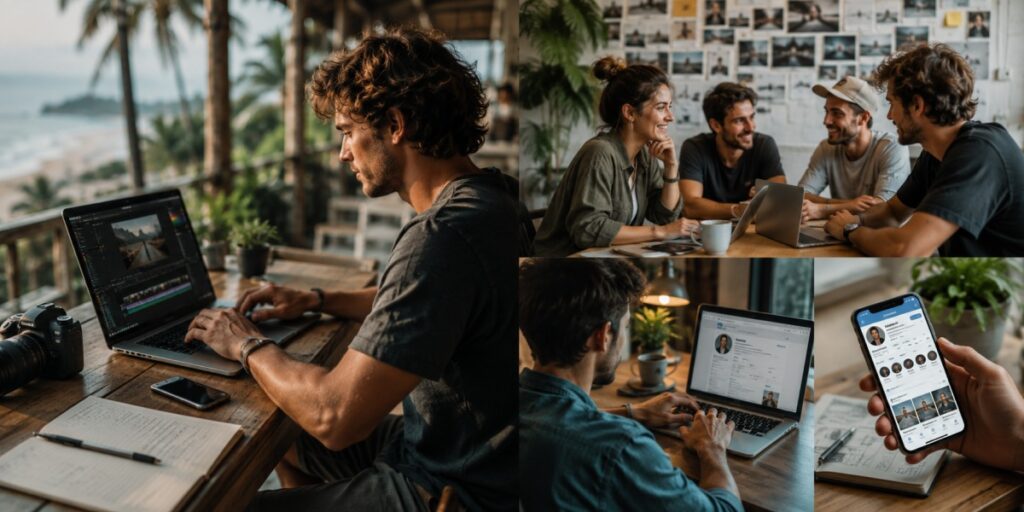
Build the portfolio out of work you’re already doing. Want to move into video editing? Edit your own travel footage and call it a showreel. Chasing web development work? Build your own site and apply with it. Aiming at social media management and already posting about your travels? That account is a portfolio. Start treating it like one.
Then start with people who already know you. Friends, former colleagues, the small business at the end of your road. Your first few jobs aren’t really about money; they’re about building testimonials, case studies, and proof of your work. Nobody hires a freelancer with an empty profile, and everybody has to solve that problem somehow.
Aim slightly above yourself rather than at brands. Bloggers, YouTubers and small creators need editing, admin and social help constantly, they’re far easier to reach than an agency, and they’ll give you a reference. It’s a much faster route to a credible portfolio than cold pitching companies who won’t reply.
Only then update your public profiles, LinkedIn, your site, wherever people find you so it’s obvious what you do before you actually need the work.
If you don’t have a skill yet
Pick one and go deep rather than collecting certificates. Udemy, Skillshare, LinkedIn Learning and Google Skillshop between them cover most of the common nomad skill sets. The classic mistake is enrolling in six courses across six disciplines. Being adequate at everything is considerably less employable than being genuinely good at one thing.
How to Transition Without Quitting Cold
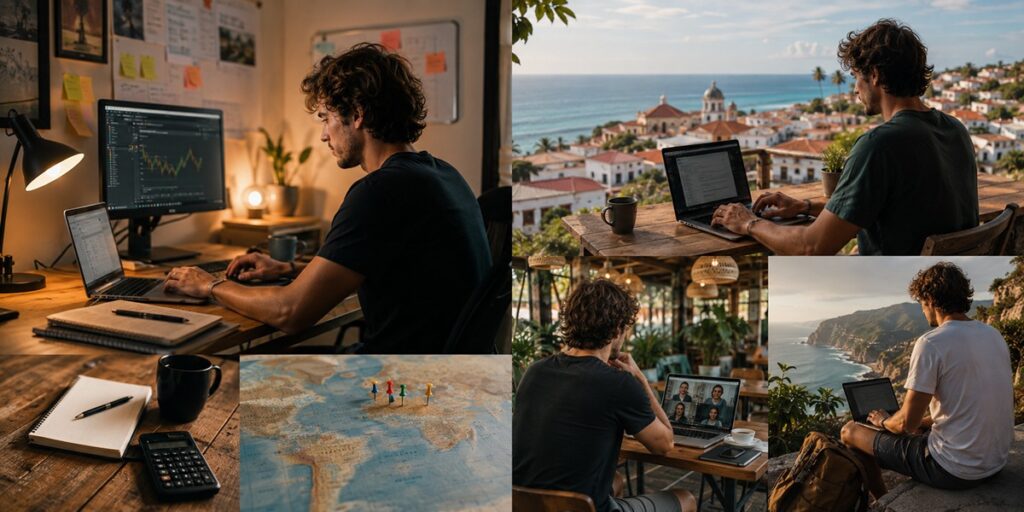
Almost nobody should go from salaried to nomadic in a single step, and guides that imply otherwise are selling a story rather than describing one.
Run it as a side hustle first. Freelance alongside your current job for a few months and you’ll learn two things you can’t find out any other way: whether you can actually win paying work in your chosen field, and whether you like working without anyone giving you direction. A surprising number of people discover they want to travel but need the structure much better to find that out while a salary is still landing.
Ask about the remote before you resign. If your existing role could be done from anywhere, that’s a conversation worth having, and keeping your current income while relocating is by a considerable distance the lowest,risk version of all this.
Trial it for a month. Take the laptop somewhere for four weeks and work your normal hours from there. You’ll discover very quickly whether you can concentrate in an unfamiliar city, whether the time-zone gap is workable, and whether you actually enjoy the thing you’ve been imagining.
Then set a floor and hold to it. Decide what monthly income you need before handing in notice and don’t leave until you’ve hit it consistently for a few months. Once is not a pattern
Budgeting and Finances
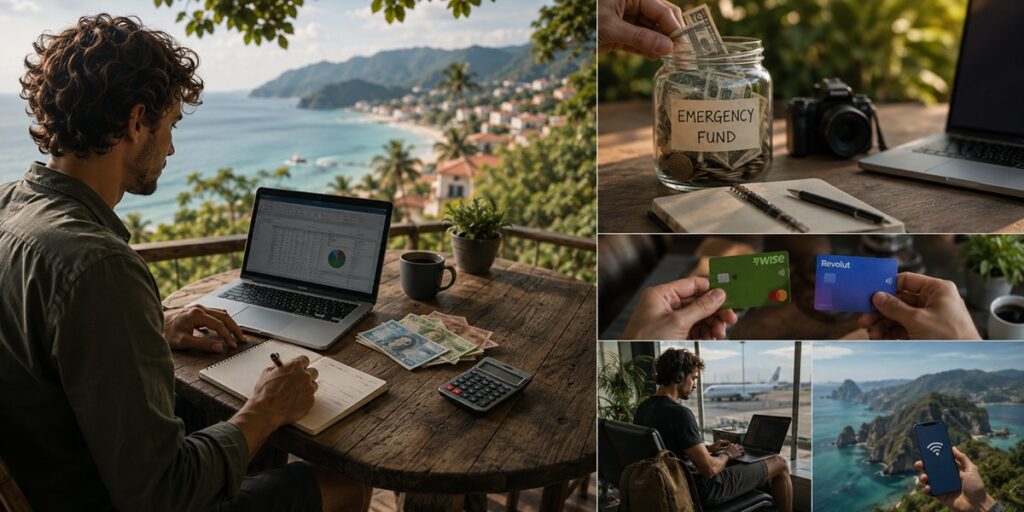
Money planning is where nomads either succeed or quietly go home. A working budget covers flights, accommodation, insurance and living costs, but the figure that matters most is the buffer sitting behind all of it.
- Build an emergency fund before anything else. Medical bills, an unplanned flight home, a laptop dying somewhere replacing it costs double these things happen, and they have a habit of happening in the same month. Three to six months of costs is the usual guidance and it’s usual for a reason.
- Expect the income to be lumpy. Freelance earnings almost never arrive evenly, and it’s genuinely common to have a strong month followed by three weeks of nothing at all. Budgeting against your best month rather than your average is the most reliable way to end up stranded somewhere expensive. Plan on the average; save the surplus.
- Sort travel-friendly banking early. Wise and Revolut both offer low or no foreign transaction fees and hold multiple currencies which matters far more than people anticipate once you’re paying rent in one currency and earning in another. Check what your existing cards charge overseas, because plenty still charge plenty.
- Understand geo-arbitrage. Earning in USD, GBP or EUR while living somewhere with a lower cost base is the single largest financial lever available to nomads, and Southeast Asia and parts of Eastern Europe stretch the same income dramatically further than the US or UK. There’s nothing clever about it. It’s just where the maths lands.
- And treat connectivity as a business cost, not a travel extra. If your income depends on being reachable, the data plan belongs in the same column as the laptop.
Our guide to avoiding roaming charges covers the settings that stop the expensive version of this happening.
Visas and Tax Residency
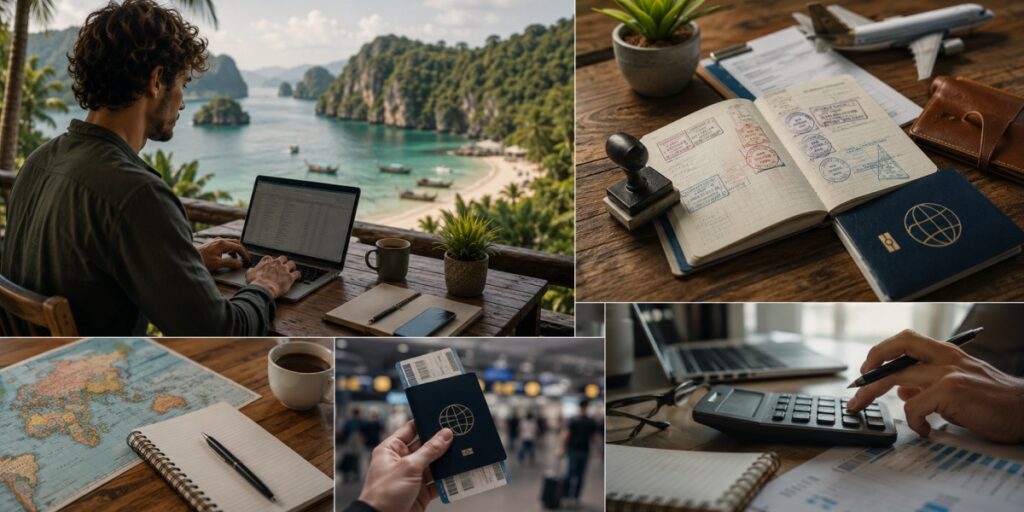
The least exciting section is usually the one that causes the most trouble.
Tourist visas usually allow 30 to 90 days, and working on one sits in a grey area almost everywhere. A great many nomads do it anyway. That isn’t the same thing as being permitted to, and the distinction occasionally matters at a border.
Digital nomad visas now exist in a substantial number of countries, built specifically for people earning from abroad while living locally. They generally require proof of income above a threshold, health insurance and a clean record, and they allow considerably longer stays than a tourist entry. Requirements and eligibility rules vary significantly by country, so always check the latest government guidance before applying.
Leaving the country doesn’t automatically end your tax residency. Many people continue to have tax obligations in their home country unless they properly change their tax residency status, and some nationalities, US citizens most notably, are taxed on worldwide income regardless of where they happen to be sitting. Pay a professional once to map this properly. It’s cheaper than guessing annually and considerably cheaper than guessing wrong.
Travel Planning
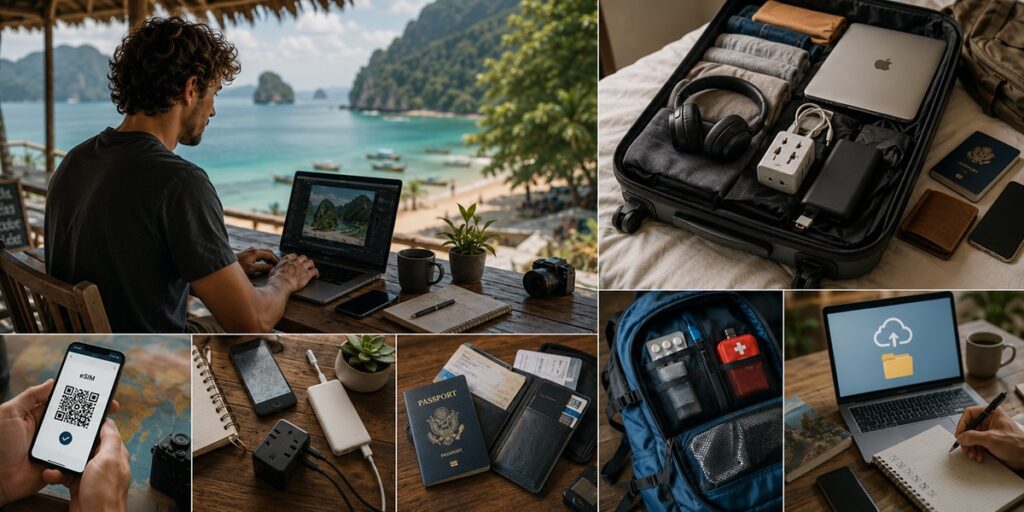
Nomadic life isn’t the same as travelling constantly, and the people who last longest are usually the ones who move less. Staying somewhere for a month or two is cheaper, considerably less exhausting, and far better for actually getting work done.
Documents. Check entry requirements before you book, not after. Keep digital copies of your passport, insurance and visas somewhere you can access without your bag, because the situation where you need them is usually the situation where you don’t have your documents with you.
Flights. Use Skyscanner and Google Flights for comparison. Mid-week departures are usually cheaper, and one way tickets offer flexibility, although you may occasionally need to prove onward travel at check in.
Gear. A reliable laptop and phone, noise-cancelling headphones, a universal adapter, and a power bank that can genuinely charge a laptop rather than just top up a phone. Before you go, confirm your handset supports eSIM.
Our eSIM compatible devices list provides the model details, and it’s a five second check that can save you from an unpleasant surprise at your destination.
Health. Check vaccination requirements for your destinations and get travel health insurance that covers emergency treatment abroad. Read the duration limits carefully, because standard travel policies often exclude long stays, which is exactly what you are planning.
Organisation. Keep bookings, contacts and plans somewhere accessible offline. Cloud storage works well until the moment you need it and have no signal.
Staying Connected and What Happens When It Fails
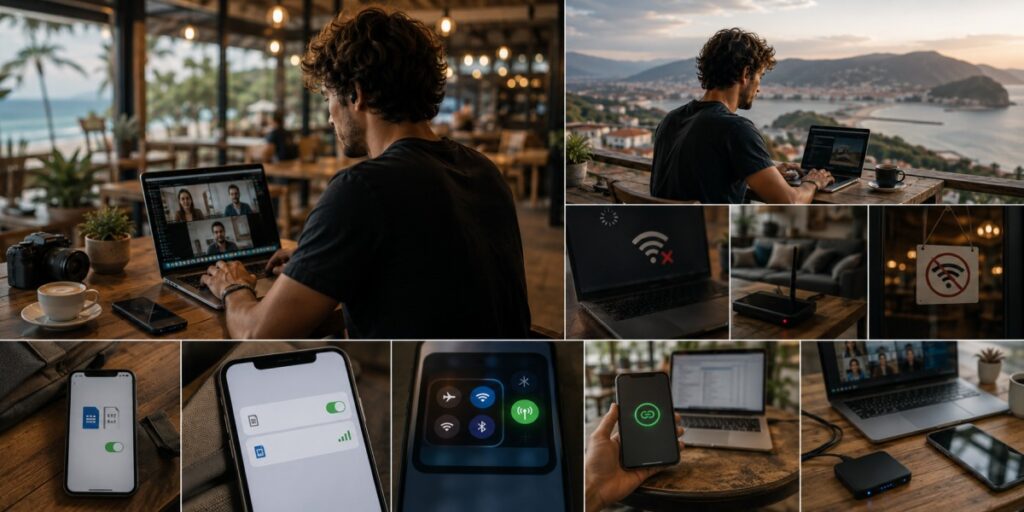
For a tourist, losing a signal is an inconvenience. For a nomad, it’s a business problem.
Consider the specifics: café Wifi that drops during a client call, an apartment whose advertised “high speed internet” turns out to be 3Mbps shared with four other guests, or a coworking space closed for a public holiday nobody mentioned. Each of these can cost money and reputation, and each is entirely predictable. What fixes them is having a second route to the internet that doesn’t depend on someone else’s router.
Your phone is that backup, which is why an eSIM global plan is better thought of as work equipment rather than just a travel convenience. Keep your home number on one profile and data on another, switch between them in a few taps, and tether your laptop when the Wifi gives up. Install it before you fly. Our how to install an eSIM guide covers the setup process and common edge cases.
Lifestyle, Community and Productivity

Three things separate the people who last from the people who go home after four months.
Keep working hours, not necessarily office hours, but consistent ones. Without a commute or colleagues, the working day expands to fill whatever you allow it to, and the two failure modes turn out to be equally common: working constantly or working almost never.
Handle the isolation deliberately. Working alone in a country where you know nobody is harder than it sounds, and it’s the single reason people cite most often for stopping. Coworking spaces, local meetups and communities aren’t nice extras. They are the infrastructure that makes everything else sustainable.
Keep learning, because skills become outdated quickly in remote work. The people still earning well three years in are usually the ones who kept adding to what they could offer.
FAQs
1. How do I become a digital nomad?
Start with the work. Build a remote-capable skill, freelance alongside your current job until you have consistent income and a few testimonials, then trial a month abroad before committing to anything. The travel logistics are the easy part; the income is what makes them possible.
2. What are the best digital nomad jobs?
Writing, editing and translation; web and app development; design, video editing, social media and SEO; and support roles like virtual assistance, bookkeeping and online teaching. Anything needing only a laptop and an internet connection is a candidate.
How much money do I need to start?
Three to six months of living costs on top of your travel budget. Freelance income arrives unevenly, and the first few months are almost always the thinnest.
3. How much do digital nomads earn?
It varies enormously by role and experience. Add sourced ranges here before publishing.
4. Do I need a special visa to work as a digital nomad?
Depends where you go. Many countries allow 30 to 90 days on a tourist visa, though working on one occupies a grey area. A growing number now offer dedicated digital nomad visas with income requirements and longer stays. Verify current countries and thresholds before publishing.
5. Do I still pay tax if I leave the country?
Usually yes, in your home country or country of tax residence, unless you’ve formally established residence elsewhere. US citizens are taxed on worldwide income regardless of location. Take professional advice once rather than guessing every year.
6. How do digital nomads get reliable internet?
A combination of accommodation WiFi, coworking spaces, and mobile data as the backup that matters when the first two fail. Many use an eSIM with unlimited data so that tethering a laptop for a client call doesn’t mean rationing gigabytes. Confirm AirHub’s unlimited plan and publish its fair-use limit alongside this.
7. Is being a digital nomad lonely?
Frequently, especially early on. It is the most common reason people stop. Coworking spaces and nomad communities are the standard answer and they genuinely work, but they require effort you actually have to make.
8. Can I do this with a full time job?
Sometimes. If your role is already remote-capable, ask about working from abroad before you resign. Keeping a salary while relocating is far less risky than freelancing from scratch. Check the tax and right-to-work implications with your employer, because they can be real obstacles rather than formalities.
Getting Started
The honest sequence: pick a skill, freelance it on the side, build three testimonials, save a buffer, trial a month somewhere, then decide.
Everything else visa, banking, packing follows from that and takes a fraction of the effort. When you’re ready, Buy eSIM for your first destination and install it before you fly, so the connection is one thing you’re not solving on arrival.
Leave a Reply