Japan’s reputation for strict social rules puts off more first-time visitors than it should. So let’s start with the part guidebooks tend to bury: nobody expects you to get everything right. You’re a guest, and people judge effort far more generously than they judge mistakes. Bow a little, keep your voice down on the train, take your shoes off when asked, and you’re already most of the way there.
A handful of customs do carry real weight, though, and knowing them is the difference between an awkward pause and a smooth exchange. And here’s the idea that makes almost all of them click: nearly every rule in Japanese etiquette comes back to meiwaku wo kakenai, not being a nuisance to the people around you. Once you see that thread, you can reason your way through situations no guide covers.
This guide is organised by situation, so you can jump to whatever’s in front of you, whether that’s a dinner, a train, a shrine or an onsen. It also covers the rules that have changed recently, which most etiquette guides haven’t caught up with yet.
Quick do’s and don’ts in Japan
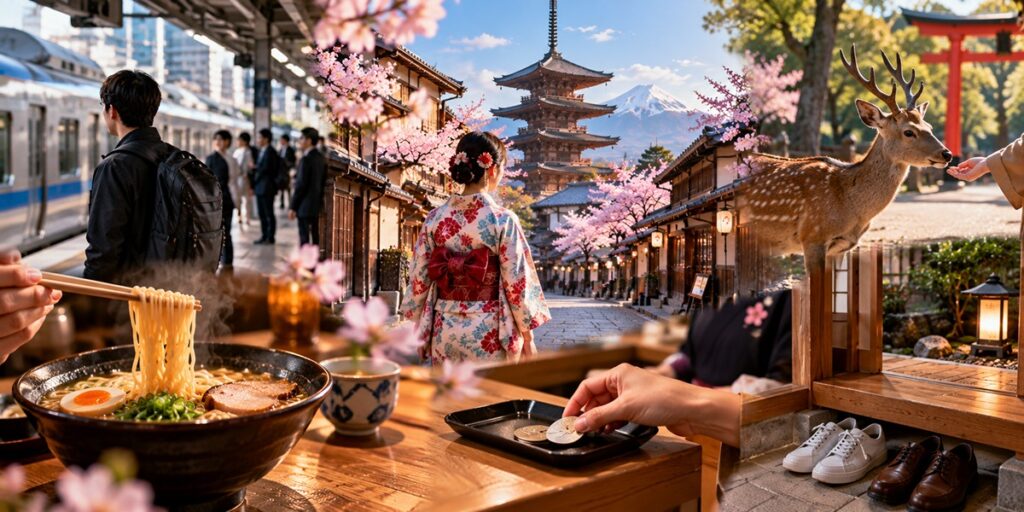
| Do | Don’t |
| Bow or nod when greeting and thanking | Tip; it can confuse or embarrass staff |
| Keep your voice down on trains and in public | Take phone calls on trains or buses |
| Take your shoes off where there’s a step up or tatami | Stick chopsticks upright in rice |
| Queue and wait your turn | Eat while walking in busy areas |
| Carry some cash | Hand money directly to staff; use the tray |
| Slurp your noodles | Pass food from chopsticks to chopsticks |
| Carry your rubbish until you find a bin | Photograph geisha or strangers without permission |
| Wash fully before getting into an onsen | Clap at a Buddhist temple (that’s for shrines) |
What’s Changed for Visitors in 2026
Most Japanese etiquette is centuries old. But record visitor numbers have pushed cities and neighbourhoods to spell out some expectations more clearly, and a few practical rules changed this year. Here’s what’s worth knowing before you go.
- The departure tax tripled. From 1 July 2026, Japan’s international departure tax rose from ¥1,000 to ¥3,000 per person. It’s usually built into your airline ticket, so there’s nothing to pay at the airport, but it explains a slightly higher fare.
- Tax-free shopping now works as a refund. From 1 November 2026, shops charge the full price including consumption tax, and you claim the tax back when you leave Japan. Keep your passport handy when shopping and allow time at the airport for the refund.
- Gion’s private alleys are off-limits. In Kyoto’s geisha district, residents have closed several private lanes off Hanamikoji Street to tourists, after years of visitors chasing geiko and maiko for photos. Signs warn of a ¥10,000 fine. The main street stays open, but photographing geisha without permission is never acceptable.
- Escalator rules are shifting. You’ll still see the old custom (stand on the left in Tokyo, on the right in Osaka) but Saitama Prefecture and Nagoya have passed ordinances asking people to stand still on both sides for safety. They carry no fines. Where you see “stand still” posters, do what they say.
- Some towns ask you not to eat while walking. Kamakura’s ordinance asks visitors not to eat on the move in crowded areas like Komachi-dori, and Kyoto’s Nishiki Market has similar signs. Again, there are no fines, but the message is clear: eat at the stall, then move on.
A useful rule of thumb: when a Japanese town asks politely, it’s rarely a suggestion. Requests like these usually come after residents have run out of patience.
Greetings, Bowing and Everyday Manners
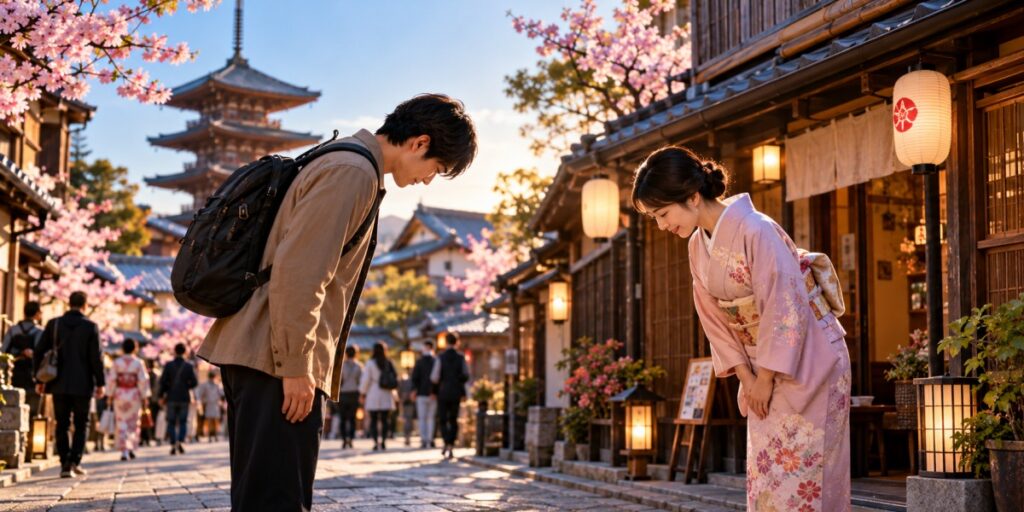
Japan greets with a bow rather than a handshake or hug. The depth signals respect: a quick nod of the head for a shopkeeper, around 15 degrees for a casual greeting, 30 for a polite one, and deeper bows for formal apologies or thanks. As a visitor, a small bow or nod is all anyone expects. If someone offers a hand, shake it; adding a slight bow is a nice touch.
Use family names with -san (Tanaka-san) unless you’re invited to use first names, and don’t add -san to your own name. Indirectness is normal, too. A hesitant “that might be difficult” usually means no, so listen for tone as much as words.
A few phrases cover most situations, and for everything else a translation app on a travel eSIM will see you through:
| Japanese | Romaji | When to use it |
| すみません | Sumimasen | Excuse me, sorry, or to get attention |
| ありがとうございます | Arigatō gozaimasu | Thank you (polite) |
| おはようございます | Ohayō gozaimasu | Good morning, until about 10am |
| こんにちは | Konnichiwa | Hello, during the day |
| こんばんは | Konbanwa | Good evening |
| はじめまして | Hajimemashite | Nice to meet you |
| いただきます | Itadakimasu | Before eating |
| ごちそうさまでした | Gochisōsama deshita | After eating, or when leaving a restaurant |
| お会計お願いします | Okaikei onegaishimasu | The bill, please |
One phrase to skip: sayōnara. It sounds like the textbook goodbye, but it carries a sense of finality. In daily life, people say mata ne (see you) or, more politely, shitsurei shimasu.
Punctuality matters as well. Being late is rude, but arriving very early can put pressure on your host. Aim for on time, or five minutes before.
Japanese Table Manners and Dining Etiquette
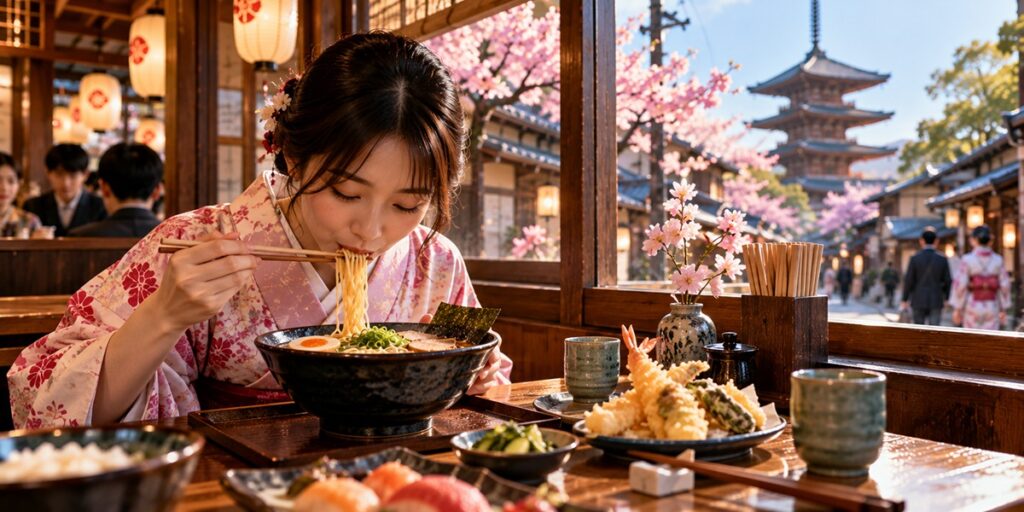
Eating out is one of the great pleasures of Japan, and the rules are easier than they look. Most restaurants will give you an oshibori, a hot or cold wet towel. It’s for your hands only, not your face or the table. Say itadakimasu before you start and gochisōsama deshita when you finish; staff genuinely appreciate it.
Chopstick etiquette
Two chopstick rules matter more than all the others, because both echo funeral rites:
- Never stand chopsticks upright in rice. It resembles incense sticks placed in rice offered to the dead.
- Never pass food from your chopsticks to someone else’s. At Japanese funerals, family members pass bone fragments this way after cremation. Put shared food on a plate instead.
Beyond those, rest your chopsticks on the holder (hashioki) rather than across your bowl, don’t point or wave them, and don’t spear food. When taking from a shared dish without serving chopsticks, some people turn theirs around and use the clean ends.
Rice, sushi and noodles
It’s polite to lift your rice bowl towards your mouth rather than lean down to it. Don’t pour soy sauce over plain rice; it’s meant to be eaten as it is. With nigiri sushi, eat each piece in one bite if you can, and dip the fish side, not the rice, into the soy sauce. Using your fingers for sushi is perfectly fine.
And yes, slurp your noodles. With ramen, soba and udon it cools them down and shows you’re enjoying the meal. One small caveat: some younger Japanese find heavy slurping annoying, so there’s no need to overdo it.
Ordering, queues and paying
Many ramen and casual restaurants use a ticket machine (shokkenki) at the entrance. You pay there, take your ticket and hand it to staff. Expect to queue at popular places, and wait to be seated rather than taking a table yourself.
When staff call out irasshaimase (welcome) as you walk in, you don’t need to reply; a smile or nod is plenty. You normally pay at the register near the door rather than at the table.
Drinking etiquette
Drinking is a big part of socialising in Japan, and it comes with a few customs:
- Pour for others, not yourself. When sharing a bottle, top up your companions’ glasses and let them pour for you. Holding the bottle, or your glass, with two hands is a polite touch.
- Wait for kanpai. Nobody drinks until everyone has a glass and the toast has been made.
- Expect to split the bill evenly. In groups, the total is often divided equally, regardless of who ordered what.
- Non-drinkers are fine. Oolong tea or a soft drink for the toast is completely acceptable.
Trains, Buses and Escalators
Public transport is where visitors most often slip up, because the norms are stricter than almost anywhere else. A phone call that nobody would notice in London or New York will turn heads in a Tokyo carriage.
- Keep quiet. Talk softly, keep headphones low, and set your phone to silent (manā mōdo, “manner mode”). Don’t take calls; step off at the next station if you must.
- Leave priority seats free for elderly passengers, pregnant women and people with disabilities. Look out for the red Help Mark tag on bags, which signals a condition that may not be visible.
- Avoid women-only carriages. Many lines run them during rush hour; they’re clearly marked on the platform and the train.
- Queue at the markings on the platform, and let passengers off before you board.
- Hold off on eating. Snacking on local trains is frowned upon. Long-distance shinkansen are the exception, where bento boxes are part of the experience.
- Wear your backpack on your front in crowded carriages, or put it on the rack.
Taxis have a quirk that catches almost everyone: the rear doors open and close automatically. Don’t touch them.
Streets, Smoking, Photos and Rubbish
What surprises many first-time visitors is how many rules apply out on the street, rather than indoors.
- Don’t eat while walking in crowded areas. Eat at the stall or step aside, then dispose of the packaging.
- Smoke only in designated areas. Smoking on the street is banned in much of central Tokyo, and some wards issue on-the-spot fines. Look for marked smoking areas.
- Wait for the green light. Jaywalking is illegal, and locals wait at red lights even on empty streets.
- Ask before photographing people, especially geiko and maiko in Kyoto. Never block their path. Some temples and museums prohibit photos inside, and drones need permits in most urban areas.
- Carry your rubbish. Japan’s streets are spotless, yet public bins are rare, because people take their rubbish home. Keep a small bag in your day pack, then use the bins at convenience stores or stations, sorting by type.
- Wear a mask if you’re sick. It’s normal and considerate in Japan. Blowing your nose loudly in public is frowned upon; find a restroom if you can.
Shrine and Temple Etiquette: They’re Not the Same

This is where many etiquette guides get it wrong. Shinto shrines (jinja) and Buddhist temples (tera) are different places with different customs, and the most common mistake is clapping at a temple. Here’s how to tell them apart and what to do at each.
| Shinto shrine | Buddhist temple | |
| How to recognise it | A torii gate, often red or plain wood | A large wooden gate (sanmon), often with guardian statues; incense burners |
| Entering | Bow once before the torii; walk at the side of the path, since the centre is for the deity | Bow at the gate; step over the threshold rather than on it |
| Purifying | Rinse at the water basin (temizuya) | Many temples also have a basin; some have an incense burner where people waft smoke over themselves |
| Praying | Coin in the box, ring the bell if there is one, then bow twice, clap twice, pray, bow once | Coin in the box, put your palms together, pray quietly and bow. No clapping |
How to use the water basin: hold the ladle in your right hand and rinse your left hand. Switch hands and rinse your right. Pour a little water into your cupped left hand and rinse your mouth (never drink from the ladle), rinse your left hand again, then tip the ladle upright so the remaining water runs down the handle. Some basins have been changed to running water or flowers; follow what’s there.
A few more customs apply at both:
- A ¥5 coin is the traditional offering. “Five yen” (go-en) sounds like the word for a good connection, or fate.
- Take off hats and sunglasses, and keep your voice down.
- Remove your shoes when entering halls with tatami or wooden floors; there’s usually a rack or a bag provided.
- Check before taking photos inside. Many halls don’t allow them, and never photograph people while they’re praying.
- Don’t open an omamori, the protective charm sold at shrines and temples. Opening it is said to release its protection.
Onsen Etiquette: A Step-by-Step Guide

A public bath, either an onsen (hot spring) or a sento (neighbourhood bathhouse), is one of the most relaxing things you can do in Japan, and the rules all come down to keeping the shared water clean.
- Take your shoes off at the entrance and put them in a locker.
- Find the right side. Baths are separated by gender. The men’s side usually has a blue curtain marked 男, the women’s a red curtain marked 女.
- Undress fully in the changing room. Swimwear isn’t allowed. Leave your clothes and large towel in a basket or locker, and take only the small towel with you.
- Wash thoroughly first. Sit on a stool at the shower stations and scrub and rinse until no soap is left. This is the most important rule of all.
- Ease in quietly. Keep the small towel out of the water (many people fold it on their heads), keep long hair tied up and out of the bath, and keep conversation low.
- Rinse or wipe down before returning to the changing room, so you don’t drip across the floor.
What about tattoos? Tattoos have long been associated with the yakuza, and many onsen still ban them. Policies are relaxing, especially in big cities and tourist areas. Look for tattoo-friendly baths, cover small tattoos with a skin-coloured patch where that’s allowed, or book a private bath (kashikiri). Always check the policy before you go.
Ryokan, Homes and the Slipper System
Staying at a ryokan (traditional inn), or being invited into a Japanese home, comes with a set of floor rules that can feel like a puzzle at first.
- Shoes come off at the entrance (genkan), where the floor steps up. Turn them so the toes point towards the door.
- Wear the slippers provided indoors, but take them off before stepping onto tatami mats. Walk on tatami in socks or bare feet.
- Use the toilet slippers waiting inside the bathroom, and leave them there. Walking back into the room in toilet slippers is a classic mistake.
- Wear your yukata left side over right. The cotton robe provided by ryokan is wrapped with the left panel on top. Right over left is how the dead are dressed for burial.
- Don’t drag luggage across tatami. Carry it, or leave it in the entrance area.
- Stick to meal and bath times. Ryokan dinners are served at set times, and staff often lay out your futon while you eat.
If you’re visiting someone’s home, bring a small gift (omiyage), such as sweets from your home country. It’s normal for the host not to open it in front of you.
Money, Tipping and Gifts
- Don’t tip. Good service is simply expected and already included in the price. Leave money on the table and staff may chase you down the street to return it. A sincere arigatō gozaimasu is the right thank-you.
- Use the tray. At most registers, there’s a small tray (karuton). Put your cash or card in it rather than handing it over, and your change will come back the same way.
- Carry some cash. Japan is far more card-friendly than it was, and phone-based Suica or PASMO cards make trains painless, but smaller restaurants, temples and rural shops still often prefer cash.
- Give and receive with both hands. This applies to gifts, business cards (meishi) and anything handed over formally. Take a moment to look at a business card before putting it away, and never stuff it in your back pocket.
- Mind the numbers in gifts. Avoid sets of four, because shi (four) sounds like the word for death. Gifts are usually wrapped neatly, and when giving money as a gift, always put it in an envelope.
Phone and Camera Manners
Your phone is probably the thing most likely to get you a disapproving look in Japan, and also the thing that helps most with everything else in this guide.
The rules are simple. Keep it on silent on public transport, and don’t take calls on trains or in restaurants. Don’t film strangers or livestream in public places; several high-profile incidents involving foreign streamers have made Japanese people especially wary of it. Ask before photographing anyone, and respect “no photo” signs in temples, shops and private alleys.
Used well, though, a phone makes etiquette easier: translating a menu, pulling up the right phrase, checking a shrine’s customs, or finding your way without blocking a busy pavement while you stare at a map. That’s where a travel eSIM helps. An Airhub Japan eSIM gives you data from the moment you land, with no airport SIM queue or pocket Wi-Fi to carry. Check that your phone supports eSIM and set it up at home before you fly. Keep your home SIM for calls and texts, and run maps and translation on the eSIM.
The Bottom Line

None of this is a test you can fail. Japanese etiquette is really consideration turned into habit: a set of small, shared agreements that keep crowded places pleasant for everyone. Bow a little, stay quiet on the train, take your shoes off when asked, carry your rubbish, and remember not to clap at temples. On the rare occasion you get something wrong, the effort you’ve made will almost always be met with warmth.
FAQs
1. What are the most important etiquette rules in Japan?
Keep your voice down in public and on trains, take your shoes off where required, don’t tip, queue patiently, never stand chopsticks upright in rice, and wash before getting into an onsen. Most rules come down to not inconveniencing the people around you.
2. What is considered rude in Japan?
Talking loudly or taking phone calls on trains, eating while walking in crowded streets, wearing shoes indoors, tipping, smoking outside designated areas, photographing people without permission and getting into an onsen without washing are all considered rude.
3. Is it rude to tip in Japan?
Yes. Tipping isn’t customary and can make staff uncomfortable, because good service is expected and included. A sincere “arigatō gozaimasu” is the right way to say thank you.
4. Do you clap at Japanese temples?
No. Clapping is part of praying at Shinto shrines, where you bow twice, clap twice and bow once. At Buddhist temples, you put your palms together and pray quietly without clapping.
5. Is it rude to eat while walking in Japan?
In busy areas, yes. Some places, including Kamakura, have ordinances asking visitors not to. Eat at the stall or step aside, then carry your rubbish until you find a bin.
6. Is slurping noodles rude in Japan?
No. Slurping ramen, soba or udon is normal and shows you’re enjoying the meal. Rice and soup are eaten quietly.
7. Can I go to an onsen with tattoos?
Sometimes. Many onsen still ban tattoos, though policies are relaxing. Look for tattoo-friendly baths, cover small tattoos with a patch where allowed, or book a private bath, and check the policy first.
8. Which side of the escalator do you stand on in Japan?
Traditionally the left in Tokyo and the right in Osaka. But Saitama and Nagoya now ask everyone to stand still on both sides, so follow local signs.
9. Do I need cash in Japan?
It’s wise to carry some. Cards and IC cards like Suica are widely accepted in cities, but small restaurants, temples and rural areas often prefer cash.
10. How can I stay connected in Japan?
Set up a travel eSIM before you go so you have data for maps, translation and train times as soon as you land. An Airhub Japan eSIM installs with a QR code in a few minutes. If you’ll be streaming, video-calling or sharing a hotspot, an eSIM with unlimited data saves you from watching your balance.
Leave a Reply