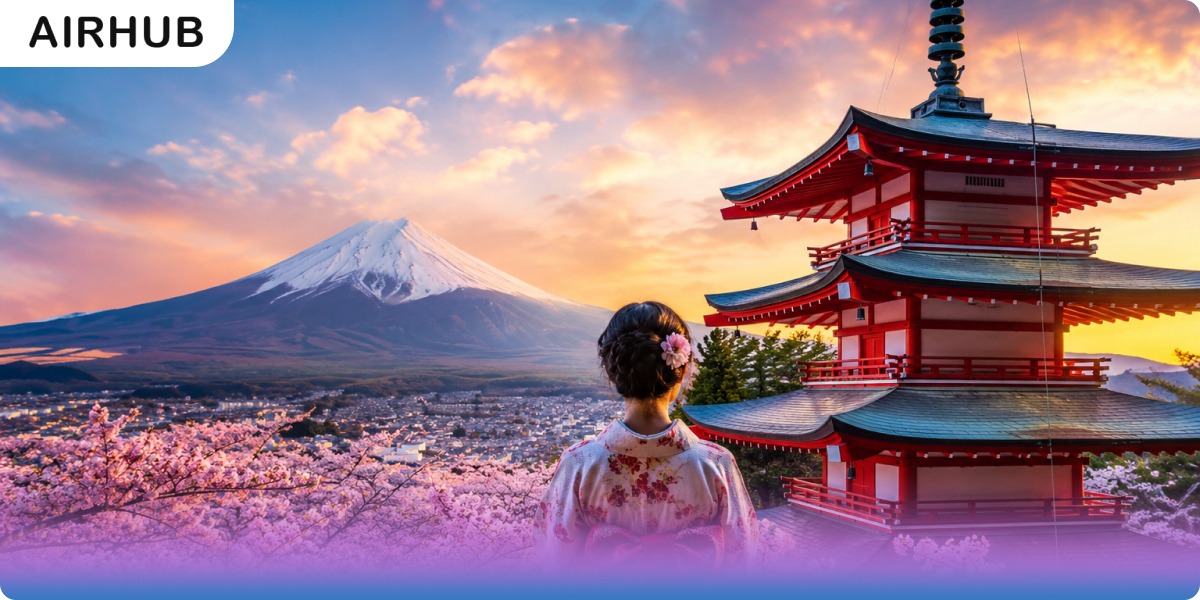
Most first-time trips to Japan are planned backwards, and it quietly ruins them. You see one photo — a torii gate in the fog, Fuji mirrored in a still lake — decide that’s the trip, and then spend two weeks chasing that single image up and down the country. Days disappear on trains. You hop between highlights that don’t connect, and the whole thing feels like admin.
There’s a better way, and Japan practically hands it to you. Instead of letting one famous sight dictate everything, pick a line of places that already sit close together and let the highlights fall along the way. The Shinkansen threads the country onto one fast, almost comically punctual line, so get the order right and you barely double back.
So this isn’t just a list of pretty places. It’s the top 10 places to visit in Japan, set in the order you’d actually travel them — big cities first, then the mountains, the history, the islands. Every entry covers what to do, when to go, how to get there, and how long to stay. And at the end, the part most guides quietly skip: the small mechanics — trains, cash, getting online — that decide whether two weeks in Japan feels effortless or exhausting.
Short on time? The classic route runs Tokyo → Hakone/Mt Fuji → Kyoto → Nara → Osaka → Hiroshima. Two weeks is comfortable; ten days works if you keep moving. The full version is below.
Quick reference
| Place | Region | Best for | Ideal stay | Best season |
| Tokyo | Kanto | City life, food, culture | 3–4 days | Spring / autumn |
| Kyoto | Kansai | Temples, old Japan | 3 days | Spring / autumn |
| Osaka | Kansai | Food, nightlife | 2 days | Spring / autumn |
| Mt Fuji (Hakone) | Chubu | Views, onsen | 1–2 days | Jul–Sep to climb |
| Hiroshima & Miyajima | Chugoku | History, island shrine | 1–2 days | Autumn |
| Takayama | Chubu (Alps) | Old-town streets, ryokan | 1–2 days | Apr / Oct |
| Yokohama | Kanto | Harbour, Chinatown | 1 day | Spring / autumn |
| Koyasan | Kansai | Temple stay | 1 night | Apr–Nov |
| Kamikōchi | Chubu (Alps) | Alpine scenery | 1 day | May–Oct |
| Yakushima | Kyushu | Ancient forest | 2–3 days | Spring / autumn |
The 10 best places to visit in Japan
1. Tokyo — the essential starting point
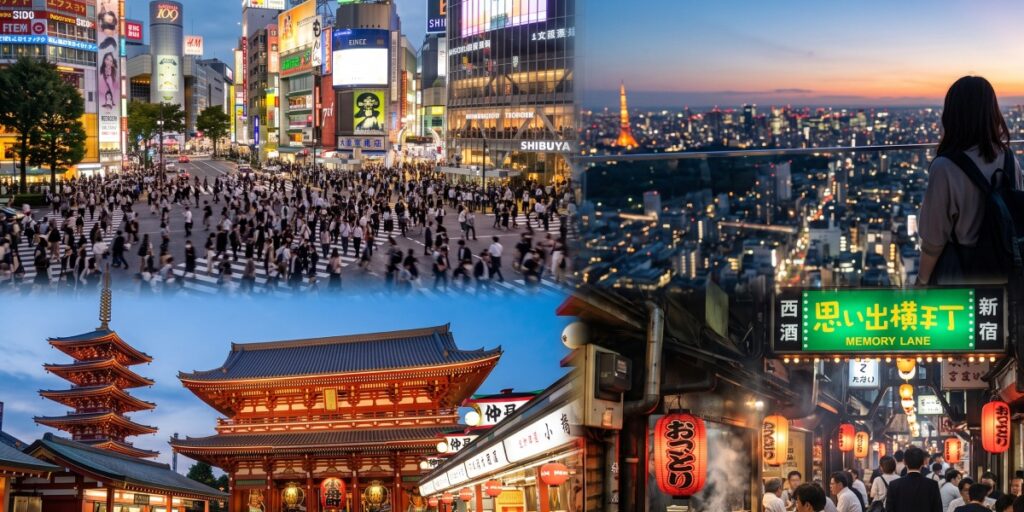
Most trips start in Tokyo, and they should. It isn’t really one city so much as a dozen small ones shoved together — and that’s the fun of it. One minute you’re wedged into the scramble at Shibuya Crossing; twenty minutes later you’re on a gravel path at Meiji Shrine and it’s dead silent.
The trick is to take it neighbourhood by neighbourhood. Do Asakusa early, before the crowds land, and see Senso-ji. Lose an afternoon in Akihabara, the electronics-and-anime district — and you will lose it. Come night, head to Shinjuku and squeeze into one of the tiny bars in Omoide Yokocho, the alley everyone name-drops afterwards. Honestly, the best of Tokyo tends to happen in the walking between the big sights, so don’t over-schedule — leave gaps.
Want one knockout view? Book Shibuya Sky at dusk. People who’ve been a few times quietly rate it above everything else: it’s open-air, and you get the full 360 as the lights come up. Skip Tokyo Skytree, though. It’s taller, sure, but between Shibuya Sky and the free views dotted around the city, it rarely earns the queue or the ticket price.
Best time: March–May or September–November — milder, less humid. Getting there: fly into Haneda if you can; it’s closer and simpler than Narita, which staples a long train ride onto an already long flight. Ideal stay: 3–4 days, or five with a day trip out to Hakone or Mt Takao.
2. Kyoto — old Japan, if you time it right
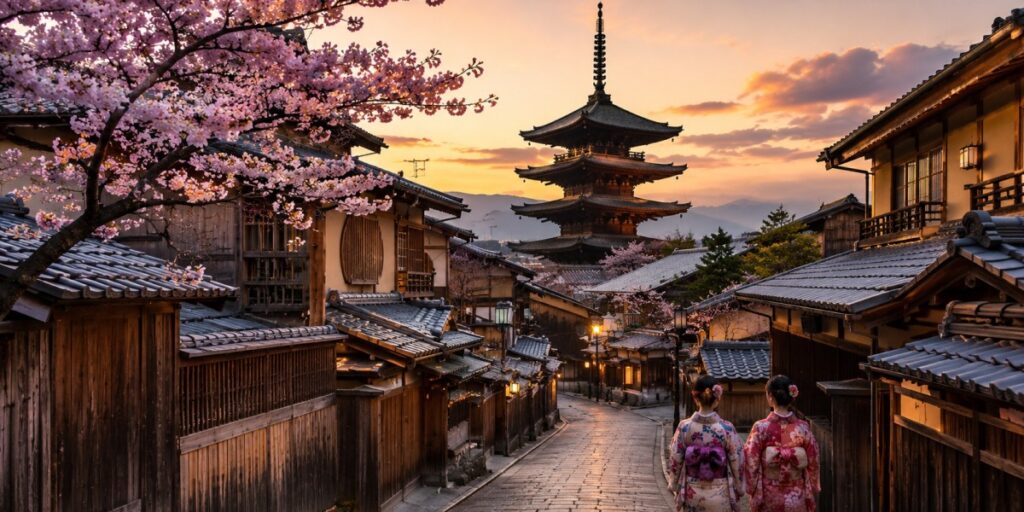
Two and a half hours from Tokyo on the bullet train and you’re in Kyoto — the Japan people picture before they’ve ever set foot in the country. Around 1,600 temples and 400 shrines. Wooden machiya townhouses. The long red torii tunnels at Fushimi Inari. Here’s the tip that genuinely pays off: don’t linger at the crowded lower gates. Keep climbing for fifteen or twenty minutes and the crowds simply melt away — then it’s just you and the stone foxes.
The postcard quarter is Higashiyama, around Kiyomizu-dera and Gion. But when it comes to where to stay, downtown near Nishiki Market is usually the smarter play — better transit, less of your day lost getting around. In cherry-blossom season the whole city seizes up, so move early or late and resist the urge to overplan. Dinner in Gion or Pontocho Alley? Book ahead; walking in almost never works.
Best time: spring or autumn, with the biggest crowds late March into early April. Getting there: bullet train from Tokyo. Ideal stay: 3 days — two really isn’t enough.
3. Osaka — Japan’s kitchen
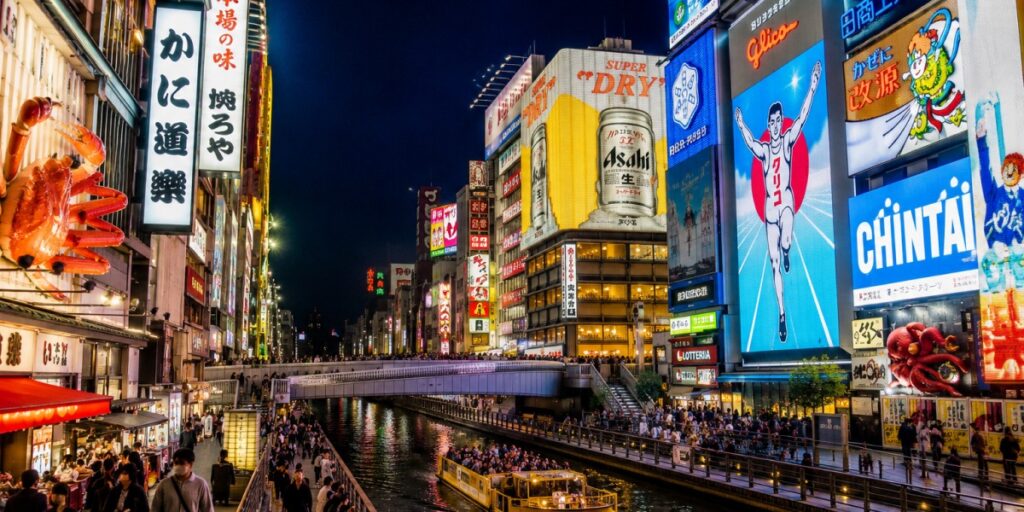
Fifteen minutes from Kyoto on the Shinkansen — half an hour on the rapid train — and the whole mood flips. Where Kyoto is hushed and historic, Osaka is loud and built around food. Ditch the reservations for a night. Walk Dotonbori under the neon and eat takoyaki straight off the griddle. Raid Kuromon Market for Kobe beef and seafood. Then hunt down a little izakaya on a side street — the sort with a handwritten menu and nobody performing for tourists.
By day, Osaka Castle and Shitennoji Temple are worth an hour; the nights belong to Namba and Dotonbori. People almost always warm to Osaka more than they expect — it’s rougher round the edges than Tokyo or Kyoto, and that’s precisely the appeal. It also doubles as a handy base for a day trip to the deer in Nara.
Best time: March–May or September–November. Getting there: about 30 minutes from Kyoto on the Special Rapid, or 15 on the Shinkansen to Shin-Osaka. Ideal stay: 2 days — three if you really like to eat.
4. Mount Fuji, via Hakone — the icon, done the smart way
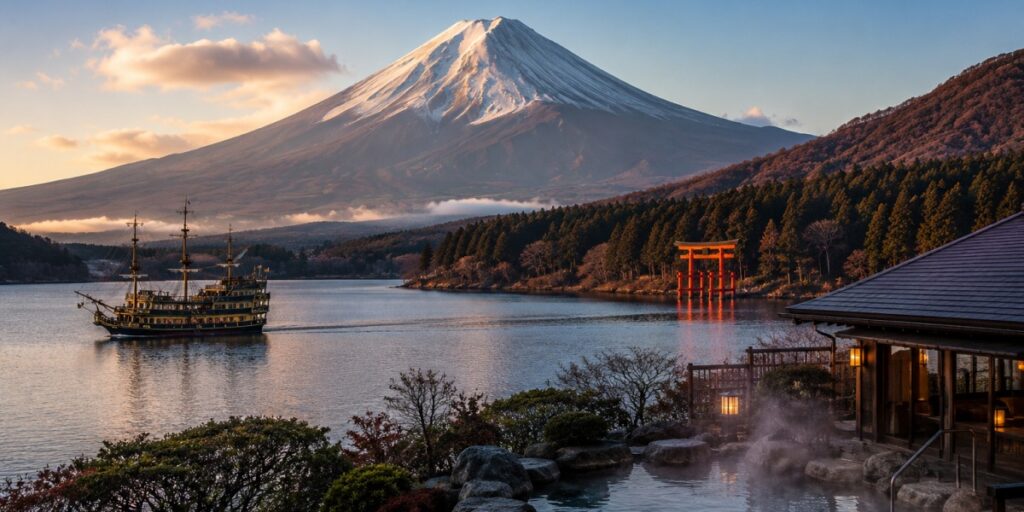
Fuji’s climbing season is brief — roughly early July to early September. Outside that window the mountain is snowed in and closed, so unless your dates line up and you genuinely want the summit, the smarter move is simply to look at it. Hakone is the easy way in: a short hop from Tokyo buys you a boat across Lake Ashi, a ropeway over the steaming volcanic vents, a scattering of open-air art, and a night in an onsen ryokan — hot-spring baths and a futon on tatami. Kawaguchiko, over in the Fuji Five Lakes, is the other strong pick, and it’s where those flawless mirror-lake shots of Fuji actually come from.
One honest warning: the mountain is shy, forever ducking behind cloud. Build in a spare day for a clear one, and know that autumn and winter tend to serve up the sharpest views.
Best time: early July to early September to climb; autumn and winter for the clearest views. Getting there: train from Tokyo to Hakone-Yumoto or Kawaguchiko. Ideal stay: 1–2 days.
5. Hiroshima & Miyajima — history that stays with you
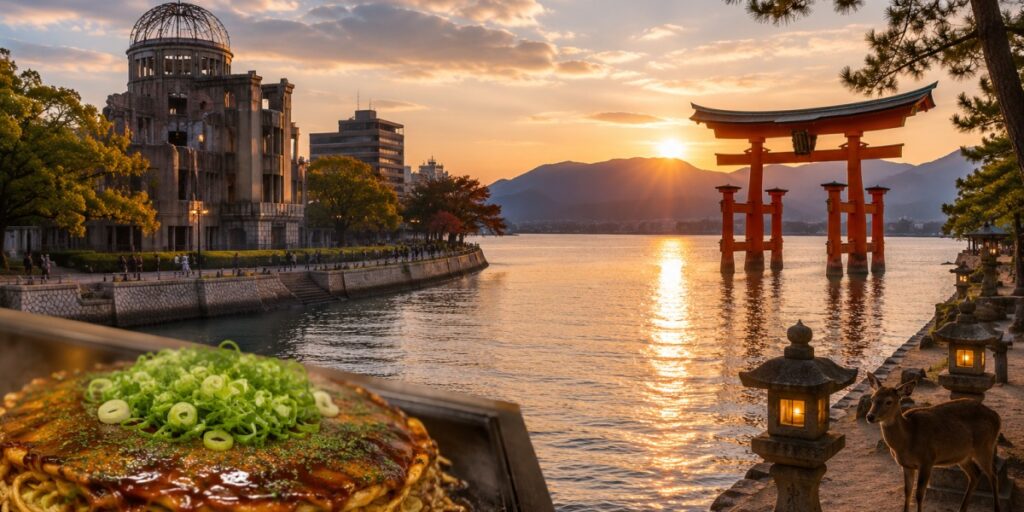
Some places you go to for fun. Hiroshima isn’t one of them. The Peace Memorial Park, the museum, the hollowed-out shell of the Atomic Bomb Dome — it’s heavy, and it’s worth every minute. A couple of hours here honestly recalibrates how you see the rest of the trip. Then the ferry to Miyajima lifts the mood again: at high tide the great red torii gate seems to float, and the deer amble about like they own the island, which, functionally, they do. Afterwards, track down Hiroshima-style okonomiyaki — layered rather than mixed like Osaka’s version, and worth going out of your way for.
Hiroshima sits far to the west, so it slots into a two-week trip far more comfortably than a rushed one.
Best time: October–November for clear, cool days. Getting there: about 1.5 hours from Osaka on the Shinkansen, then a short train and a ferry across to Miyajima. Ideal stay: 1–2 days — one for the city, one for the island.
6. Takayama — the old town in the Alps
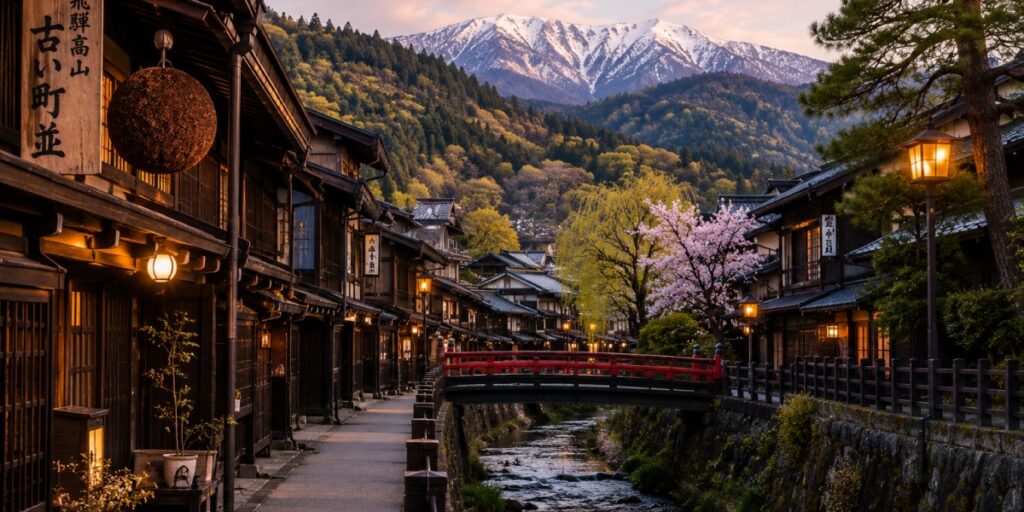
Take the winding train up from Nagoya and watch the city dissolve into river valleys. Takayama, tucked in the Hida mountains, keeps one of the best-preserved old towns in the country: dark-wood sake breweries with fat cedar balls hung above the doors, riverside morning markets, quiet lantern-lit lanes in Sanmachi Suji. Land there during the Takayama Festival in April or October and you’ll catch one of the finest float parades in Japan.
Stay in a ryokan while you’re up here — tatami, shared baths, a long, unhurried kaiseki dinner. And carve out half a day for Shirakawa-go nearby, the UNESCO village whose steep thatched roofs were built to shrug off heavy snow.
Best time: April or October, for the festivals. Getting there: a scenic 2.5-hour train from Nagoya. Ideal stay: 1–2 days.
7. Yokohama — Tokyo’s easygoing neighbour
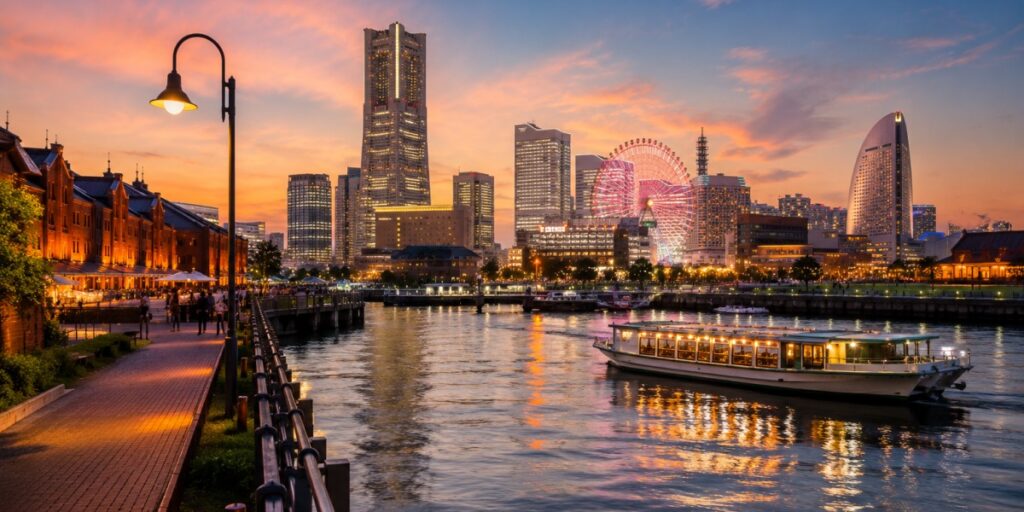
Half an hour south of Tokyo, Yokohama is a relaxed harbour city — the ideal release valve for a day when Tokyo starts to feel like a lot. Stroll the waterfront at Minato Mirai, eat your way through Japan’s biggest Chinatown, and yes, actually go to the Cup Noodles Museum; it’s far better than it has any right to be. As one of the first ports Japan opened to the world, it still carries that easy, mixed, international air.
Best time: March–May or September–November. Getting there: a short train from central Tokyo. Ideal stay: 1 day.
8. Koyasan — a night with the monks
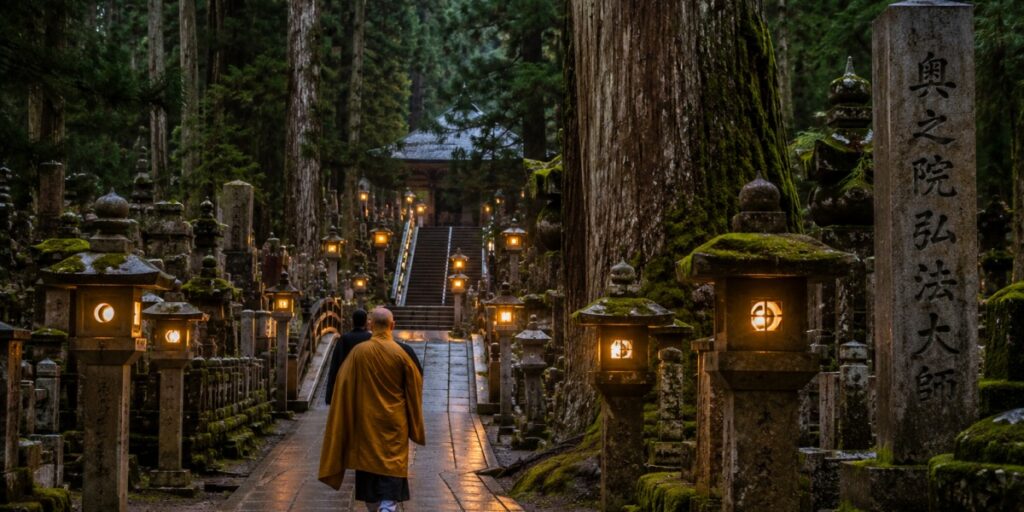
For something no city can give you, climb up to Koyasan, a sacred mountain town at the heart of Shingon Buddhism. The whole point of coming is the shukubo — an overnight stay inside a working temple. You sleep in a spare, simple room, eat shojin ryori (the vegetarian food the monks themselves eat), and wake before dawn for chanting and a fire ritual. Save the evening for Okunoin, Japan’s largest cemetery: a two-kilometre path of moss-furred stone lanterns beneath enormous old cedars. It’s hushed, and about as atmospheric as anywhere in the country.
Best time: April–November; winters up here are cold and snowbound. Getting there: train and cable car from Osaka. Ideal stay: 1 night — the overnight is the point.
9. Kamikōchi — the Alps without the effort
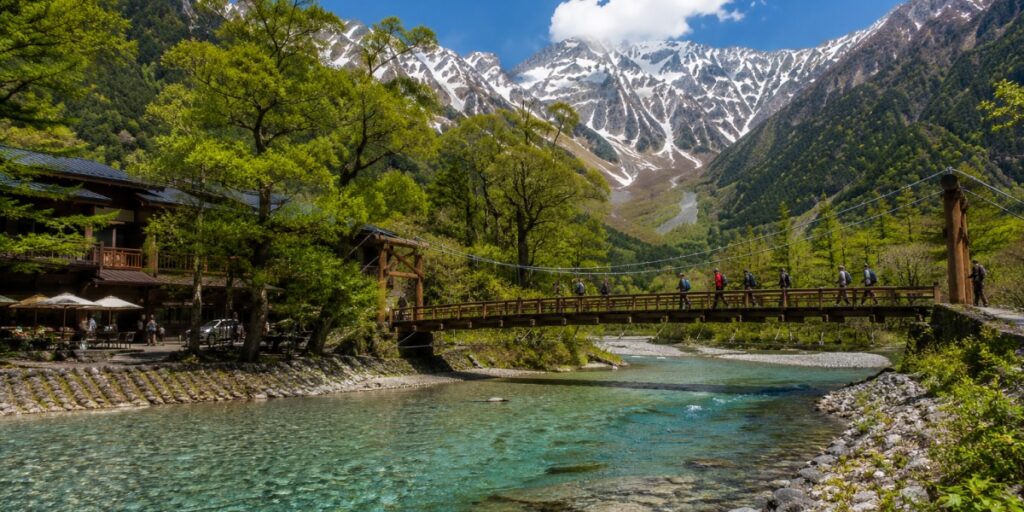
Kamikōchi is a car-free valley high in the Northern Japan Alps, open roughly mid-April to mid-November. Private cars are banned, which is exactly what keeps it so peaceful — and you don’t need to be a hiker to love it. The valley floor is largely flat, laced with boardwalks and gentle trails along the startlingly clear Azusa River. Kappa Bridge frames the peaks behind it, and the air genuinely feels different up there. If you want a taste of alpine Japan without climbing a thing, this is the easiest door in.
Best time: May–October; it closes down entirely in winter. Getting there: train to Matsumoto, then a bus in — no cars allowed. Ideal stay: a full day, or overnight to properly slow down.
10. Yakushima — the island out of a Ghibli film
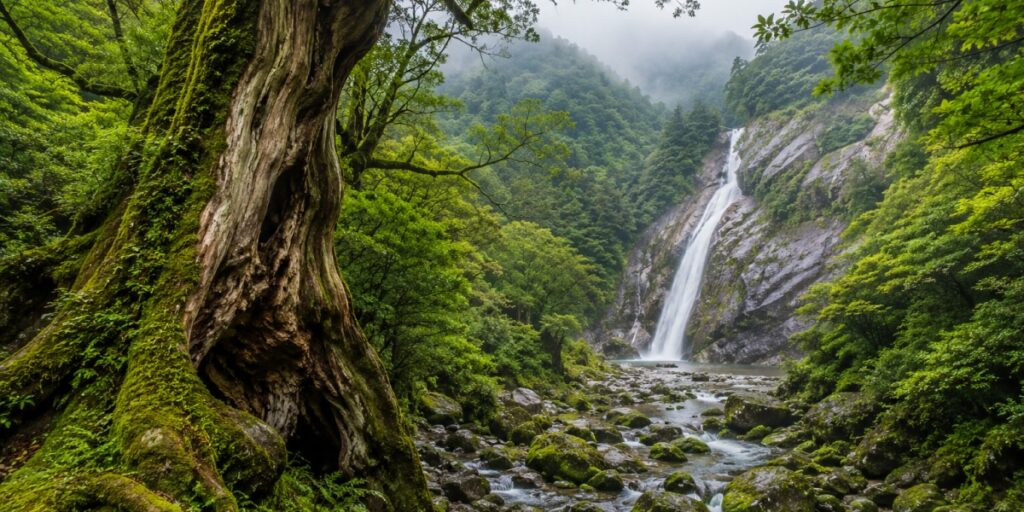
Off the coast of Kyushu, Yakushima feels genuinely ancient: a mist-wrapped, moss-drowned cedar forest of the kind said to have inspired Studio Ghibli’s Princess Mononoke. Some of the yakusugi cedars here have stood for thousands of years, and the island is stitched through with waterfalls and mountain trails. It’s a superb final chapter for a nature lover — just pack proper rain gear. This is one of the wettest places in Japan, which is precisely why it’s so impossibly, luminously green.
Best time: spring or autumn — cooler, and a touch drier. Getting there: a short flight or ferry from Kagoshima. Ideal stay: 2–3 days.
Worth adding if you have time
A few more that repay the detour — barely a detour at all, really. Nara is an hour from Osaka or Kyoto, with a park full of bowing deer around the colossal bronze Buddha at Todai-ji. Kanazawa has Kenroku-en, one of the three great gardens of Japan, plus a geisha district every bit as lovely as Kyoto’s but without the crush. And Himeji — the finest surviving original castle in the country — sits right on the line between Osaka and Hiroshima, so it drops into the route with almost no detour at all. All three slide straight into the plan.
Plan your trip: days, route & getting around
- How many days? A week is plenty for Tokyo, Kyoto and Osaka at a civilised pace. Stretch it to 10–14 if you want to fold in Fuji/Hakone, Hiroshima, and one mountain or island stop without feeling hurried.
- A route that works for first-timers: Tokyo (3–4 days) → Hakone/Mt Fuji (1–2) → Kyoto (3) → a day trip to Nara → Osaka (2) → Hiroshima with Miyajima (1–2). Want it quieter and wilder? Work in Takayama, Kamikōchi, Koyasan, or Yakushima. It’s essentially a clean sweep west and south, with very little doubling back.
- Getting around. The Shinkansen is the backbone — fast, spotless, always on time. If you’re covering serious ground, price out a Japan Rail Pass and check whether it genuinely beats buying single tickets for your route. It’s gone up in price lately, so it no longer wins by default the way it used to; do the maths first. In the cities, an IC card (Suica or Pasmo — both now live in Apple Wallet and Google Wallet) taps you onto trains, buses, and even convenience-store counters. Japan is safe, clean, and easy to navigate on the main routes. It’s worth lining up an eSIM Japan plan too, so you’ve got data for navigation, translation, ride-hailing and bookings the moment you land.
The part other guides skip: Japan’s travel mechanics
This is the bit most “best places” lists leave out, and it’s the bit that actually shapes your day. Japan runs on a handful of small systems. Once they click they’re effortless; until they do, they’re quietly baffling.
The konbini is your basecamp. 7-Eleven, Lawson and FamilyMart aren’t just corner shops here. You’ll find genuinely good food for a few hundred yen, ATMs that reliably accept foreign cards (plenty of overseas cards get rejected at Japanese bank ATMs but work fine at 7-Eleven), tickets for events and attractions, even a counter to send a suitcase ahead.
Cash still matters more than you’d think. For all its high-tech reputation, Japan runs on cash more than visitors expect. Temples, small restaurants, countryside buses, markets — notes only, a lot of the time. Keep some yen on you and top up at that konbini ATM whenever you’re running low.
Luggage forwarding — takuhaibin — is a quiet gift. For a small fee, usually a couple of thousand yen a bag, your suitcase is shipped hotel to hotel overnight while you travel with just a day pack. On a jammed Shinkansen, or in a station that’s nothing but stairs, it’s transformative.
And connectivity ties the whole lot together. Almost everything above assumes you’re online: the ATM finder, the train app, translating a cash-only menu, hunting down a temple on an unmarked lane. Free public Wi-Fi in Japan is patchier than people expect, and it tends to evaporate the second you step away from a station or café. Sorting your mobile data before you land is one of the most underrated pieces of prepping for this trip.
Staying connected in Japan with an eSIM
/Picking up a physical SIM as a foreigner can still mean a counter, a queue, and a form or two. An eSIM sidesteps all of it: set up a Japan plan before you fly, and you’re online the instant you land — no shop, no swap. It’s the quiet thing that makes the rest of the trip run smoothly, from Google Maps and menu translation to booking the next Shinkansen leg on the move. Install it before you leave so it’s ready to switch on when you arrive, and just check first that your phone supports eSIM — most recent iPhones, Pixels and Galaxy models do. And if you’ll want to make the odd real phone call (ringing ahead to a ryokan, say), an esim with data and voice calls covers both rather than data alone.
FAQs
1. Is Japan worth visiting?
Few countries pack in this much — big cities, extraordinary food, old temples, mountains, islands — and manage it with travel this smooth, safe, and clean. For most first-timers, it clears the hype with room to spare.
2. How many days do you need in Japan?
A week covers Tokyo, Kyoto and Osaka. Give it 10–14 days if you want Fuji/Hakone, Hiroshima, and a nature stop without feeling rushed.
3. What’s the best time to visit Japan?
Spring (late March to May) for the cherry blossoms, autumn (October–November) for the changing leaves. Summer is hot and humid; winter brings snow, hot springs, and thinner crowds. Our best time to visit Japan guide breaks it down month by month.
4. Is Japan expensive to travel?
It can be surprisingly affordable. Convenience-store food, ramen shops, and business hotels keep daily costs down, and a Japan Rail Pass can still pay off over long distances. Bring cash — small towns remain cash-first.
5. Is $1,000 enough for a trip to Japan?
For on-the-ground costs, yes — if you’re smart about it. Budget hotels or hostels, local food, a rail pass where it makes sense. Tight but doable, and that’s before flights.
6. What should I avoid doing as a tourist in Japan?
Don’t talk loudly or take calls on trains. Wash thoroughly before getting into an onsen. And never stand your chopsticks upright in a bowl of rice — it echoes a funeral custom, and it’s a genuine faux pas.
7. Do I need a visa to visit Japan?
Many nationalities get visa-free entry for up to 90 days, but it depends on your passport. Check your own country’s rules before booking.
8. How much mobile data do I need for two weeks in Japan?
Around 5–10GB covers two weeks if you’re mainly on Google Maps, messaging, browsing, and social media. If you’ll stream, upload a lot of photos, or work remotely, size up to 20GB or an unlimited plan. Sorting an eSIM before you travel means you can navigate, translate menus, and book transport from the moment you land — no hunting for public Wi-Fi.
Leave a Reply