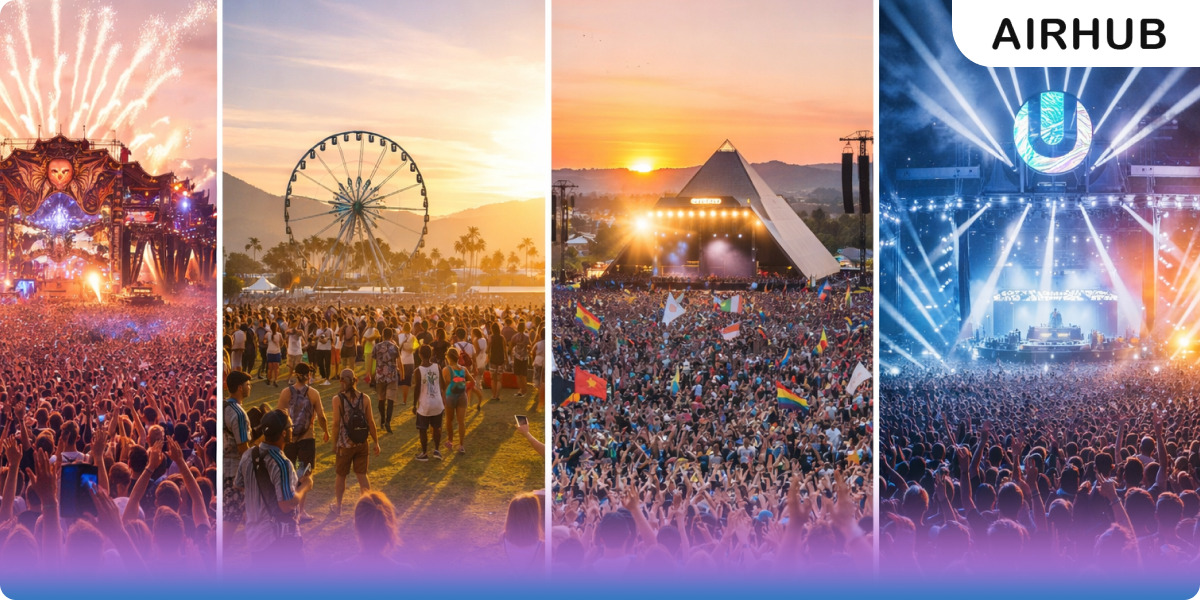
From Tomorrowland to Coachella, here are some of the world’s biggest music festivals by reported attendance and global reach, with 2026 dates, lineups, travel tips, and advice for staying connected abroad.
Ask ten people to name the biggest music festival on earth and you’ll probably hear the same handful of answers: Coachella, Glastonbury, Tomorrowland. Here’s the catch none of them has the highest reported attendance.
The festival that holds the record is a free event on an island in Vienna that many international travelers have never heard of. That gap between the festivals that dominate your feed and the ones that quietly attract millions of visitors is one of the most interesting things about this category.
Whether you’re a rock fan, EDM devotee, or simply chasing one unforgettable weekend abroad, this guide looks at the biggest festivals by reported attendance and global reputation, then breaks down what each one is like and how to plan the trip as an international traveler including how to stay connected once you’re standing in a field with thousands of other people.
What Is the Biggest Music Festival in the World?
It depends on how you measure “biggest.”
By a single-event attendance record, Donauinselfest in Vienna is the standout. The free, three-day festival attracted around 3.3 million people in 2015, a figure associated with the Guinness World Record for the largest attendance at a music festival at a single location.
Summerfest in Milwaukee is another major contender and continues to use the “World’s Largest Music Festival” name. In 2026, it welcomed 568,711 people across its official nine-day, three-weekend run, with total attendance reaching 613,475 when two Garth Brooks kickoff shows are included.
Meanwhile, festivals such as Coachella and Tomorrowland have a much smaller physical audience but enormous global influence. Coachella is one of the world’s most recognizable pop-culture festivals, while Tomorrowland’s 2026 edition brought together around 400,000 people from more than 200 countries across two weekends.
So, “biggest” can mean the most visitors, the most performances, the biggest international audience, or the greatest cultural influence. This guide covers all of those angles.
The Biggest Music Festivals by the Numbers
Reported attendance figures give you a useful sense of scale, but they aren’t directly comparable. Free festivals can count total visits across several days, while ticketed festivals generally report admissions or attendance across the event.
| Festival | Country | Genre | Reported attendance |
| Donauinselfest | Austria | Multi-genre | ~3.3 million |
| Mawazine | Morocco | World, pop | ~2.75 million |
| Montreal International Jazz Festival | Canada | Jazz, multi-genre | ~2 million |
| Summerfest | USA | Multi-genre | ~568,000 in 2026 |
| Rock in Rio | Brazil | Rock, pop, electronic | 100,000+ expected per day in 2026 |
| Sziget | Hungary | Multi-genre | Up to ~530,000 |
| Lollapalooza | USA | Multi-genre | ~400,000 |
| Tomorrowland | Belgium | Electronic, EDM | ~400,000 across two weekends |
| Coachella | USA | Pop, indie, hip-hop | ~250,000 across two weekends |
| Glastonbury | UK | Multi-genre | 200,000+ in typical editions |
The figures above should be treated as reported or historical attendance rather than an exact apples-to-apples ranking. For example, the Montreal International Jazz Festival has reported more than two million visitors, much of that attendance coming from free outdoor programming.
Summerfest’s official 2026 figure was 568,711 for the festival itself. Tomorrowland says around 400,000 people from more than 200 countries attend its Belgium edition across the two weekends.
The numbers also show why size and fame aren’t the same thing. Coachella and Tomorrowland attract hundreds of thousands rather than millions, but their international cultural reach is enormous.
The Biggest Electronic Music Festivals
Want the loudest, brightest and most over-the-top version of a festival? Electronic music festivals are built around DJ sets and genres such as house, techno, trance, drum and bass and EDM. These are three of the biggest names to know.
Tomorrowland — Boom, Belgium
Tomorrowland is one of the world’s most recognizable electronic music festivals. Every summer, the Belgian town of Boom becomes a themed festival world across two weekends, with elaborate stages, large-scale production and performances from some of the biggest names in electronic music.
The 2026 Belgium edition took place July 17–19 and July 24–26 at De Schorre in Boom. The 2026 theme was Consciencia, and the event was officially sold out.
There’s also DreamVille, the festival’s camping village, which lets ticket-holders stay close to the action.
Before you go: register for the official ticket sale in advance, as demand is extremely high. If you’re staying at DreamVille, plan accommodation and transport early.
A Belgium eSIM or Europe eSIM can also be useful for maps, transport, messaging and meeting friends during the trip.
Ultra Music Festival — Miami, USA
Ultra Music Festival takes over Bayfront Park in downtown Miami and is one of the biggest electronic music events in the world.
The 2026 edition took place March 27–29. The festival’s organizers reported that the 2025 edition welcomed 165,000 attendees from more than 100 countries, showing just how international its audience has become.
Miami is the flagship Ultra event, while the wider Ultra brand has expanded into festivals around the world.
Before you go: book early, prepare for Miami’s heat and humidity, and plan your transport before the festival gets busy. A USA eSIM can help with maps, ride-hailing, messages and tickets while you’re in the city.
Sunburn — Goa, India
Sunburn is one of India’s best-known electronic music festivals and has become a major destination for EDM fans.
The festival combines international and Indian DJs with large stages, visual effects and a beach-and-party atmosphere that makes Goa a natural setting.
December is peak travel season in Goa, so accommodation can become expensive around major events. Book your stay early and plan transport between your accommodation and the venue.
Airhub currently lists India eSIM plans, including options with data and calls.
The Biggest Music Festivals in the US
The US has one of the world’s biggest festival markets, with events ranging from giant city festivals to huge desert gatherings.
Coachella Valley Music and Arts Festival — Indio, California
Coachella is one of the most influential festivals in the world. Held at the Empire Polo Club in Indio, California, it runs across two consecutive weekends and combines pop, rock, hip-hop, indie, electronic music and art.
The 2026 festival took place April 10–12 and April 17–19. Sabrina Carpenter, Justin Bieber and Karol G were the main headliners, with Anyma also presenting the Eden project. The lineup included The Strokes, Young Thug, The xx, Disclosure, Iggy Pop, FKA twigs and many more.
Karol G also became the first Latina artist to headline Coachella.
General admission initially started at $649 for Weekend 1 and $549 for Weekend 2.
The desert climate can be extreme, with hot days and much cooler nights, so layers, sunscreen and plenty of water are essential.
If you’re traveling internationally, set up a USA eSIM before you leave so you’re ready for maps, transport, messages and payments when you arrive.
Burning Man — Black Rock Desert, Nevada
Calling Burning Man simply a music festival doesn’t really capture it.
For about a week, a temporary city appears in Nevada’s Black Rock Desert, bringing together art installations, themed camps, performances and community-built experiences. There isn’t a traditional headliner structure; the event is built around participation and creativity.
The environment is demanding. Expect heat, dust and the possibility of severe weather. Participants are expected to prepare their own food, water, shelter and supplies.
If you’re planning to attend, start preparing well in advance and check the official event guidance before traveling.
Lollapalooza — Chicago, Illinois
Lollapalooza takes over Grant Park in downtown Chicago for four days of rock, pop, hip-hop and electronic music.
The festival has an estimated attendance of around 400,000 and has expanded into an international brand with editions in several countries.
One of its biggest advantages for travelers is the location. You don’t need to camp in a remote field: Chicago hotels, restaurants, public transport and attractions are all nearby.
A USA eSIM is useful for navigating the city, checking set times, using ride-hailing apps and staying in contact with your group.
The Biggest Rock, Pop & Multi-Genre Festivals Worldwide
Beyond the US and the EDM circuit, several multi-genre festivals combine huge crowds with decades of history.
Donauinselfest — Vienna, Austria
Donauinselfest is the attendance champion by its famous 3.3-million-person 2015 record.
The free festival takes place on Danube Island in Vienna and combines pop, rock, electronic music and other genres across numerous stages. The scale is difficult to compare with ticketed festivals because visitors can attend different parts of the event across multiple days.
If you’re visiting Vienna for the festival, public transport is the easiest way to get around. Book accommodation early, especially if you’re planning a weekend trip.
Glastonbury — Worthy Farm, Somerset, UK
Glastonbury is one of the world’s most famous festivals, combining major music performances with theatre, comedy, arts and other forms of entertainment.
The festival has been held at Worthy Farm since 1970 and has featured artists ranging from David Bowie to Beyoncé.
There was no Glastonbury Festival in 2026 because the event took its scheduled fallow year. The next festival is scheduled for June 23–27, 2027.
For future visits, prepare for unpredictable British weather. Waterproof footwear and a rain jacket can make a major difference.
A UK eSIM is also useful for transport, maps, messages and checking festival updates.
Rock in Rio — Rio de Janeiro, Brazil
Rock in Rio has been one of Brazil’s biggest international music events since its launch in 1985.
The 2026 Rio edition takes place September 4–7 and September 11–13 at Cidade do Rock in Rio de Janeiro. The lineup includes Foo Fighters, Elton John, Maroon 5, Calvin Harris, Stray Kids, Twenty One Pilots and other major international and Brazilian artists.
The festival is expected to attract more than 100,000 people on some days, with local authorities planning major transport and security operations around the venue.
If you’re traveling to Rio, book accommodation early and plan your route to the venue in advance. A Brazil eSIM can help with maps, ride-hailing, messages and translation.
Fuji Rock — Naeba, Japan
Fuji Rock is one of Japan’s best-known outdoor music festivals and takes place at Naeba Ski Resort in Niigata Prefecture.
The 2026 edition ran July 24–26 and featured artists including The xx, Khruangbin, Mitski, Turnstile and many others.
Because the festival takes place in the mountains, weather can change quickly. Pack proper rain gear and comfortable shoes.
A Japan eSIM is useful for navigating trains, buses, accommodation and the festival area.
Sziget — Budapest, Hungary
Sziget takes over Óbuda Island in Budapest for several days of music, art and cultural activities. The festival has attracted hundreds of thousands of visitors and is known for its broad mix of pop, rock, electronic and world music.
Camping is available on the island, while Budapest’s hotels and public transport make it possible to stay in the city instead.
A Europe eSIM is particularly useful if Sziget is part of a longer European trip.
Wacken Open Air — Wacken, Germany
Wacken Open Air is one of the world’s most famous heavy-metal festivals.
The event brings tens of thousands of metal fans to the small German village of Wacken each year. Its lineup focuses on heavy metal, hard rock and related genres, and camping is an important part of the experience.
If you’re attending, prepare for a full outdoor festival experience, including changing weather and large crowds.
A Europe eSIM can keep you connected during the festival and across Germany or other European destinations on your trip.
Immersive & Cultural Festivals That Go Beyond the Music
Not every major festival is defined only by its headliners. Some are closely tied to the identity of an entire city.
Mardi Gras — New Orleans, Louisiana, USA
Mardi Gras is a city-wide celebration built around parades, brass bands, jazz, food and street culture.
Music is woven through New Orleans itself, from the French Quarter to Frenchmen Street and the city’s famous music venues.
The celebration reaches its peak on Fat Tuesday, with the exact date changing every year. Accommodation can become expensive and difficult to find, so book well in advance.
For travelers, a USA eSIM can make it easier to navigate the city, check parade routes and stay connected with friends.
Festival Calendar: When the Biggest Festivals Happen
Most major festivals take place between spring and early autumn, although there are notable events outside that window.
| Month | Festivals |
| Feb–Mar | Mardi Gras, New Orleans |
| March | Ultra Music Festival, Miami |
| April | Coachella, Indio |
| May–June | Mawazine, Rabat |
| June | Donauinselfest, Vienna |
| July | Tomorrowland, Boom; Fuji Rock, Naeba |
| August | Lollapalooza, Chicago; Sziget, Budapest; Wacken, Germany; Burning Man |
| September | Rock in Rio, Rio de Janeiro |
| December | Sunburn, Goa |
Glastonbury normally takes place in June but had a fallow year in 2026. The next edition is scheduled for June 23–27, 2027.
Tips for Attending as a Traveler
The festivals may be completely different, but the basic travel strategy is similar.
- Book early. The biggest festivals can sell out quickly. Set reminders for ticket sales and accommodation releases.
- Budget beyond the ticket. Flights, accommodation, food, local transport and festival extras can add significantly to the cost of a trip.
- Learn the layout before you arrive. Download the official festival app if there is one and check maps, stages, entrances, medical areas and transport information.
- Plan your must-see performances. Once set times are available, choose your priority acts first and build the rest of your schedule around them.
- Pack for the weather. Sunscreen, a refillable water bottle, a portable charger and suitable footwear are useful at almost every major festival.
- Keep important information offline. Save your accommodation address, transport details, tickets and emergency information to your phone in case the mobile network becomes congested.
Staying Connected: How Much Data You Actually Need at a Festival
Staying online at a major festival can be surprisingly difficult. Thousands of people may be trying to use the same mobile networks at the same time, especially during headline performances.
You’ll need data for messaging, maps, ride-hailing, checking schedules, posting photos and videos, and finding friends in a crowded venue.
An Airhub eSIM lets travelers purchase a plan before departure and activate it for their destination without buying a physical SIM after landing. Airhub currently advertises eSIM coverage across 190+ countries and offers local, regional and global plans.
The amount of data you need depends heavily on how you use your phone. As a rough guide:
| Activity | Rough data use |
| Messaging | ~1–5 MB/hour |
| Maps & navigation | ~5–10 MB/hour |
| Music streaming | ~150 MB/hour |
| Social scrolling + posting | ~250–500 MB/hour |
| HD video | ~1.5–3 GB/hour |
| Live video/uploading | Can use hundreds of MB in 30 minutes |
For a typical festival day involving messaging, maps, social media and some streaming, around 1.5–3 GB per day can be a reasonable planning estimate, although actual usage varies significantly by app, video quality and how often you stream.
For longer trips, download offline maps before leaving and keep a power bank charged. Even when you have a strong data plan, heavy festival traffic can affect network performance.
One useful Airhub option is its range of destination-specific, regional and global plans, so you can choose based on the countries you’re visiting rather than relying on one fixed plan for every trip.
FAQs
1. What is the biggest music festival in the world?
By the famous single-location attendance record, Donauinselfest in Vienna stands out, with around 3.3 million people reported for its 2015 edition. Summerfest is also widely known as the “World’s Largest Music Festival” and welcomed 568,711 attendees during its official 2026 festival run.
2. What are the biggest music festivals by attendance?
Donauinselfest, Mawazine and the Montreal International Jazz Festival have reported attendance in the millions, while Summerfest, Rock in Rio, Sziget, Lollapalooza and Tomorrowland attract hundreds of thousands. The figures aren’t directly comparable because festivals use different attendance measurements.
3. What is an electronic music festival?
An electronic music festival is centered around DJ performances and electronic genres such as house, techno, trance, drum and bass and EDM. Tomorrowland, Ultra Music Festival and Sunburn are well-known examples.
4. What are the biggest music festivals in the US?
Major US festivals include Summerfest, Coachella, Lollapalooza, Ultra Music Festival and Burning Man. Summerfest has one of the largest reported annual attendance figures, while Coachella has enormous global cultural influence.
5. Which country has the most music festivals?
There isn’t a single reliable global ranking that definitively identifies which country hosts the most music festivals. The US, UK and many European countries have large and well-established festival scenes.
6. When do the biggest music festivals take place?
Most major festivals take place between March and September. Ultra is held in March, Coachella in April, Donauinselfest and Tomorrowland in June and July, Lollapalooza and Sziget in summer, and Rock in Rio in September. Sunburn is typically held in December.
7. How can I attend the best music festivals without breaking the bank?
Buy tickets during the earliest sales period when possible, book flights and accommodation early, and consider camping where available. Free festivals such as Donauinselfest can also reduce the overall cost. For international travel, an eSIM can help you avoid relying on expensive roaming while you’re abroad.
Leave a Reply